


A Simply Wonderful Original Trojan War Period Full Length Bronze Sword Blade, 21 Inches Long. Circa 1200 B.C.Archean Greeks, the Mycenean Greeks, The Trojans & The Hitites. From The Warring Times Of Menalaus King of Sparta & King Agamemnon
2nd millennium BC. A simply fabulous historical ancient bronze sword with stunning natural aged patination of richest dark emerald green. Long, tapering, raised median ridged blade with graduating parallel, multiple, low ridges, alongside the central rib, only a very short, cylindrical, partial tang remains. Originally it would have been fitted with a likely organic hilt of possibly ivory or carved horn or hardwood. A sword that would have been eagerly traded with the Archean Greeks, the Mycenean Greeks, the Trojan peoples and The Hitites.
In the gallery we show museum exhibited Attic pottery of the time with ancient Minoans fighting the Minotaur, and illustrations where the ancient Trojan and Mycenaean warriors, all are using the exact form of sharply graduating sword, all having that most identifiable central median rib, as this beautiful sword.
The trade of Bronze Age weaponry followed trade routes that started in the the Assyrian Empire, East of Babylon, right through to the Mediterranean region, and all of empires and kingdoms in between. Also, all manner of Bronze Age utilitarian wares, personal adornments, and tools came from this famed bronze smithing region and their trading merchants.
In Greek mythology, the Trojan War was waged against the city of Troy by the Achaeans (Greeks) after Paris of Troy took Helen from her husband Menelaus, king of Sparta. The war is one of the most important events in Greek mythology and has been narrated through many works of Greek literature, most notably Homer's Iliad. The core of the Iliad (Books II – XXIII) describes a period of four days and two nights in the tenth year of the decade-long siege of Troy; the Odyssey describes the journey home of Odysseus, one of the war's heroes. Other parts of the war are described in a cycle of epic poems, which have survived through fragments. Episodes from the war provided material for Greek tragedy and other works of Greek literature, and for Roman poets including Virgil and Ovid.
The ancient Greeks believed that Troy was located near the Dardanelles and that the Trojan War was a historical event of the 13th or 12th century BC, but by the mid-19th century AD, both the war and the city were widely seen as non-historical. In 1868, however, the German archaeologist Heinrich Schliemann met Frank Calvert, who convinced Schliemann that Troy was a real city at what is now Hisarlik in Turkey. On the basis of excavations conducted by Schliemann and others, this claim is now accepted by most scholars.
Whether there is any historical reality behind the Trojan War remains an open question. Many scholars believe that there is a historical core to the tale, though this may simply mean that the Homeric stories are a fusion of various tales of sieges and expeditions by Mycenaean Greeks during the Bronze Age. Those who believe that the stories of the Trojan War are derived from a specific historical conflict usually date it to the 12th or 11th century BC, often preferring the dates given by Eratosthenes, 1194–1184 BC, which roughly correspond to archaeological evidence of a catastrophic burning of Troy VII, and the Late Bronze Age collapse. Legend has it that the war originated from a quarrel between the goddesses Hera, Athena, and Aphrodite, after Eris, the goddess of strife and discord, gave them a golden apple, sometimes known as the Apple of Discord, marked "for the fairest". Zeus sent the goddesses to Paris of Troy, who judged that Aphrodite, as the "fairest", should receive the apple. In exchange, Aphrodite made Helen, the most beautiful of all women and wife of Menelaus of Sparta, fall in love with Paris, who quit Sparta with her and returned to Troy. Menelaus's brother Agamemnon, king of Mycenae, led an expedition of Achaean troops to Troy and besieged the city for ten years because of Paris' insult. After the deaths of many heroes, including the Achaeans Achilles and Ajax, and the Trojans Hector and Paris, the city fell to the ruse of the Trojan Horse. The Achaeans slaughtered the Trojans (except for some of the women and children whom they kept or sold as slaves) and desecrated the temples, thus earning the gods' wrath. Few of the Achaeans returned safely to their homes and many founded colonies in distant shores. The Romans later traced their origin to Aeneas, Aphrodite's son and one of the Trojans, who was said to have led the surviving Trojans to modern-day Italy.
Most of our antiquities and artefacts are from 200 year past souvenir accumulations from British ‘Grand Tours’. Beautiful Items and antiquities were oft acquired in the 18th and early 19th century by British noblemen and women touring battle sites in Northern France and Italy, in fact most of Europe and the Middle East, on their so-called ‘Grand Tour’. They were often placed on display upon their return home, within the family’s ‘cabinet of curiosities’, within their country house. Some significant British stately homes had entire galleries displaying the treasures and artefacts gathered and purchased on such tours, and some tours lasted many years, and the accumulated souvenirs numbered in their hundreds or even thousands
As with all our items it comes complete with our certificate of authenticity. read more
3450.00 GBP
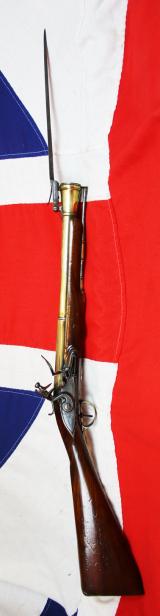
A Superb Royal Naval, Brass Cannon Barrel Blunderbuss With Finest 'Juglans Regia' Walnut Stock Spring Bayonet, Elaborately Engraved All Brass Furniture, by Daykin of Nottingham
Manufactured circa 1780, this is a jolly rare and stunningly beautiful example of a brass, cannon barrelled blunderbuss, from the mid Georgian period, with a sprung loaded, quick-release snap-bayonet. Overall in superb condition for age.
A hugely popular gun used aboard naval ships by their captains in the era of King George IIIrd during the American Revolution and including the Napoleonic Wars, from the days of Admiral Nelson's Victory at Trafalgar. The rarest of the types used had a spring loaded bayonet that was incredibly effective for use after the blunderbuss had discharged its load against any 'boarders', and to effect the 'coup de gras' {the stroke of grace} to those that are still determinedly putting up a fight against the British ship's captain.
The three-stage round barrel has a flared muzzle and turned moldings. The sprung bayonet is fitted beneath, and the ramrod is housed to left side. The right side of the breech is struck with Tower private proof marks and the maker’s mark. The engraved action is signed "Daykin" and the barrel engraved " Daykin Nottingham" the blunderbuss has finest and elaborately engraved brass fittings, including the trigger guard. with a beautiful acorn finial.
The figured walnut buttstock it mounted with an engraved brass buttplate. The ramrod is in traditional naval service steel
The Blunderbuss (born of the Dutch word "Donderbus", appropriately meaning "Thunder Pipe" or "Thunder Gun") came to prominence in the early part of the 18th Century (1701-1800) and was more akin to the modern day shotgun than a "long gun" musket or heavy pistol of the time. As such, she excelled in close-in fighting, be it within the confines of naval warfare or walled nature of the urban environment, such as for protection of a Royal Mail coach, where her spread of shot could inflict maximum damage to targets at close ranges. Its manageable size, coupled with its spread shot, ensured some level of accuracy for even the novice user and its appearance was rather intimidating to those unfortunate enough to be staring down the business end, and the flashing bayonet nicely finished off those that survived the first salvo of shot! As with modern firearms, the Blunderbuss also made for an excellent security-minded weapon and soon found popularity amongst all matter of operators - military, civilian and, of course, criminal parties - by the middle of the 1700s. Even George Washington championed the Blunderbuss for Continental Army "Dragoon" units of the burgeoning American military as opposed to the carbine this being nothing more than a full-featured long gun of lesser overall length, proving suitable for horse-mounted handling. In fact, the short-form version of the Blunderbuss came to be known as the "Dragon", giving rise to the term "Dragoon" for such gun-wielding cavalrymen. Dragoons went on to form specialized units of mounted infantrymen within their respective armies during the end of the 17th Century and into the middle of the 18th Century - in a way, becoming an evolutionary step of the fabled mounted knight of the Middle Ages. Their use of Dragons soon gave way to the widely-accepted carbine musket. The Blunderbuss was also known as the "Blunderbess"
As with all our antique guns no license is required as they are all unrestricted antique collectables
The stock is superb with some edge bruising etc. around the lock. read more
3850.00 GBP

A Beautiful, Pirate Age, Late 17th Century Brass Barrel Blunderbuss By William Wallis & John Hall. Barrel Proofs of 1690. John Hall Supplier of Fuzees, Buccaneer Guns & Blunderbusses For The Royal African Co. King William IIIrd to Queen Anne Period
A stunning blunderbuss desirable for service, both on the company galleons of the merchants, and, the pirate's galleons that pillaged them in the 17th century seven seas.
Finest walnut stock, all brass furniture finely engraved, widely flared brass barrel proofed by its maker William Wallis, with his crowned WW proof stamp, and also, bearing King William IIIrd's 1690 proofs. the steel lock engraved for the guns maker John Hall.
In the mid to late 17th century in the Western world, the period from the 1680s to the 1720s, has come to be known as the ‘Golden Age’ of piracy.
This was a time of heightened pirate activity, when thousands of ships in the Atlantic and beyond became the prey of roving bands of sea-robbers. Many of the most infamous pirates and buccaneers from history come from this era, Edward 'Blackbeard' Teach, Captain William Kidd, Anne Bonny, 'Calico' Jack Rackham, Henry Morgan, Stede Bonnet and more.
The Caribbean and the east coast of North America were the main areas that saw a surge in activity in the early 1700s. Ships carrying expensive cargoes were often intercepted, and stolen goods were sold in nearby islands and European colonies. Some pirates operated further afield, off the West African coast or in the Indian Ocean, where the island of Madagascar became a key base.
The real Pirates of the Caribbean
"The ‘golden age’ of piracy coincided with the expansion of English, later British, colonial activity around the Caribbean," writes Blyth. "This began in earnest with the capture of Jamaica from Spain in 1655." While piracy has been traditionally portrayed as a male-dominated pursuit, historical evidence suggests that women actively participated in piratical activities during various periods. In the Golden Age of Piracy, from the late 17th to the early 18th centuries, the presence of women in pirate crews became more pronounced. Anne Bonny and Mary Read are two notable examples of women who defied societal norms and navigated the perilous waters of piracy alongside their male counterparts. Their inclusion in pirate crews challenged prevailing gender roles and added a layer of complexity to the maritime lore of the era.
The story of Henry Morgan
Henry Morgan, a British privateer turned pirate, rose to prominence as a cunning strategist and a master of raiding Spanish colonies. Born circa 1635 in Wales, Morgan's early life remains relatively obscure, with scant historical records providing details about his upbringing. His maritime career began as a privateer, authorized by English authorities to harass Spanish colonies and shipping interests in the Caribbean during a period marked by geopolitical tensions between England and Spain.
Sir Henry Morgan was a unique individual in the history of buccaneering. He started out life as an indentured servant on a plantation in Barbados, but worked himself up to become one of the most notorious buccaneers there ever was, receiving not only praise from his uncouth brethren of the coast, but also from his king, who rewarded him with the a knighthood and a lofty position. Morgan had connections running in all levels of society, from the lowest dregs, his mutinous crewmen, to the highest echelons of nobility. Together with his loyal friend and crony, Sir Thomas Modyford, he rampaged the Spanish territories in the Caribbean, his name inspiring fear along the vast coastline of New Spain and its dependencies. Through his network he was able to operate as a broker between criminals from various countries and a nation state, culminating in the biggest amphibious buccaneering raid ever in the Caribbean and the destruction of the once proud city of Panama, of which the ruins can still be visited today. The expected end for a man of his making would be at the gallows, or swinging from the gibbet in some port or another. But not for Sir Henry Morgan. His networking skills protected him, set him up with a respectable position after his career as a buccaneer, and provided him with the luxury of drinking himself to death in the comfort of his own home at the ripe age of 53; a fate most other pirates must have surely envied him for. His exploits in the plunder of Port Royal and the attack on Spanish merchant ships contributed to the era’s rich folklore and became the stuff of legends. Sabatini based the first part of the story of Blood on Henry Pitman, a surgeon who tended the wounded Monmouth rebels and was sentenced to death by Judge Jeffreys, but whose sentence was commuted to penal transportation to Barbados where he escaped and was captured by pirates. Unlike the fictional Blood, Pitman did not join them, and eventually made his way back to England where he wrote a popular account of his ordeal. For Blood's life as a buccaneer, Sabatini used several models, including Henry Morgan and the work of Alexandre Exquemelin, for historical details
The motivations for women to join pirate crews were as diverse as those of their male counterparts. Some, like Anne Bonny and Mary Read, disguised themselves as men to gain access to the adventurous and lucrative world of piracy. Their ability to conceal their gender allowed them to operate freely within the confines of a pirate ship, participating in raids, engaging in combat, and earning the respect of their fellow crew members. The reasons for adopting a pirate's life were multifaceted, often stemming from a desire for economic independence, a rejection of societal constraints, or a quest for personal freedom in an era when opportunities for women were limited.
Anne Bonny, as pictured in Charles Johnson’s 1724 book, A General History of the Robberies and Murders of the most notorious Pyrates. Anne Bonnya (disappeared after 28 November 1720) was a pirate who served under John Rackham. Amongst the few recorded female pirates in the Golden Age of Piracy, she has become one of the most recognized pirates of the era, as well as in the history of piracy in general.
The first biography of Bonny comes from Captain Charles Johnson's 1724 book A General History of the Pyrates. In August 1720, Bonny, Rackham, and another woman, Mary Read, together with about a dozen other pirate crewmembers, stole the sloop William, then at anchor in Nassau harbor, and put out to sea. The crew spent months in the West Indies attacking merchant ships. Bonny took part in piracy alongside the men, handing out gunpowder to fellow pirates, a job usually referred to as a powder monkey. On 5 September 1720, Governor Rogers put out a proclamation, later published in The Boston Gazette, demanding the arrest of Rackham and his associates. Among those named are Anne Bonny and Mary Read
Capt. Sir Henry Morgan, as pictured in Alexandre Exquemelin's Piratas de la America (1681) It is probable that in the early 1660s Morgan was active with a group of privateers led by Sir Christopher Myngs attacking Spanish cities and settlements in the Caribbean and Central America when England was at war with Spain. It is likely that in 1663 Morgan captained one of the ships in Myngs' fleet, and took part in the attack on Santiago de Cuba and the Sack of Campeche on the Yucatán Peninsula
Capt. Stede Bonnet flew a Jolly Roger flag {from A General History of the Pyrates 1724}
Stede Bonnet (c. 1688 – 10 December 1718) was an English pirate who was known as the Gentleman Pirate because he was a moderately wealthy landowner before turning to a life of crime. Bonnet was born into a wealthy English family on the island of Barbados, and inherited the family estate after his father's death in 1694. Despite his lack of sailing experience, Bonnet decided he should turn to piracy in the spring of 1717. He bought a sailing vessel, the Revenge, and traveled with his paid crew along the Eastern Seaboard of what is now the United States, capturing other vessels and burning other Barbadian ships.
Bonnet set sail for Nassau in the Bahamas, to the haven for pirates known as the "Republic of Pirates", but he was seriously wounded en route during an encounter with a Spanish warship. After arriving in Nassau, Bonnet met the infamous pirate Blackbeard. Incapable of leading his crew, Bonnet temporarily ceded his ship's command to Blackbeard. Before separating in December 1717, Blackbeard and Bonnet plundered and captured merchant ships along the East Coast. After Bonnet failed to capture the Protestant Caesar, his crew abandoned him to join Blackbeard aboard the Queen Anne's Revenge. Bonnet stayed on Blackbeard's ship as a guest, and did not command a crew again until summer 1718, when he was pardoned by North Carolina governor Charles Eden and received clearance to undertake privateering against Spanish shipping interests. Bonnet was tempted to resume his piracy but did not want to lose his pardon, so he adopted the alias "Captain Thomas" and changed his ship's name to Royal James. He had returned to piracy by July.
The brass barrel and the guns brass furniture are in superb condition, the steel lock is good, with working action, and bearing old surface russetting traces, typical of sea service guns, bearing the maker's name engraved of HALL. The walnut stock has a breathtaking patination, garnered over three centuries of dedicated polishing and care, and has the usual combat surface marks and light cracks thereon as to be expected.
15 inch barrel, overall 30.5 inches read more
4450.00 GBP

A Fine 18th Century Historic Blunderbuss With Brass Flared Mouth Barrel, Fine Walnut Stock and Engraved Brass Furniture. By Griffin and Tow London Circa 1775. One Of England's Great Gunsmith Partnerships
Joseph Griffin opened his business in 1739 in Bond Street London, and went into partnership with Tow in 1773 to form the well known gunmakers Griffin and Tow.
This is an incredible brass barreled blunderbuss, of great age, around 250 years old, and with immense character. It has clearly seen combat service and use, but it is now just so beautiful still as an original artifact of the American Revolutionary War period, by one of the great gun partnerships in Georgian England. It has accumulated fabulous patination on the both the stock and barrel through the centuries of cleaning and polishing, interspersed with close combat use in the war, in fact, probably several wars, and potentially dozens of battles, either at sea, or on land, in its working life of around 80 years.
During this use period it has had close quarter combat injury, likely caused by its use as a club, after its load was discharged and their was no time for re-loading. It is around the stock, at the butt, and it has seen a typical, contemporary 'field service' combat repair, probably by the ship's carpenter, that has actually acquired its own age patination, through constant polishing. The barrel is excellent, with Joseph Griffin's own proof stamp, between the regular proof-house stamps, with numerous very small combat service markings, likely from sword or cutlass impacts. If you observe picture 10 in the gallery, you will note at the top portion of the painting, a sailor about to fire his brass barrel blunderbuss into the boarding enemy, and that sailor is using his blunderbuss as a club, holding the barrel as its handle.
In the 18th century, naval forces, privateers, and pirates used the blunderbuss as a short-range, large-bore combat weapon designed primarily for chaotic close-quarters boarding actions.
Naval blunderbusses often featured brass barrels instead of iron or steel because brass resisted corrosion and was practically impervious to salty sea spray.
The iconic trumpet-shaped muzzle was not actually designed to scatter shot widely, but rather to act as a built-in funnel for quickly pouring in black powder and lead balls while on a rolling ship deck.
While military loads typically used lead balls, swan shot (large pellets), or iron slugs, sailors could improvise by loading with rock salt for psychological effect without the likely-hood of fatal injury being inflicted
For use as boarding weapons they were ssued to naval officers, marines, and pirate crews, standard shoulder-stock blunderbusses easily cleared enemy decks during intense close-quarters fighting.
The Blunderbuss (born of the Dutch word "Donderbus", appropriately meaning "Thunder Pipe" or "Thunder Gun") came to prominence in the early part of the 18th Century (1701-1800) and was more akin to the modern day shotgun than a "long gun" musket or heavy pistol of the time. As such, she excelled in close-in fighting, be it within the confines of naval warfare or walled nature of the urban environment, where her spread of shot could inflict maximum damage to targets at close ranges. Its manageable size, coupled with its spread shot, ensured some level of accuracy for even the novice user and its appearance was rather intimidating to those unfortunate enough to be staring down the business end. As with modern firearms, the Blunderbuss also made for an excellent security-minded weapon and soon found popularity amongst all matter of operators - military, civilian and, of course, criminal parties - by the middle of the 1700s. Even George Washington championed the Blunderbuss for Continental Army "Dragoon" units of the burgeoning American military as opposed to the carbine this being nothing more than a full-featured long gun of lesser overall length, proving suitable for horse-mounted handling. In fact, the short-form version of the Blunderbuss came to be known as the "Dragon", giving rise to the term "Dragoon" for such gun-wielding cavalrymen. Dragoons went on to form specialized units of mounted infantrymen within their respective armies during the end of the 17th Century and into the middle of the 18th Century - in a way, becoming an evolutionary step of the fabled mounted knight of the Middle Ages. Their use of Dragons soon gave way to the widely-accepted carbine musket. The Blunderbuss was also known as the "Blunderbess" As with all our antique guns no license is required as they are all unrestricted antique collectables
Griffin and Tow was a prominent 18th-century London gunmaking partnership renowned for crafting high-quality flintlock sporting guns, officers' pistols, and blunderbusses.
Joseph Griffin began his independent gunmaking career in 1739 on Bond Street, London. He worked alongside his father until 1770 and built a strong reputation for producing exceptional flintlock firearms. Joseph Griffin entered into a partnership with an individual named Tow in 1773, officially establishing the firm Griffin and Tow.
The business operated out of London during the height of Georgian flintlock craftsmanship, active through the late 18th century (roughly spanning the 1740–1790 era when including Griffin's individual work before the partnership).
They specialized in fine flintlock weapons, including double-barrelled sporting shotguns, private officer pistols, and brass-barreled muzzleloading blunderbusses.
Surviving pieces from the firm, in the great museum collections today—often featuring intricately engraved brass or steel, and walnut stocks and are highly valued collector's items today.
Their operational history and specific surviving serial/named pieces were meticulously cataloged in the seminal 1989 text British Gunmakers: Messrs. Griffin and Tow and W. Bailes, 1740-1790 by W. Keith Neal and D.H.L. Back read more
3350.00 GBP

A Beautiful Antique Edo Period 1598-1868 Tanto Signed Satsuma ju Yoshizane
In all original Edo period mounts fittings and saya, stunning ishime stone finish lacquer to the saya in pristine condition.
Kozuka utility knife also signed with maker's signature. See photo 10 in the gallery
Pair of menuki of gold embellished flower sprays, iron silver inlaid kashira, gilt and nanko fuchi.
Blade in full traditional stone polish showing a delightful notare hamon.
Tanto are generally forged in hira-zukuri style (without ridgeline), meaning that their sides have no ridge line and are nearly flat, unlike the shinogi-zukuri structure of a katana. Some tanto have particularly thick cross-sections for armour-piercing duty, and are called yoroi toshi. Tanto first began to appear in the Heian period, however these blades lacked artistic qualities and were purely weapons. In the Early Kamakura period high quality tanto with artistic qualities began to appear, and the famous Yoshimitsu (the greatest tanto maker in Japanese history) began his forging. Tanto production increased greatly around the Muromachi period and then dropped off in the Shinto period. Shinto period tanto are quite rare. Tanto were mostly carried by Samurai; commoners did not generally carry them. Women sometimes carried a small tanto called a kaiken in their obi for self defence. It was sometimes worn as the shoto in place of a wakizashi in a daisho, especially on the battlefield. Before the 16th century it was common for a Samurai to carry a tachi and a tanto as opposed to a katana and a wakizashi.
. read more
3750.00 GBP
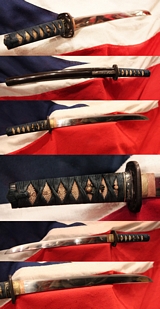
Huge & Impressively Bladed 400 Year Old Samurai Tanto Signed Omi Kami Minamoto Kagehiro. Shinto Period From The Province of Settsu
A beautiful and large samurai dagger, with fine 'status' blade. Squared sukashi tsuba in iron, pure gold inlaid shakudo fushi, decorated with a constellation of stars and celestial bodies, that are inlaid with gold over a nanako ground, with a carved and polished buffalo horn kashira.
Pure gold and shakudo menuki of takabori crabs. Fine shakudo kozuka decorated in relief with mount Fuji, two piece habaki. Wide blade without ridge line flat sided with suguha hamon. A most impressive and sizeable tanto.
It has its original Edo period lacquered saya scabbard in rich dark brown urushi lacquer, with a kozuka {utility knife} of shakudo, decorated with a fishermen within a small boat, with Mount Fuiji in the distance. The kozuka blade is very nicely signed.
Shakudo is a billon of gold and copper (typically 4-10% gold, 96-90% copper) which can be treated to form an indigo/black patina resembling lacquer. Unpatinated shakudo Visually resembles bronze; the dark color is induced by applying and heating rokusho, a special patination formula.
Shakudo Was historically used in Japan to construct or decorate katana fittings such as tsuba, menuki, and kozuka; as well as other small ornaments. When it was introduced to the West in the mid-19th century, it was thought to be previously unknown outside Asia, but recent studies have suggested close similarities to certain decorative alloys used in ancient Egypt, Greece, and Rome. The lacquer surface of the saya has some age bruising etc. due to its vintage. read more
3995.00 GBP

A Good Shinto Aikuchi Tanto Samurai Dagger With a Fine & Beautiful Polish Blade. Around 400 years Old. All Original Edo Period Koshirae
The blade has a fine Hamon with a full, back edge temper, and a running itami grain hada. With giant rayskin bound hilt grip and black speckled dark red lacquer saya. Flying geese kozuka, carved buffalo black horn fittings. Shinto period, circa 1620.
Tanto first began to appear in the Heian period, however these blades lacked artistic qualities and were purely weapons. In the Early Kamakura period high quality tanto with artistic qualities began to appear, and the famous Yoshimitsu (the greatest tanto maker in Japanese history) began his forging. Tanto production increased greatly around the Muromachi period and then dropped off in the Shinto period. Shinto period tanto are quite rare. Tanto were mostly carried by Samurai; commoners did not generally carry them. Women sometimes carried a small tanto called a kaiken in their obi for self defence.It was sometimes worn as the shoto in place of a wakizashi in a daisho, especially on the battlefield. Before the 16th century it was common for a Samurai to carry a tachi and a tanto as opposed to a katana and a wakizashi. all the fittings and lacquer are original Edo period, the old saya lacquer has some usual wear marks, and the kozuka small utility knife handle has a small area of age denting.
As once told to us by an esteemed regular visitor, Victor Harris, to us here in our gallery, and the same words that are repeated in his book;
“In these textures lies an extraordinary and unique feature of the sword {all samurai edge weapons are called swords, despite however small} - the steel itself possesses an intrinsic beauty. The Japanese sword has been appreciated as an art object since its perfection some time during the tenth century AD. Fine swords have been more highly prized than lands or riches, those of superior quality being handed down from generation to generation. In fact, many well-documented swords, whose blades are signed by their makers, survive from nearly a thousand years ago. Recognizable features of the blades of hundreds of schools of sword-making have been punctiliously recorded, and the study of the sword is a guide to the flow of Japanese history.”
Victor Harris
Curator, Assistant Keeper and then Keeper (1998-2003) of the Department of Japanese Antiquities at the British Museum. He studied from 1968-71 under Sato Kenzan, Tokyo National Museum and Society for the Preservation of Japanese Swords
Overall length in saya approx 16 inches, blade 11 inches. read more
2475.00 GBP
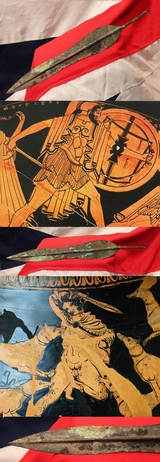
A Very Fine, Original, Ancient, Punic War Period Early Roman Republic Era Short Sword, A Gladius Hispaniensis Double Leaf Shaped Bronze Blade Circa 2,300 Years Old From The Time Of Alexander The Great and Early Rome.
Gladius is a Latin word properly referring to the type of sword that was used by ancient Roman foot soldiers starting from the Republic period of the 3rd century BC, and until the mid Roman Empire period of 3rd century AD. From thence forward the more standard Roman sword was the spartha
Early ancient Roman swords were similar to those of the Greeks, called xiphe . From the 3rd century BC, however, the Romans adopted a weapon based on the sword of the Celtiberians of Hispania in service to Carthage during the Punic Wars, known in Latin as the gladius hispaniensis, meaning "Hispanic-type sword". Over time, the Romans improved their sword into an iron version weapon, depending on how Roman battle units waged war, and also created a number of variants. By 20 BC the Hispaniensis was replaced by the Mainz gladius (named after Roman swords found in Germany), in turn replaced by the Pompeii gladius. Finally, in the third century AD the heavy Roman infantry replaced the gladius with the spatha (already common among Roman cavalrymen), relegating the gladius as a weapon for light Roman infantry.
The Roman Republic had been aggressively expanding in the southern Italian mainland for a century before the First Punic War. It had conquered peninsular Italy south of the Arno River by 270 BC, when the Greek cities of southern Italy (Magna Graecia) submitted after the conclusion of the Pyrrhic War. During this period of Roman expansion Carthage, with its capital in what is now Tunisia, had come to dominate southern Iberia, much of the coastal regions of North Africa, the Balearic Islands, Corsica, Sardinia and the western half of Sicily in a thalassocracy.
Beginning in 480 BC Carthage fought a series of inconclusive wars against the Greek city-states of Sicily, led by Syracuse. By 264 BC Carthage was the dominant external power on the island, and Carthage and Rome were the preeminent powers in the western Mediterranean. Relationships were good and the two states had several times declared their mutual friendship via formal alliances: in 509 BC, 348 BC and around 279 BC. There were strong commercial links. During the Pyrrhic War of 280–275 BC, against a king of Epirus who alternately fought Rome in Italy and Carthage on Sicily, Carthage provided materiel to the Romans and on at least one occasion used its navy to ferry a Roman force. According to the classicist Richard Miles Rome had an expansionary attitude after southern Italy came under its control, while Carthage had a proprietary approach to Sicily. The interaction of these conflicting policies caused the two powers to stumble into war more by accident than design. The immediate cause of the war was the issue of control of the independent Sicilian city state of Messana (modern Messina). In 264 BC Carthage and Rome went to war, starting the First Punic War
A picture is shown in the gallery of a vase painting depicting a hoplite, 5th century BC. He is armed with a bronze cuirass, a leaf shaped hoplite sword and a hoplite shield of the Argive type, very similar to the gladius hispaniensis. (Paris, Louvre Museum). We show another sword carried in a period vase painting of the Death of Actaeon.
Bronze copper alloy, with superb natural age patination. And likely, the copper of the alloy was sourced from the ancient Cretan copper mines, with a percentage of added tin, in order to create the stronger bronze alloy. Small old age crack at the base of the blades tang. The Hilt would have been made from organic material, such as horn, bone or wood, a material that never survives once buried for the two millennia since it was last used in war. So all that remains is the bronze blade and its tang read more
1875.00 GBP
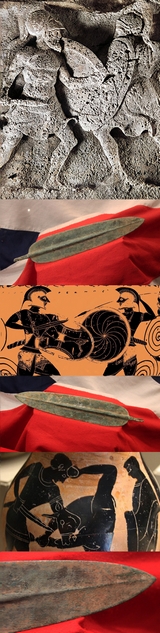
An Original Ancient Greek Sword as Used by King Odysseus King of Ithaca, During The Siege Of Troy, And As incredibly Depicted in Homer's Poem The Iliad, and Homer's The Odyssey Named After Odysseus
A Superb ancient Greek bronze age sword blade, from the ancient pre-history period 'Heroic Age', with fabulous areas of crystallized malachite blue/green patina. From the era of the Mycenaean and Ithacan Greek Trojan Wars,. in overall fabulous condition.
Naturally it cannot be assumed to have been used by the most famed character in Homer's iconic poetry, however, if he was real, this is exactly the sword he would likely have used, some 3200 years ago.
The Hilt, which no longer exists, would have been made from organic material such as horn, bone or wood, and that form of material never survives once buried for the three millennia since it was used in war period in around 1200 B.C.Thus, all that remains is the bronze blade's tang and the iconic leaf form blade. The bronze for this blade, which was likely made from the Cretan copper mines, as an alloy, with an element of added tin.
The story of the Trojan War the Bronze Age conflict between the kingdoms of Troy and Mycenaean Greece straddles the history and mythology of ancient Greece and inspired the greatest writers of antiquity, from Homer, Herodotus and Sophocles to Virgil. Since the 19th-century rediscovery of the site of Troy in what is now western Turkey, archaeologists have uncovered increasing evidence of a kingdom that peaked and may have been destroyed around 1,180 B.C. perhaps forming the basis for the tales recounted by Homer some 400 years later in the Iliad and the Odyssey. According to classical sources, the war began after the abduction (or elopement) of Queen Helen of Sparta by the Trojan prince Paris. Helen's jilted husband Menelaus convinced his brother Agamemnon, king of Mycenae, to lead an expedition to retrieve her. Agamemnon was joined by the Greek heroes Achilles, Odysseus, Nestor and Ajax, and accompanied by a fleet of more than a thousand ships from throughout the Hellenic world. They crossed the Aegean Sea to Asia Minor to lay siege to Troy and demand Helen’s return by Priam, the Trojan king. The siege, punctuated by battles and skirmishes including the storied deaths of the Trojan prince Hector and the nearly-invincible Achilles, lasted more than 10 years until the morning the Greek armies retreated from their camp, leaving a large wooden horse outside the gates of Troy. After much debate (and unheeded warnings by Priam's daughter Cassandra), the Trojans pulled the mysterious gift into the city. When night fell, the horse opened up and a group of Greek warriors, led by Odysseus, climbed out and sacked the Troy from within. After the Trojan defeat, the Greeks heroes slowly made their way home.
Odysseus took 10 years to make the arduous and often-interrupted journey home to Ithaca recounted in the Odyssey. Helen, whose two successive Trojan husbands were killed during the war, returned to Sparta to reign with Menelaus. After his death, some sources say she was exiled to the island of Rhodes, where a vengeful war widow had her hanged.
The Greek Heroic Age, in mythology, is the period between the coming of the Greeks to Thessaly and the Greek warriors' return from Troy after their return with Helen of Troy. The poet Hesiod (fl. c. 700 BCE) identified this mythological era as one of his five Ages of Man. The period spans roughly six generations; the heroes denoted by the term are superhuman, though not divine, and are celebrated in the literature of Homer and of others, such as Sophocles, Aeschylus and Euripides.
The Greek heroes can be grouped into an approximate mythic chronology, based on the stories of events such as the Argonautic expedition and the Trojan War. Over the course of time, many heroes, such as Heracles, Achilles, Hector and Perseus, came to figure prominently in Greek mythology.
Early heroes
Many of the early Greek heroes were descended from the gods and were part of the founding narratives of various city-states. They also became the ancestors of later heroes. The Phoenician prince Cadmus, a grandson of Poseidon, was the first Greek hero and the founder of Thebes.
Perseus, famous for his exploits well before the days of his great-grandson, Heracles, was the son of Zeus. Perseus beheaded the Medusa, saved Andromeda from the sea monster Cetus, and was the legendary founder of Mycenae.
Aeacus was also a son of Zeus. Bellerophon was descended from the nymph Orseis. Oenomaus, king of Pisa, in the Peloponnese, was the son of Ares.
Among these early heroes the three - Cadmus, Perseus and Bellerophon - were considered the greatest Greek heroes and slayers of monsters before the days of Heracles.
Of course, despite the Age of Heroes and the time of the Gods of Olympus, being based almost entirely on mythology, apart from the actual city of Troy, which is now proved to be not a myth, the real warriors that lived during that age and time, in ancient pre-history, actually existed, and this is their very form of sword, and one that they would have used.
Photo in the gallery of an Attic black figure vase that shows Theseus killing the Minotaur of the Cretan labyrinth with an identical pattern of Greek sword. A feminine figure looks on from the right, possibly Ariadne. Late 6th, early 5th century BCE. (Archaeological Museum, Milan). See discussion in Branigan, K. Aegean Metalwork of the Early and Middle Bronze Age, Oxford, 1974, p.8-21. `15.5 inches long overall read more
3250.00 GBP

A Superb & Most Scarce King George IIIrd Period Therapeutic Phlebotomy Mechanical Instrument, A Scarifyer Of Superb Quality by Ferguson of London. A Pistol Action To Instantaneously Release & Retract 12 Rotating Blades to Slice The Skin For Blood Letting
A fabulous Georgian collectable, mechanical scientific medical instrument, and a superb conversation piece.
Made in 1822 by Daniel Ferguson, 14 Castle Street, London
A phlebotomy scarificator (or scarifyer) is a historical 18th- and 19th-century spring-loaded medical device used to perform bloodletting by making multiple, uniform shallow cuts in the skin.
One of the best condition and beautiful examples, outside of the Science Museum, we have seen in the past 50 years
The Spring-Action Mechanism The device was armed by cocking a lever like a pistol hammer, and placed the instrument flat side down firmly against the patient's skin (typically on the back, arms, or legs).
When the practitioner pressed a trigger, a complex internal gear system released a series of rotating or snapping concealed blades—usually numbering around 12—which instantly slashed the flesh.
Practitioners used bloodletting under the belief that draining blood could re-balance the body's four fundamental "humors" and cure ailments ranging from fevers and infections to mental illness.
Compared to a single handheld lancet or knife, the multi-bladed scarificator was considered a more sophisticated and rapid way to draw a large volume of blood.
By the late 19th century, medical science advanced, proving that the ancient practice of bloodletting lacked therapeutic value for most conditions and often worsened patient outcomes, rendering the scarificator obsolete
See you tube film on their action, use and lack of efficacy from the Medical History Museum In Mebourne Australia
https://www.youtube.com/watch?v=MTF0yGGjZEQ&t=100s read more
375.00 GBP