

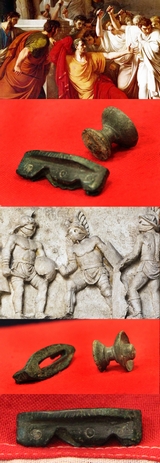
A Super Roman Dagger Pommel and Scabbard Mount. Around 2000 Years Old, From 100 bc to 100 ad
From the Roman Republican to Imperial Rome era. Made for and used by a Roman noble, senator or gladiator. It may even be the same form of dagger that was used to assassinate Caeser on the Ides of March. The blade grip and scabbard have not survived as is more than usual. A superb pair of Roman dagger mounts from the historical time of Julius Caeser, the first Emperor, Augustus, Mark Anthony and Cleopatra, and last, but not least, Jesus of Nazareth. The Ides of March comes from the ides, a term the Romans used to note the middle of a month. Every month has an ides around the middle (as well as a calends at the beginning of the month and nones eight days before the ides). The Ides of March feels special for a couple of reasons: it's the day Caesar was murdered, and it's the subject of a soothsayer's spooky prophecy in William Shakespeare's Julius Caesar. Before Caesar, Roman nobility and military were free to plunder the provinces they ruled. But under Caesar, Rome controlled the process and sent inspectors to check up on everything, so they could only exploit their provinces under Caesar's supervision.
That slight was compounded by Caesar's rebranding of political real estate in his name ? he built statues in his image and renamed monuments for himself. He brought power to his family by giving them political appointments and honorifics, and drew allies outside the charmed circle of Roman nobility, like his soldiers and leaders in the provinces. As far as epic betrayals go, we tend to imagine Brutus in the same league as Judas. In reality, that infamy should be reserved for someone called Decimus.
Caesar trusted Decimus much more than he trusted Brutus ? and that made his betrayal more shocking. Misspelled in Shakespeare's Julius Caesar as "Decius," Decimus was much more important than most of us realize. "There were three leaders of the assassins' conspiracy, Brutus, Cassius, and Decimus." Decimus dined with Caesar the night before his assassination and convinced Caesar to leave his house the next morning (he was staying home because his wife, Calpurnia, was worried). Decimus' betrayal followed an adult life spent at Caesar's side. Brutus, however, had often fought against Caesar, like when he took Pompey's side against Caesar in the Civil War that lasted from 49 to 45 BC. He only came over to Caesar's side after a handsome cash award and profitable political appointment. When he was stabbed, most of the sources say he tried to get up and escape. Unfortunately for Caesar, the conspirators were trained soldiers, so they'd formed a tight perimeter. "They knew how you carry out an ambush,and some of the senators were assigned the job of crowd control."
As far as what Caesar said when he died, "Et tu, Brute" is a Renaissance invention. But Caesar did perform a few resonant gestures. He tried to escape, like any soldier would, but when death was near, he covered his face before he died. It may have been an attempt to preserve his dignity. Bibilography; Professor Strauss, Cornell, Classics and History. As with all our items it comes complete with our certificate of authenticity. read more
385.00 GBP

A Fabulous 10th to 12th Century, Crusader Knights Period, Original, Large Reliquary Pectoral Cross Pendant, Crucifix. Possibly Cleaved By a Sword Cut
With a deep relief cast Jesus Christ on the cross, dressed with a long robe (sticharion) and single remaining flanking small figure (probably Saint John) to Christ’s right, the left arm has been struck off and now missing. It may well have been damaged by such as a sword cut, breaking off an arm and separating the crucifix into town pieces, of course this is only speculation. Christ stands on a pedestal that resembles a suppedaneum used to support the feet in a crucifixion.
The hollow portion formed inside the box was intended for the sacred relic that the faithful would have worn around the neck. Part of the amazing collection of Crusades period Crucifixes and reliquary crosses for the early Anglo Norman Crusader knights and Jerusalem pilgrims. As used in the early Crusades Period by Knights, such as the Knights of Malta Knights Hospitaller, the Knights of Jerusalem the Knights Templar, the Knights of St John.The new Norman rulers were culturally and ethnically distinct from the old French aristocracy, most of whom traced their lineage to the Franks of the Carolingian dynasty from the days of Charlemagne in the 9th century. Most Norman knights remained poor and land-hungry, and by the time of the expedition and invasion of England in 1066, Normandy had been exporting fighting horsemen for more than a generation. Many Normans of Italy, France and England eventually served as avid Crusaders soldiers under the Italo-Norman prince Bohemund I of Antioch and the Anglo-Norman king Richard the Lion-Heart, one of the more famous and illustrious Kings of England. An encolpion "on the chest" is a medallion with an icon in the centre worn around the neck upon the chest. This stunning and large neck worn example is bronze front panel. 10th to 12th century. The hollow portion formed inside the cross was intended for the sacred relic that the faithful would have worn around the neck. The custom of carrying a relic was largely widespread, and many early bronze examples were later worn by the Crusader knights on their crusades to liberate the Holy Land. Relics of the True Cross became very popular from the 9th century, and were carried in cross-shaped reliquaries like this, often decorated with enamels, niellos, and precious stones. The True Cross is the name for physical remnants from the cross upon which Jesus Christ was crucified. Many Catholic and Orthodox churches possess fragmentary remains that are by tradition believed to those of the True Cross. Saint John Chrysostom relates that fragments of the True Cross were kept in reliquaries "which men reverently wear upon their persons". A fragment of the True Cross was received by King Alfred from Pope Marinus I (Anglo-Saxon Chronicle, year 883). An inscription of 359, found at Tixter, in the neighbourhood of Sétif in Mauretania, was said to mention, in an enumeration of relics, a fragment of the True Cross, according to an entry in Roman Miscellanies, X, 441.
Fragments of the Cross were broken up, and the pieces were widely distributed; in 348, in one of his Catecheses, Cyril of Jerusalem remarked that the "whole earth is full of the relics of the Cross of Christ," and in another, "The holy wood of the Cross bears witness, seen among us to this day, and from this place now almost filling the whole world, by means of those who in faith take portions from it." Egeria's account testifies to how highly these relics of the crucifixion were prized. Saint John Chrysostom relates that fragments of the True Cross were kept in golden reliquaries, "which men reverently wear upon their persons." Even two Latin inscriptions around 350 from today's Algeria testify to the keeping and admiration of small particles of the cross. Around the year 455, Juvenal Patriarch of Jerusalem sent to Pope Leo I a fragment of the "precious wood", according to the Letters of Pope Leo. A portion of the cross was taken to Rome in the seventh century by Pope Sergius I, who was of Byzantine origin. "In the small part is power of the whole cross", says an inscription in the Felix Basilica of Nola, built by bishop Paulinus at the beginning of 5th century. The cross particle was inserted in the altar.
The Old English poem Dream of the Rood mentions the finding of the cross and the beginning of the tradition of the veneration of its relics. The Anglo-Saxon Chronicle also talks of King Alfred receiving a fragment of the cross from Pope Marinus (see: Annal Alfred the Great, year 883). Although it is possible, the poem need not be referring to this specific relic or have this incident as the reason for its composition. However, there is a later source that speaks of a bequest made to the 'Holy Cross' at Shaftesbury Abbey in Dorset; Shaftesbury abbey was founded by King Alfred, supported with a large portion of state funds and given to the charge of his own daughter when he was alive – it is conceivable that if Alfred really received this relic, that he may have given it to the care of the nuns at Shaftesbury
Most of the very small relics of the True Cross in Europe came from Constantinople. The city was captured and sacked by the Fourth Crusade in 1204: "After the conquest of the city Constantinople inestimable wealth was found: incomparably precious jewels and also a part of the cross of the Lord, which Helena transferred from Jerusalem and which was decorated with gold and precious jewels. There it attained the highest admiration. It was carved up by the present bishops and was divided with other very precious relics among the knights; later, after their return to the homeland, it was donated to churches and monasteries.To the category of engolpia belong also the ampullae, or vials or vessels of lead, clay or other materials in which were preserved such esteemed relics as oil from the lamps that burned before the Holy Sepulchre, and the golden keys with filings from St. Peter's chains, one of which was sent by St. Gregory the Great to the Frankish King Childebert.
Encolpion, a different anglicization of the same word, covers the early medieval tradition in both Eastern and Western civilisation.
Surface in very good condition, right arm broken off, with typical natural aged patina with encrustations. As with all our items it comes complete with our certificate of authenticity. read more
750.00 GBP
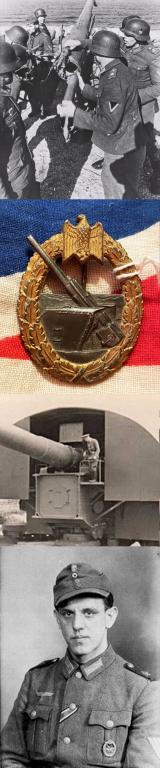
A Very Good Original, WW2, Kriegsmarine Coastal Artillery Combat Badge Kriegsabzeichen für die Marineartillerie By Friedrich Linden of Lüdenscheid. From One Of Ian Fleming’s Naval Intelligence Section’s So Called ‘Red Indians’ 30 Commando Special Engineer
An original Kriegsmarine Coastal artillery badge by by FLL 43 – Friedrich Linden of Lüdenscheid constructed in zinc with nice gilt finish. . A zinc produced piece with a great amount of gold finish remaining. The Kriegsmarine maintained a large ground force, organized along the same lines as the German Army, which was known as the Marine-Infanterie . Kriegsmarine naval artillery and anti-aircraft crews were considered as shore personnel. Artillery units were organized into either regiments or sections while flak units were maintained in brigades and regiments. Both types of units were assigned to various ports and harbors and thus were under the direct operational authority of both the port commanders as well as the commander harbour security forces. During actual invasion of coastal regions by enemy forces, these units became part of the sea defense zones.
The Naval Artillery War Badge or War Badge for the Coastal Artillery (German: Kriegsabzeichen für die Marineartillerie) was a World War II German military decoration awarded to the crews of Kriegsmarine land-based marine artillery and anti-aircraft units. It was presented to personnel of coastal defense units, and anti-aircraft units. The award was instituted on 24 June 1941 by Grand Admiral Erich Raeder to reward the actions of both individuals and crew members. It was also awarded to those killed in action in said units.
Originally taken by a commando of 30 commando X troop while on clandestine missions as part of 30 Commando reconnaissance and sabotage.
From a former special engineering unit {Ian Fleming’s so called ‘Red Indians} in wartime Europe were a vital part of clandestine warfare, and all parts of the units combat service were then trained in recognising enemy mines, booby traps, handling of explosives, demolitions, counter-demolitions, bomb disposal, and combined with recognition of enemy uniforms and equipment for intelligence gathering. Reporting all elements of their findings back to CoCO, and by them to the Admiralty. Fleming referred to such brave men as his ‘Red Indians’. see Casino Royale for reference.
There were seven active Marinekustenten-Bataillons or MKBs consisting of two to six companies each, prior to the invasion of Norway. These battalions were charged initially with protecting the coasts and harbors of Germany. With the fall of Norway, France, and the Low Countries, these units were expanded to include four large-caliber naval batteries between Calais and Boulogne. These were to be used during the planned invasion of Britain to provide the initial shore bombardment of the Dover Area and prevent the Royal Navy from interfering with the invasion fleet.
When the invasion was scrubbed in late 1940 in favor of starving Britain into submission, additionally Navy Artillery and Flak companies were formed to protect the many U-Boot bases being built along the Atlantic Coast. In mid-1941, battalions were formed to fortify the Channel Islands and the coast of Norway.
Artillerie of HKB was responsible for “Filling-In” the coastal areas between these points by covering possible landing sites. The Navy Artillery units were normally situated directly on the coast and used as direct fire control procedure similar to that used on ships, with the Army positioned further inland, which protected them from Allied “Air” and “Naval” attack, but limited their ability to track and engage enemy ships and landing craft. Navy artillery battalions were separate from the Heer, under the Navy.
Battery organization generally depended on the weapon system to which Fuhrer Directive 40, March 1942, provided detailed instructions for the construction and defense of what became known as the Atlantic Wall. This meant a massive expansion of the Naval Artillery, with some 100 Battalions* created by the end of the war.
Navy (Kriegsmarine) units were primarily deployed to defend, important ports, or harbors, rivers, estuaries, and other points critical to naval operations.
The brain child of naval commander Ian Fleming & Lord Louis Mountbatten, 30 Commando, this wartime unit was a secret well kept for over 50 years after the war by the Official Secrets Act, some remains classified. At the time, officially, they didn’t exist. The members of this unit were forbidden to discuss or document their activities, a pledge that many of the men kept even many years after the war was over, or even for their entire lives!
Due to the fact these men operated in very small groups on ‘need-to-know’ basis it is very difficult to get clear picture of everything they were doing.
Fleming’s/NID30AU secretary Miss Margaret Priestley (a history professor from Leeds University) played a vital role in the running and administration of 30AU and became his inspiration for Miss Petty Pettaval - the original character name that became Miss Moneypenny.
As revealed here for the first time! (see Beau Bête)
Miss Preistley transferred over to NID30AU during the winter of 1943-44 from DNR - (Department of Naval Research) where she worked as a civilian, although there were obvious links between DNR and NID30AU as intelligence on enemy targets was collected for Fleming’s ‘Black List’.
Also Known as: Fleming's 'Red Indians'
Fleming himself referred to the men of the unit as behaving like 'Red Indians'. (A reference he also used when referring to his character, James Bond, four times in his first novel Casino Royale. Which effectively makes this unit the ‘literary James Bond’s wartime unit’.)
Formerly:- (NID30 Command Office at Admiralty),
Special Engineering Unit.
'RED' Marines.
Latterly:- 30 Assault Unit,
30 Advanced Unit, 30AU
and incorrectly as 30th Assault Unit.
The number '30' was used for no better reason than it was NID/Miss Priestley’s Office Door number at the Admiralty. (Fleming’s Office was No. 39, see photo in the gallery of Fleming in room 39 of the Admiralty) 'Assault Unit' was 'overt' cover for the fact that they were intelligence gathering.
Date Founded: 30 September 1942
Date Disbanded: 26 March 1946
Date Reformed: February 2010 - 30 Cdo IXG
Mission When Founded:
The collection of technical intelligence and personnel from enemy headquarters and installations. Ahead of allied advances and before enemy could destroy it, to ‘Attain by Surprise’.
30 Commando consisted of Royal Marine, Army and Royal Navy elements that were organised into three Sections: No. 33, No. 34 and No.36 respectively. Initially code-named the Special Engineering Unit, the unit reported to the Chief of Combined Operations, though the Admiralty retained ultimate control of No.36 Section. No.35 Section was left vacant for the RAF to utilise but they never raised a troop to participate in 30 Cdo. Although they did supply intelligence officers and specific targets to pursue after D-Day for ‘Operation Crossbow’.
Unit members were given general commando skills and weapons training, and were then trained in recognising enemy mines, booby traps, handling of explosives, demolitions, counter-demolitions, recognition of enemy uniforms and equipment. Parachute training, small boat handling, recognition of enemy documents, search techniques including lock picking and safecracking, prisoner handling, photography and escape techniques were also taught.
A significant number of the initial recruits were formerly policemen. Although at least one ‘expert’ was recruited straight from prison, thought by the police to be the best safe-breaker in England at the time.
30 Cdo’s operational tactic was to move ahead of advancing Allied forces, or to undertake covert missions into enemy territory by land, sea or air, to capture intelligence, in the form of equipment, documents, codes or enemy personnel. 30 Cdo often worked closely with the Intelligence Corps' Field Security sections. More often than not each team consisted of two special operations Jeeps (As used by the SAS and 30AU) manned by one Naval Commander in possession of a ‘Black Book’ which listed targets from Ian Fleming’s famous ‘Black List’. The Naval Commander was the only man in each team who knew where and what the targets actually were. This Naval Commander was usually accompanied by at least one weapons expert or scientist who he relied on to evaluate the information or equipment they encountered. There were also usually at least six Royal Marines and one RM Officer whose main job was to do any fighting required and to keep the Naval Commander and any experts alive and out of trouble. (For details Reading section.)
The individual Sections served in all the Mediterranean and NW European operational theatres, usually operating independently, gathering information from captured facilities. The unit served in North Africa, the Greek Islands, Norway, Pantelleria, Sicily, Italy, and Corsica, 1942-1943 as 30 Commando.
As the Allies broke through 30AU split into many ‘Field Teams’ and these were responsible for capturing many and varied targets throughout Germany.
Team 2 under Curtis captured Prof. Helmut Walter, designer of the Me163 Rocket Plane and Midget Submarines at Kiel. (Kept by the British!).
Team 5 under USN Lambie captured Prof. Herbert Wagner (Handed to US Agents) designer of the guided flying bomb Hs293, already used to sink HMS Egret and to kill over 1000 troops on HMT Rohna. He went on to work for the US Navy. He did not surrender in Bavaria with Dornberger and the von Braun brothers as the Allied military would have us believe..
The capture of Prof. Magnus von Braun (Martin) V2 fuel chemist. (Handed to US Agents). He did not surrender in Bavaria as the Allied military want us to believe.
The capture of the designer of the Nazi V2 (who went on to the NASA Saturn V), Prof. von Braun and his brother. (Some men were convinced they were some of the scientists they caught!) Did they surrender in Bavaria as the Allied military want us to believe or was that staged afterwards? (see Beau Bête for details and FREE preview PDF, in Reading)
Team 55 under Glanville captured the entire Nazi Naval records collection at ‘Tambach Castle’.
Team 4 under Job(e) captured the Bremen dockyards with type 21; 25 submarines and destroyers. Then took the surrender of Bremerhaven and captured Naval HQ SS Europa and Z29 Destroyer. (All handed over to US Agents).
Team 2 Postlethwaite captures the Torpedo testing facility at Ekenförde.
Another team captured Admiral Dönitz (as Führer).
And many other things yet to be revealed by the government!
Ref; https://www.30au.co.uk
An amazing historic collection of information, including. https://www.amazon.co.uk/Beau-B%C3%A9te-assigned-Flemings-intelligence/dp/B08R7XYHXW
Every single item from The Lanes Armoury is accompanied by our unique Certificate of Authenticity. Part of our continued dedication to maintain the standards forged by us over the past 100 years of trading read more
450.00 GBP

A Most Fabulous, Large, Ancient Bronze Coiled Serpent Armilla or Armlet Arm Ring, From The 2nd Millenium B.C., From the Eras of the Pharoahs Ahmenhotep To Tutankhamun
One of two we acquired from an ancient antiquity collection, not quite a pair but very similar from the same period and country of origin, and we are offering them separately, but they were in fact often worn with one on each arm and may indeed came from the same tomb etc. 200 years or so ago. See catalogue item number 24880
Over 3,300 to 3500 Years Old, 18th dynasty ancient Egyptian period, that includes Pharoah Ahmenhotep, Queen Nefertari, the most venerated Queen in Egyptian history, Pharoah Thutmose III, who became known as the greatest military pharaoh ever, and the most famous Pharoah in history, Tutankhamun.
A bronze serpent armilla arm ring that could be worn at the top of the arm or on the forearm, as it was adjustable in its day, expanding to the size required.
Worn by ancient Egyptian men or women of status, and we show pictures of original tomb art depicting figures of Egyptian dieties such as Osiris, almost all wearing armillae, but in their case likely made of gold, but the bronze type such as this would be polished bright and appear as gold as well.
Arm decoration and ornamentation was a very important sign of status and position in Ancient Egyptian society, and as it did in all the empires that followed over the next two thousand years. An intricate gold armlet from the artifacts of Nubian Queen Amanishakheto is displayed in the State Museum of Egyptian Art, in Munich, Germany. The armlet features a gold winged goddess. Another beautiful gold armlet is exhibited in Cairo Museum bearing the name of the pharaoh, Ahmose I, founder of the 18th Dynasty. The ancient Greeks and Romans also wore armlets, which were usually made from bronze or gold, and some of which were in the shape of serpents, winding plants, or embellished with images of gods and goddesses. Large, heavy armlets had hoops on the backs that attached to garments to help support their weight.
The Ancient Egyptian Dynasty XVIII was founded by Pharoah Ahmose I, the brother or son of Kamose, the last ruler of the 17th Dynasty. Ahmose finished the campaign to expel the Hyksos rulers. His reign is seen as the end of the Second Intermediate Period and the start of the New Kingdom. Ahmose's consort, Queen Ahmose-Nefertari was "arguably the most venerated woman in Egyptian history, and the grandmother of the 18th Dynasty." She was deified after she died. Ahmose was succeeded by his son, Amenhotep I, whose reign was relatively uneventful.
Amenhotep I probably left no male heir and the next pharaoh, Thutmose I, seems to have been related to the royal family through marriage. During his reign, the borders of Egypt's empire reached their greatest expanse, extending in the north to Carchemish on the Euphrates and in the south up to Kurgus beyond the fourth cataract of the Nile. Thutmose I was succeeded by Thutmose II and his queen, Hatshepsut, who was the daughter of Thutmose I. After her husband's death and a period of regency for her minor stepson (who would later become pharaoh as Thutmose III) Hatshepsut became pharaoh in her own right and ruled for over twenty years.
Thutmose III, who became known as the greatest military pharaoh ever, also had a lengthy reign after becoming pharaoh. He had a second co-regency in his old age with his son Amenhotep II. Amenhotep II was succeeded by Thutmose IV, who in his turn was followed by his son Amenhotep III, whose reign is seen as a high point in this dynasty.
Amenhotep III's reign was a period of unprecedented prosperity, artistic splendour, and international power, as attested by over 250 statues (more than any other pharaoh) and 200 large stone scarabs discovered from Syria to Nubia, Amenhotep III undertook large scale building programmes, the extent of which can only be compared with those of the much longer reign of Ramesses II during Dynasty XIX. Amenhotep III's consort was the Great Royal Wife Tiye, for whom he built an artificial lake, as described on eleven scarabs.
Akhenaten, the Amarna Period, and Tutankhamun
Akhenaten and his family adoring the Aten. Second from the left is Meritaten, daughter of Akhenaten.
Amenhotep III may have shared the throne for up to twelve years with his son Amenhotep IV. There is much debate about this proposed co-regency, with different experts considering that there was a lengthy co-regency, a short one, or none at all.
In the fifth year of his reign, Amenhotep IV changed his name to Akhenaten and moved his capital to Amarna, which he named Akhetaten. During the reign of Akhenaten, the Aten became, first, the most prominent deity, and eventually came to be considered the only god. Whether this amounted to true monotheism continues to be the subject of debate within the academic community. Some state that Akhenaten created a monotheism, while others point out that he merely suppressed a dominant solar cult by the assertion of another, while he never completely abandoned several other traditional deities.
Later Egyptians considered this "Amarna Period" an unfortunate aberration. After his death, Akhenaten was succeeded by two short-lived pharaohs, Smenkhkare and Neferneferuaten, of which little is known. In 1334 Akhenaten's son, Tutankhaten, ascended to the throne: shortly after, he restored Egyptian polytheist cult and subsequently changed his name in Tutankhamun, in honour to the Egyptian god Amun. His infant daughters, represent the final genetically related generation of the Eighteenth Dynasty
Ancient Egyptian art shows both men and women wearing pairs of armlets.
The 10th Duke of Hamilton had a strong interest in Ancient Egyptian mummies, and was so impressed with the work of mummy expert Thomas Pettigrew that he arranged for Pettigrew to mummify him after his death. He died on 18 August 1852 at age 84 at 12 Portman Square, London, England and was buried on 4 September 1852 at Hamilton Palace, Hamilton, Scotland. In accordance with his wishes, Hamilton's body was mummified after his death and placed in a sarcophagus of the Ptolemaic period that he had originally acquired in Paris in 1836 ostensibly for the British Museum. We have been acquiring similar such items from Duke's descendants from the family's 'Grand Tour' collection for the past 30 years or more. read more
1195.00 GBP

A Most Fabulous, Large, Ancient Bronze Coiled Serpent Armilla or Armlet Arm Ring, From The 2nd Millenium B.C., From the Eras of the Pharoahs Ahmenhotep To Tutankhamun
One of two we acquired from an ancient antiquity collection, not quite a pair but very similar from the same period and country of origin, and we are offering them separately, but they were in fact often worn with one on each arm and may indeed came from the same tomb etc. 200 years or so ago. This example has a small pattern of indents at both ends, to appear like serpent's heads.
Over 3,300 to 3500 Years Old, 18th dynasty ancient Egyptian period, that includes Pharoah Ahmenhotep, Queen Nefertari, the most venerated Queen in Egyptian history, Pharoah Thutmose III, who became known as the greatest military pharaoh ever, and the most famous Pharoah in history, Tutankhamun.
A bronze serpent armilla arm ring that could be worn at the top of the arm or on the forearm, as it was adjustable in its day, expanding to the size required.
Worn by ancient Egyptian men or women of status, and we show pictures of original tomb art depicting figures of Egyptian dieties such as Osiris, almost all wearing armillae, but in their case likely made of gold, but the bronze type such as this would be polished bright and appear as gold as well.
Arm decoration and ornamentation was a very important sign of status and position in Ancient Egyptian society, and as it did in all the empires that followed over the next two thousand years. An intricate gold armlet from the artifacts of Nubian Queen Amanishakheto is displayed in the State Museum of Egyptian Art, in Munich, Germany. The armlet features a gold winged goddess. Another beautiful gold armlet is exhibited in Cairo Museum bearing the name of the pharaoh, Ahmose I, founder of the 18th Dynasty. The ancient Greeks and Romans also wore armlets, which were usually made from bronze or gold, and some of which were in the shape of serpents, winding plants, or embellished with images of gods and goddesses. Large, heavy armlets had hoops on the backs that attached to garments to help support their weight.
The Ancient Egyptian Dynasty XVIII was founded by Pharoah Ahmose I, the brother or son of Kamose, the last ruler of the 17th Dynasty. Ahmose finished the campaign to expel the Hyksos rulers. His reign is seen as the end of the Second Intermediate Period and the start of the New Kingdom. Ahmose's consort, Queen Ahmose-Nefertari was "arguably the most venerated woman in Egyptian history, and the grandmother of the 18th Dynasty." She was deified after she died. Ahmose was succeeded by his son, Amenhotep I, whose reign was relatively uneventful.
Amenhotep I probably left no male heir and the next pharaoh, Thutmose I, seems to have been related to the royal family through marriage. During his reign, the borders of Egypt's empire reached their greatest expanse, extending in the north to Carchemish on the Euphrates and in the south up to Kurgus beyond the fourth cataract of the Nile. Thutmose I was succeeded by Thutmose II and his queen, Hatshepsut, who was the daughter of Thutmose I. After her husband's death and a period of regency for her minor stepson (who would later become pharaoh as Thutmose III) Hatshepsut became pharaoh in her own right and ruled for over twenty years.
Thutmose III, who became known as the greatest military pharaoh ever, also had a lengthy reign after becoming pharaoh. He had a second co-regency in his old age with his son Amenhotep II. Amenhotep II was succeeded by Thutmose IV, who in his turn was followed by his son Amenhotep III, whose reign is seen as a high point in this dynasty.
Amenhotep III's reign was a period of unprecedented prosperity, artistic splendour, and international power, as attested by over 250 statues (more than any other pharaoh) and 200 large stone scarabs discovered from Syria to Nubia, Amenhotep III undertook large scale building programmes, the extent of which can only be compared with those of the much longer reign of Ramesses II during Dynasty XIX. Amenhotep III's consort was the Great Royal Wife Tiye, for whom he built an artificial lake, as described on eleven scarabs.
Akhenaten, the Amarna Period, and Tutankhamun
Akhenaten and his family adoring the Aten. Second from the left is Meritaten, daughter of Akhenaten.
Amenhotep III may have shared the throne for up to twelve years with his son Amenhotep IV. There is much debate about this proposed co-regency, with different experts considering that there was a lengthy co-regency, a short one, or none at all.
In the fifth year of his reign, Amenhotep IV changed his name to Akhenaten and moved his capital to Amarna, which he named Akhetaten. During the reign of Akhenaten, the Aten became, first, the most prominent deity, and eventually came to be considered the only god. Whether this amounted to true monotheism continues to be the subject of debate within the academic community. Some state that Akhenaten created a monotheism, while others point out that he merely suppressed a dominant solar cult by the assertion of another, while he never completely abandoned several other traditional deities.
Later Egyptians considered this "Amarna Period" an unfortunate aberration. After his death, Akhenaten was succeeded by two short-lived pharaohs, Smenkhkare and Neferneferuaten, of which little is known. In 1334 Akhenaten's son, Tutankhaten, ascended to the throne: shortly after, he restored Egyptian polytheist cult and subsequently changed his name in Tutankhamun, in honour to the Egyptian god Amun. His infant daughters, represent the final genetically related generation of the Eighteenth Dynasty
Ancient Egyptian art shows both men and women wearing pairs of armlets.
The 10th Duke of Hamilton had a strong interest in Ancient Egyptian mummies, and was so impressed with the work of mummy expert Thomas Pettigrew that he arranged for Pettigrew to mummify him after his death. He died on 18 August 1852 at age 84 at 12 Portman Square, London, England and was buried on 4 September 1852 at Hamilton Palace, Hamilton, Scotland. In accordance with his wishes, Hamilton's body was mummified after his death and placed in a sarcophagus of the Ptolemaic period that he had originally acquired in Paris in 1836 ostensibly for the British Museum. We have been acquiring similar such items from Duke's descendants from the family's 'Grand Tour' collection for the past 30 years or more.
82mm across at its widest point. read more
1185.00 GBP

3rd Century Roman Axe-Adze 'Dolabra' Roman Empire to Byzantine Period For The Construction of Military Forts & Bridges, To The Making of Seige Weapons, Such as Catapulta and Ballista In Times Of Combat Used From the 3rd to 14th Century. A Tool & Weapon
In complete condition, without repair and restoration, The form used by Rome for over a 1000 years. Just arrived after two weeks of hand conservation in our workshop.
Ancient Roman utility axe used from the construction of military forts and bridges, to the making of seige weapons in time of combat, and it doubled as an incredibly effective combat weapon. Almost identical to another iron dolabra recovered recently from the Harzhorn event, from the time of Emperor Maximinus Thrax 235 to 236 ad .{see photo in the gallery.}
The Roman Battle of Harzhorn ;
The battle between Roman legionaries and auxiliary troops and Germanic tribes around 235 AD on the western edge of the Harz Mountain.
The axe was a fundamental weapon of the Roman to Byzantine soldiers - both on foot and on horseback. Aside from combat, one of the main utility tools of the Roman army was the axe. The adze axe was useful in splitting wood and a fundamental tool needed to do everything from constructing military forts, to building large siege weapons such as catapulta and ballista. In times of war, these axes doubled as highly effective weapons, able to defeat armour, breaking bones and crushing skulls with a single blow. This specific adze axe 'dolabra' was found on an ancient battlefield with a large number of other iron weapons, over a century ago, indicating its final use was in combat. It has now been professionally cleaned and conserved by us recently..
This item was used by the Imperial Roman army and its type by the Byzantine Roman armies defending the Empire's northern border along the Danube River in the present day East Balkans. This region was the northern-most boundary of the Roman Empire for most of its duration and evolution into Byzantium right up until 1336 AD when the area fell under Ottoman rule. In the Balkans, Roman camps and fortresses along the Danube were constantly being challenged by opposing tribes and armies. The river served as a natural barrier against attacks from the north. Collected from a region that was once occupied by the Byzantine Roman military as they fought against the challengers of the Christian Roman Empire, they were utilized by Roman soldiers in one of the many violent and frequent battles that took place in defense of Byzantium.
The dolabra is a versatile axe, of two main types, used by the people of Italy since ancient times. The more curved and longer dolabra could serve as a pickaxe, used by miners and excavators, a priest's implement for ritual religious slaughtering of animals and as an entrenching tool (mattock) and further used in Roman infantry tactics. The shorter less curved regular dolabra (like this one) was used for both construction and combat In the 1st century CE, at the Siege of Augustodunum Haeduorum, where famously, armoured Gallic gladiators were defeated by legionaries wielding such dolabrae. See depictions carved into Trajans column in the gallery for their use in combat.
The Siege of Augustodunum Haeduorum (modern Autun, France) took place between 269 and 270 AD, during the reign of the Gallic Emperor Victorinus. The city, which had declared allegiance to Claudius Gothicus, was besieged by Victorinus' troops for seven months before being captured and plundered.
Early Roman Dolabra.
General Gnaeus Domitius Corbulo famously once said, "you defeat the enemy with a pickaxe"
We show in the gallery a recently excavated near pair to our dolabra found in the famous Harzhorn Event. Not only is it a near identical pair to ours, it was in the identical condition state as ours before both were conserved. See the photo of theirs and ours side by side in the gallery before and after conservation. Note the state of corruption of our iron dolabra {before connservation} is absolutely identical to the state of iron corruption of the Battle of Harzhorn recovered dolabra, before conservation, that had remained buried for around 1800 years, just as was ours.
The term Harzhorn event refers to several connected battles that took place between several thousand Roman legionaries and their auxiliary troops and an unknown number of Germanic tribes around the year 235/236 on the western edge of the Harz Mountains on the Harzhorn hill and represent a comparatively late example of the military presence of the Romans in Germania .
The archaeological sites are located near the Kalefeld district of Wiershausen on the northern edge of the Northeim district of Lower Saxony and initially covered an area of 2.0 × 0.5 kilometers (as of April 2009). At the end of 2010, another extensive site was discovered approximately three kilometers away. Both sites are considered by the scientists commissioned to investigate them to be spectacular discoveries of extraordinary scientific importance: Along with the Kalkriese region, they are the best-preserved ancient battlefield in Europe. This offers a unique opportunity to examine the archaeological remains of a Roman army engaged in combat.
To date, around 1,700 artifacts from the fighting have been found (as of summer 2013). Along with the Roman camp at Hedemünden , the Bentumersiel site , the Roman marching camp at Wilkenburg, and the Kalkriese region, the sites around the Harzhorn are one of the largest sites of Roman militaria in northern Germany. This find is also significant because of its context in the historical events at the beginning of the so-called Imperial Crisis of the 3rd century . Previously, historical research had considered such wide-ranging military operations by the Romans to be impossible at this time and in this area. According to current evidence, it is almost certain that the battle belongs in the context of the Germanic Wars of Emperor Maximinus Thrax in 235 and 236.
Dolabrae are mentioned several times in ancient literature, are depicted on the reliefs of Trajan's Column and appear in the finds of imperial military camps, but also in battlefield finds such as in Kalkriese.
11 inches long 2.1 pounds in weight. read more
950.00 GBP

A Impressive Ancient Roman Dolabra Pick-Axe. General Gnaeus Domitius Corbulo Once Famously Said Of This Form Of Dolabra, "You Defeat The Enemy With a Pickaxe". Thus It Was Used For Combat & The Destruction of Fortifications. Used From The 1st Century
Gnaeus Domitius Corbulo (Peltuinum c. AD 7 – 67) was a popular Roman general, brother-in-law of the emperor Caligula and father-in-law of Domitian. The emperor Nero, highly fearful of Corbulo's reputation, ordered him to commit suicide, which the general carried out faithfully, exclaiming "Axios", meaning "I am worthy", and fell on his own sword.
Corbulo's early career is unknown but he was suffect consul in AD 39 during the reign of Caligula, his brother-in-law through Caligula's marriage to Corbulo's half-sister Milonia Caesonia.
After Caligula's assassination, Corbulo's career came to a halt until, in AD 47, the new Emperor Claudius made him commander of the armies in Germania Inferior, with a base camp in Colonia (Cologne).
The new assignment was a difficult one and Corbulo had to deal with major rebellions by the Germanic Cherusci and Chauci tribes. During his stay in Germania, the general ordered the construction of a canal between the rivers Rhine and Meuse. Parts of this engineering work, known as Fossa Corbulonis or Corbulo's Canal, have been found at archaeological digs. It ran largely parallel to the modern-day Vliet canal, which connects the modern towns of Leiden (ancient Matilo) and Voorburg (Forum Hadriani). Upon reaching lower Germania, Corbulo employed both the army and naval squadrons of the fleet patrolling the Rhine and the North Sea, eventually expelling the Chauci away from the Roman Provinces and instituting a rigorous training program in order to ensure maximum effectiveness of his legions. He supposedly executed two legionaries after they were found to have laid aside their swords when labouring in the construction of fortifications on a marching camp. Corbulo is famously, purported to have said, "You defeat the enemy with a pickaxe."
The Siege of Augustodunum Haeduorum
Legionaries used dolabrae to defeat armoured crupellarii gladiators.
An instance occurred in 21 AD during the Florus and Sacrovir revolt, where enemy rebels used heavily armored gladiators called crupellarii as their front ranks. The Romans could not pierce the armour of the crupellarii with their swords, so they retrieved their pickaxes and mattocks to batter the rebel gladiators into submission.
In complete condition, without repair and restoration, The form used by Rome for over a 1000 years.
This ancient Imperial Roman utility pick axe (dolabra) was used from the construction of military forts and bridges, to the destruction of enemy fortifications, and it further doubled as an incredibly effective weapon against armoured enemies of Rome, yet just as effective for the tearing down of walled defences. Another iron, axe-adze dolabra was recovered recently from the Harzhorn event, from the time of Emperor Maximinus Thrax 235 to 236 ad .{see photo in the gallery.}
The Roman Battle of Harzhorn ;
The battle between Roman legionaries and auxiliary troops and Germanic tribes around 235 AD on the western edge of the Harz Mountain.
The axe was a fundamental weapon of the Roman to Byzantine soldiers - both on foot and on horseback. Aside from combat, one of the main utility tools of the Roman army was the axe. The pick axe was useful in splitting wood and a fundamental tool needed to do everything from constructing military forts, to building large siege weapons such as catapulta and ballista. In times of war, these axes doubled as highly effective weapons, able to defeat armour, breaking bones and crushing skulls with a single blow and destroying enemy fortifications. This specific long adze axe 'dolabra' was found on an ancient battlefield with a large number of other iron weapons, over a century ago, indicating its final use was in combat. Professionally cleaned and conserved.
This item was used by the Imperial Roman army, and similar versions still used by later Byzantine Roman armies defending the Empire's northern border along the Danube River in the present day East Balkans. This region was the northern-most boundary of the Roman Empire for most of its duration and evolution into Byzantium right up until 1336 AD when the area fell under Ottoman rule. In the Balkans, Roman camps and fortresses along the Danube were constantly being challenged by opposing tribes and armies. The river served as a natural barrier against attacks from the north. Collected from a region that was once occupied by the Byzantine Roman military as they fought against the challengers of the Christian Roman Empire, they were utilized by Roman soldiers in one of the many violent and frequent battles that took place in defense of Byzantium.
The dolabra is a versatile utility axe {either axe -adze, or pick axe} used by the people of Italy since ancient times. This dolabra could serve as a pickaxe, used by miners and excavators, a priest's implement for ritual religious slaughtering of animals, as an entrenching tool (mattock) and also used in Roman infantry combat tactics. In the 1st century CE, at the Siege of Augustodunum Haeduorum, armoured Gallic gladiators were defeated by legionaries wielding dolabrae. The Siege of Augustodunum Haeduorum (modern Autun, France) took place between 269 and 270 AD, during the reign of the Gallic Emperor Victorinus. The city, which had declared allegiance to Claudius Gothicus, was besieged by Victorinus' troops for seven months before being captured and plundered.
Describing the Roman Dolabra.
Gnaeus Domitius Corbulo said, "you defeat the enemy with a pickaxe"
The term Harzhorn event refers to several connected battles that took place between several thousand Roman legionaries and their auxiliary troops and an unknown number of Germanic tribes around the year 235/236 on the western edge of the Harz Mountains on the Harzhorn hill and represent a comparatively late example of the military presence of the Romans in Germania .
The archaeological sites are located near the Kalefeld district of Wiershausen on the northern edge of the Northeim district of Lower Saxony and initially covered an area of 2.0 × 0.5 kilometers (as of April 2009). At the end of 2010, another extensive site was discovered approximately three kilometers away. Both sites are considered by the scientists commissioned to investigate them to be spectacular discoveries of extraordinary scientific importance: Along with the Kalkriese region, they are the best-preserved ancient battlefield in Europe. This offers a unique opportunity to examine the archaeological remains of a Roman army engaged in combat.
To date, around 1,700 artifacts from the fighting have been found (as of summer 2013). Along with the Roman camp at Hedemünden , the Bentumersiel site , the Roman marching camp at Wilkenburg, and the Kalkriese region, the sites around the Harzhorn are one of the largest sites of Roman militaria in northern Germany. This find is also significant because of its context in the historical events at the beginning of the so-called Imperial Crisis of the 3rd century . Previously, historical research had considered such wide-ranging military operations by the Romans to be impossible at this time and in this area. According to current evidence, it is almost certain that the battle belongs in the context of the Germanic Wars of Emperor Maximinus Thrax in 235 and 236.
Dolabrae are mentioned several times in ancient literature, are depicted on the reliefs of Trajan's Column and appear in the finds of imperial military camps, but also in battlefield finds such as in Kalkriese.
Picture 8 in the gallery is of our other Dolabra, identical to one found in a recent excavation at the Imperial Roman Harzhorn battle sites of 265AD, before conservation and after, compared to ours. Picture 10 is this long Dolabra before and after conservation. Note the state of corruption of both dolabra is absolutely identical to the state of iron corruption of the Battle of Harzhorn recovered dolabra, that had remained buried for around 1800 years, just as was ours.
11 inches long measured straight, 14 inches along its curvature. 2 pounds in weight
Every single item from The Lanes Armoury is accompanied by our unique Certificate of Authenticity. Part of our continued dedication to maintain the standards forged by us over the past 100 years of trading read more
995.00 GBP

A Vintage Carved Aboriginal Culture Wunda Parrying Shield With a Chip Carving Design of Kangaroo and Emu.
Very nice quality & stands as a piece of art as well as an Aboriginal implement.
It is a good size (22" long x 4" at the widest) & handcarved from a heavy solid grain timber, possibly West Australian Mulga It is in very nice condition
Best of all is the quality of the decoration, it has one kangaroo and two emu on the back (handle side) & a wonderful scene with three kangaroos & two emu on the front. Even the background has been carved with a fine textured look which must have taken some time, no doubt the artist really had talent & took pride in the quality of their work.
Australian Aboriginal shield come in many different forms depending on the tribe that made them and their function. Aboriginal shields come in 2 main types, Broad shields, and Parrying shields. Parrying shields parry blows from a club whereas broad shields block spears. Shields for parrying are thick strong and narrow whereas broad shields are wide but thin. Aboriginal shields were made from different materials in different areas, they were made from buttress root, mulga wood and bark.
This shield was probably also used as a ceremonial dance shield.
19th to 20th century. read more
825.00 GBP
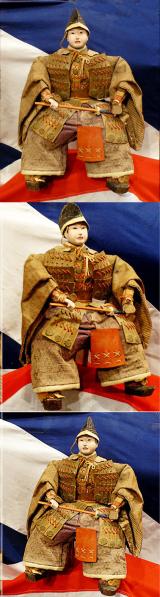
A Superb Antique Edo Period Musha-Ningyo Samurai General Warrior Doll. A Uniquely Japanese Art Form Representing The Legendary Samurai
Adorned with full traditional miniature armour of lacquerwork and lacings and court cap jingasa and damask silk clothing, he is holding a katana. He is seated on a traditional stool. Warrior dolls also known as musha-ningyo are very popular as fine Japanese traditional works of art among Western collectors. Embodying the martial spirit of the samurai, these figures are decked out in full military regalia with lacquered armour, weaponry. They frequently represent very specific historical characters and are a fascinating window into Japan’s rich military past. There may be a continuity in the making of the dogū, humanoid figures, by the ancient Jomon culture in Japan (8000-200 BC) and in the Haniwa funerary figures of the subsequent Kofun culture (around 300-600 AD). Expert Alan Pate notes that temple records refer to the making of a grass doll to be blessed and thrown into the river at Ise Shrine in 3 BC; the custom was probably even more ancient, but it is at the root of the modern doll festival or Hinamatsuri. There are various types of traditional dolls, some representing children and babies, some the imperial court, warriors and heroes, fairy-tale characters, gods and (rarely) demons, and also people of the daily life of Japanese cities. Many have a long tradition Musha, or warrior dolls, are usually made of materials similar to the hina dolls, but the construction is often more complicated, since the dolls represent men (or women) seated on camp chairs, standing, or riding horses. Armor, helmets, and weapons are made of lacquered paper, often with metal accents. There is no specified "set" of such dolls; subjects include Emperor Jimmu, Empress Jingu with her prime minister Takenouchi holding her newborn imperial son, Shoki the Demon-Queller, Toyotomi Hideyoshi and his generals and tea-master, and fairy-tale figures such as Momotaro the Peach Boy or Kintaro the Golden Boy. In the nineteenth century ningyo were introduced to the West.
Doll collecting has since become a popular pastime in the West. Famous well known collectors from the West include individuals such as James Tissot (1836–1902), Jules Adeline (1845–1909), Eloise Thomas (1907–1982), and Samuel Pryor (1898–1985). During the Meiji period, three men became pioneers in collecting ningyo, Shimizu Seifū (1851-1913), Nishizawa Senko (1864–1914), and Tsuboi Shogoro (1863–1913). The three men are referred to as "Gangu San Ketsu" (the three great toy collectors). They introduced a systematic approach to collecting ningyo in an effort to preserve and document the various forms of ningyo. Shimizu, an artist and calligrapher, put his artistic ability to use by creating an illustrated catalog of his own collection of 440 ningyo dolls. The catalog was published in 1891, under the title Unai no Tomo. Nishizawa, a banker, gathered a significant collection on hina-ningyo. He was an active researcher, collector of stories, documents, and information relating to the development of hina-ningyo during the Edo period. Nishizawa’s son Tekiho (1889–1965) inherited his collection but a great portion of the collection was lost in the Kanto earthquake of 1923. Tsuboi, founder of the Tokyo Anthropological Society, was the most trained of the three, and he brought a scientific element to the collecting of ningyo. Dolls have been a part of Japanese culture for many years, and the phenomenon of collecting them is still practiced. Many collections are preserved in museums, including the Peabody Essex Museum, Kyoto National Museum, and the Yodoko Guest House.
The doll is similar to the work of Maruhei a famous Japanese doll artist from Kyoto
Dimensions: 17.5 inches high
Condition: The doll is in very good condition according to age and with wonderful antique taste. Some wear and fading to fabric in places. read more
1595.00 GBP

The Incredible Story of Japanese Urushi Lacquer on Our Original Ancient and Antique Samurai Sword's Saya & Fittings. Without Doubt, Japanese Urushi Lacquerwork & Decor is The Finest Skilled Craftsmanship Of Its Kind In The World
Japanese lacquer, or urushi, is a transformative and highly prized material that has been refined for over 7000 years.
Cherished for its infinite versatility, urushi is a distinctive art form that has spread across all facets of Japanese culture from the tea ceremony to the saya scabbards of samurai swords.
Japanese artists created their own style and perfected the art of decorated lacquerware during the 8th century. Japanese lacquer skills reached its peak as early as the twelfth century, at the end of the Heian period (794-1185). This skill was passed on from father to son and from master to apprentice.
Some provinces of Japan were famous for their contribution to this art: the province of Edo (later Tokyo), for example, produced the most beautiful lacquered pieces from the 17th to the 18th centuries. Lords and shoguns privately employed lacquerers to produce ceremonial and decorative objects for their homes and palaces.
The varnish used in Japanese lacquer is made from the sap of the urushi tree, also known as the lacquer tree or the Japanese varnish tree (Rhus vernacifera), which mainly grows in Japan and China, as well as Southeast Asia. Japanese lacquer, 漆 urushi, is made from the sap of the lacquer tree. The tree must be tapped carefully, as in its raw form the liquid is poisonous to the touch, and even breathing in the fumes can be dangerous. But people in Japan have been working with this material for many millennia, so there has been time to refine the technique!
Flowing from incisions made in the bark, the sap, or raw lacquer is a viscous greyish-white juice. The harvesting of the resin can only be done in very small quantities.
Three to five years after being harvested, the resin is treated to make an extremely resistant, honey-textured lacquer. After filtering, homogenization and dehydration, the sap becomes transparent and can be tinted in black, red, yellow, green or brown.
Once applied on an object, lacquer is dried under very precise conditions: a temperature between 25 and 30°C and a humidity level between 75 and 80%. Its harvesting and highly technical processing make urushi an expensive raw material applied in exceptionally fine successive layers, on objects such as bowls, boxes, samurai sword saya and fittings. After heating and filtering, urushi can be applied directly to a solid, usually wooden, base. Pure urushi dries into a transparent film, while the more familiar black and red colours are created by adding minerals to the material. Each layer is left to dry and polished before the next layer is added. This process can be very time-consuming and labour-intensive, taking up to a year for each item, which contributes to the desirability, and high costs, of traditionally made lacquer goods. The skills and techniques of Japanese lacquer have been passed down through the generations for many centuries. For four hundred years, the master artisans of Zohiko’s Kyoto workshop have provided refined lacquer articles for the imperial household.
Photo in the gallery of several examples of exceptionally beautiful urushi lacquer on our currently available antique samurai swords.
We pride ourselves on trying our utmost to provide the largest and most varied selection of original, ancient and antique samurai swords for sale in the world, from which our clients can choose, outside of Japan.
As once told to us by an esteemed regular visitor to us here in our gallery, probably the most respected Japanese sword expert in the world, in order to view and study our Japanese edged weapons and armour gallery, and the very same words he spoke to us, are repeated in his book;
“In these textures lies an extraordinary and unique feature of the sword - the steel itself possesses an intrinsic beauty. The Japanese sword has been appreciated as an art object since its perfection some time during the tenth century AD. Fine swords have been more highly prized than lands or riches, those of superior quality being handed down from generation to generation. In fact, many well-documented swords, whose blades are signed by their makers, survive from nearly a thousand years ago. Recognizable features of the blades of hundreds of schools of sword-making have been punctiliously recorded, and the study of the sword is a guide to the flow of Japanese history.”
Victor Harris
Curator, Assistant Keeper and then Keeper (1998-2003) of the Department of Japanese Antiquities at the British Museum. He studied from 1968-71 under Sato Kenzan, Tokyo National Museum and Society for the Preservation of Japanese Swords. read more
Price
on
Request