
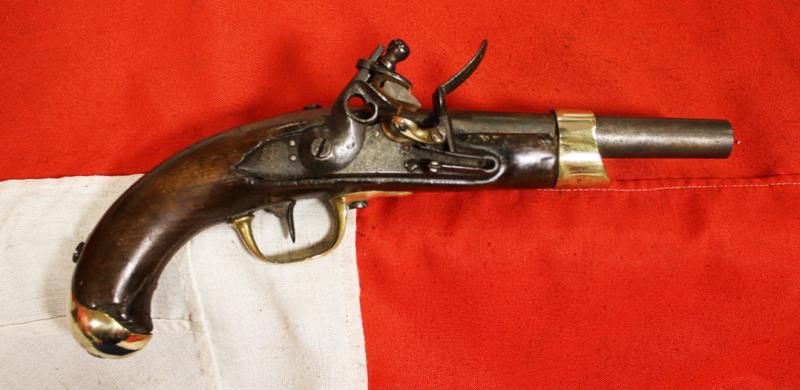
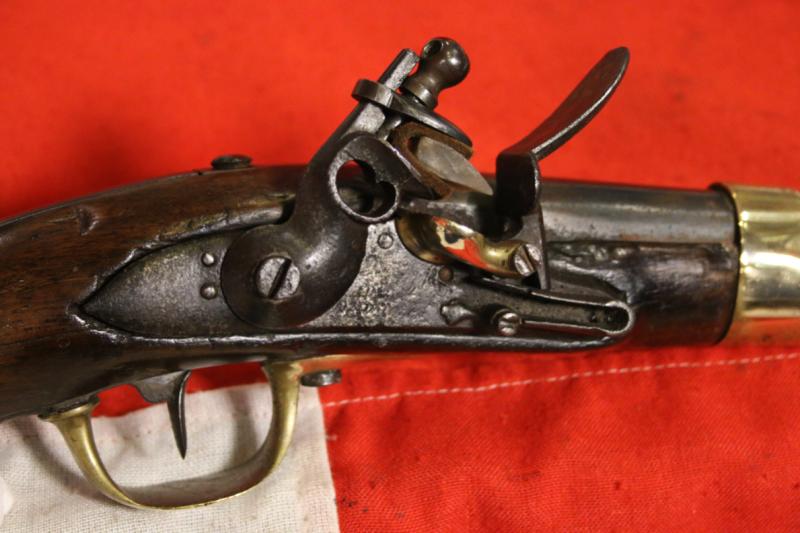
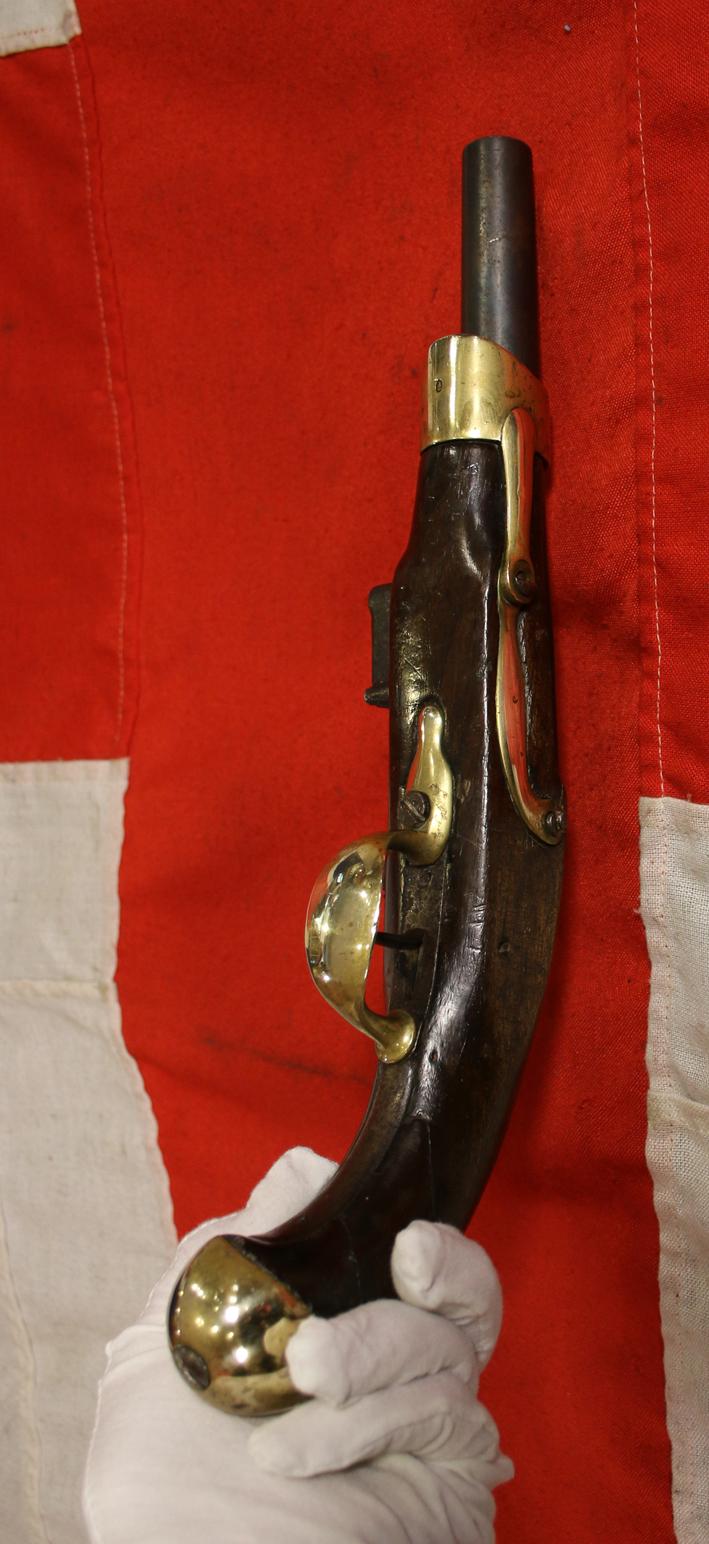
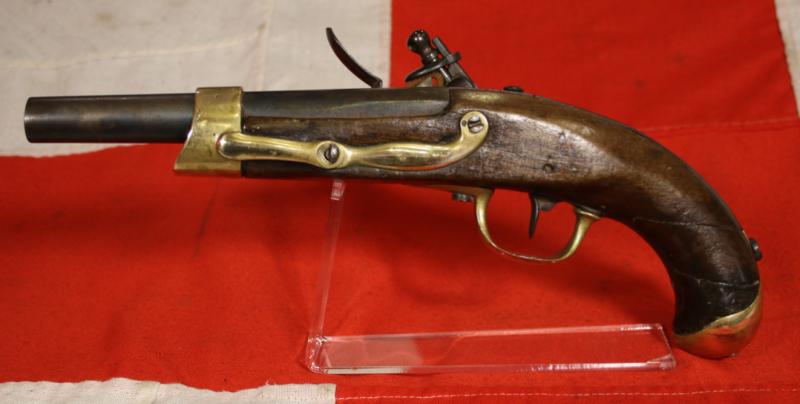
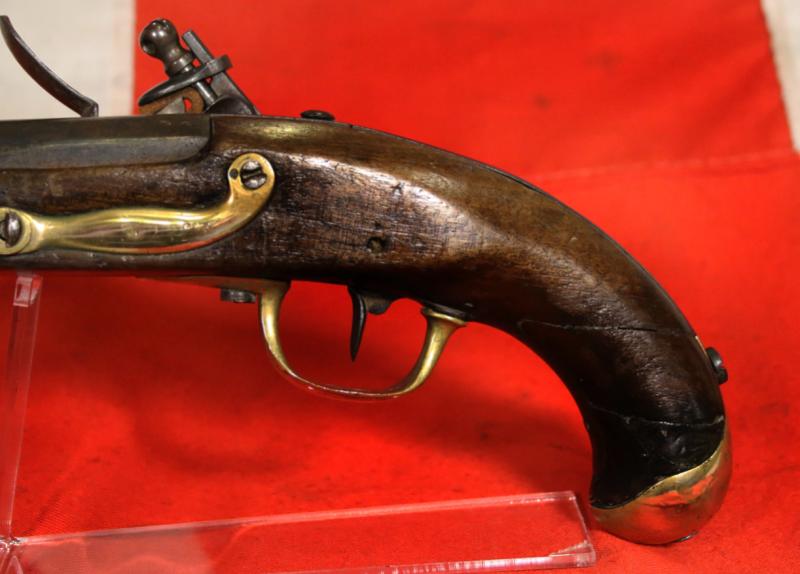
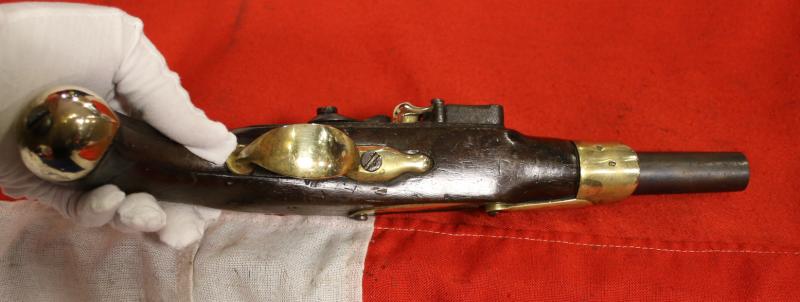
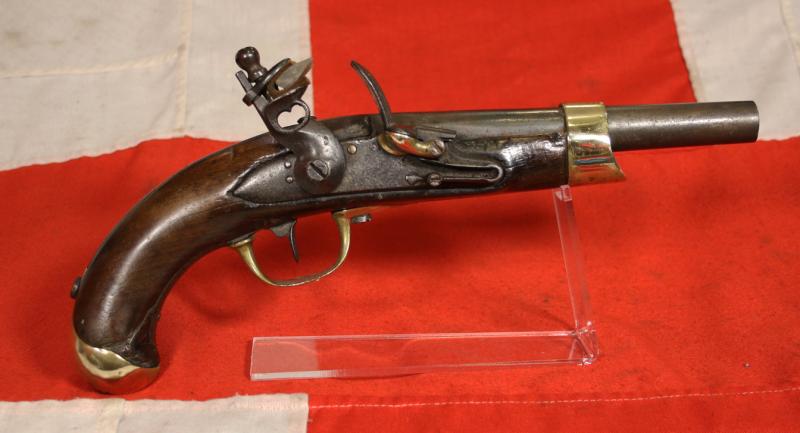
An Original, French, Napoleonic Year 13 Modele, Manufactured in 1807, French Flintlock Line Cavalry Pistol, Inspected by Inspector Le Febre In Charleville. Used In the Peninsular Campaign, The War in Russia and Up To Waterloo.
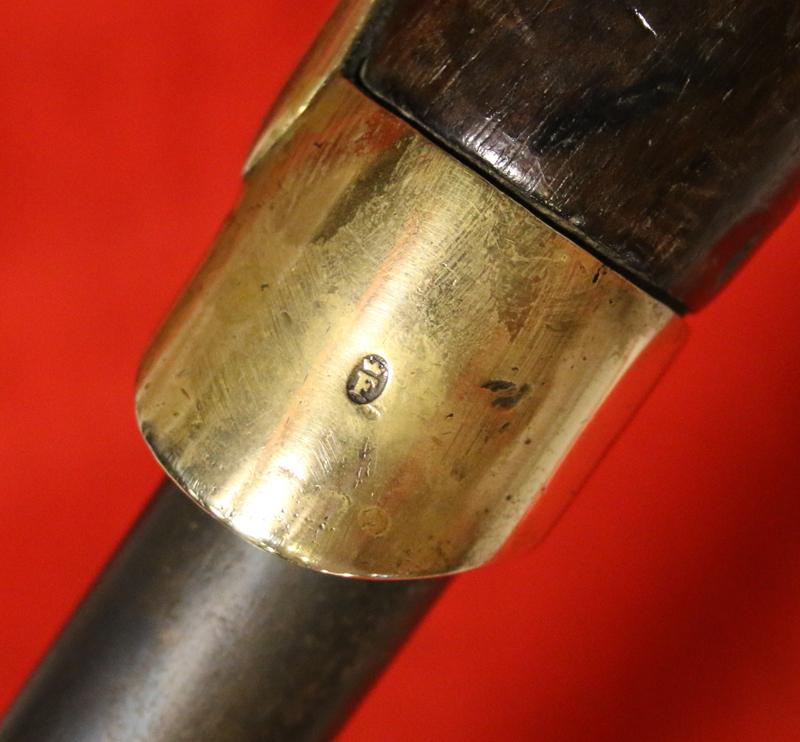
Used as a line regimental issue sidearm, by the very best, French Napoleonic frontline cavalry, the carabineers, cuirassiers, chasseurs, dragoons and lancers, serving in Napoleon Bonaparte's army during the Napoleonic Wars, from 1807 until 1815. The crowned F stamp is for Napoleonic Inspector Le Febre, controller of Charleville in 1807. His stamp changed to remove the crown in 1808, so it is easy to date its manufacture
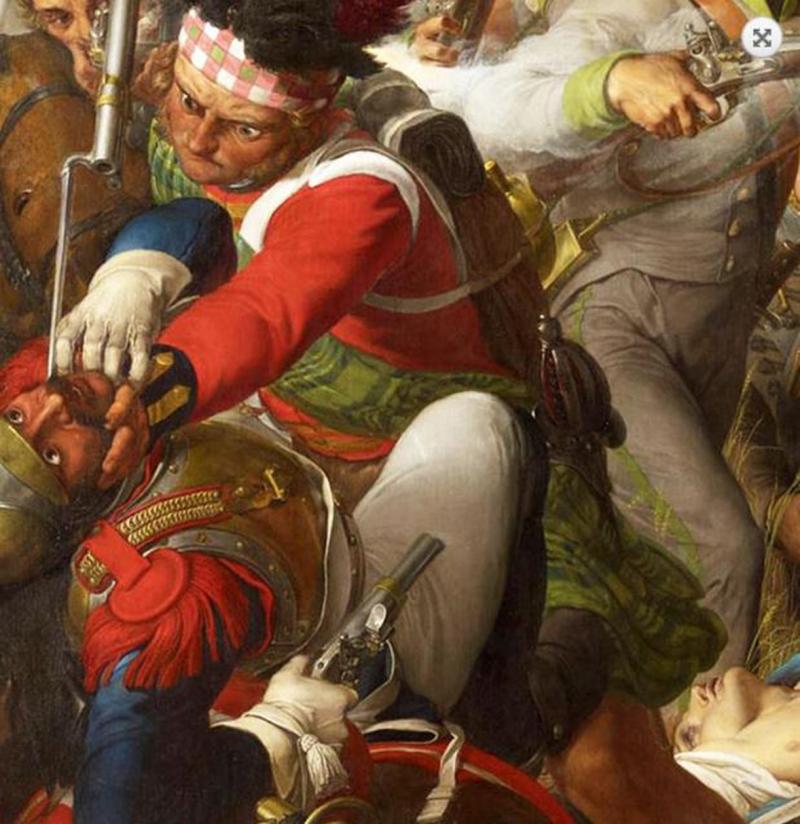
Thus, it has clearly seen combat service, as it bears the wear and combat scars as should be expected, and enjoyed. It has the distinctive bird's head brass butt, that was designed to be utilized as a skull crusher. After the pistol was fired, in close combat, it cannot be reloaded, so, it would be turned around, held by the barrel, and then used as a fearsome club, whilst held in the left hand of the trooper with his sword in the right. When that occurs there are often very distinctive impact cracks in the butt, which this pistol has.
This is the pattern called the AN 13 {year 13} which represents the 13th year of French Ist Republic of 1792. The French Republican Calendar or French Revolutionary Calendar was a calendar proposed during the French Revolution, and used by the French government for about 12 years from late 1793. This is the pattern of pistol that would have first seen service in the Elite Imperial Guard Cuirassiers of Napoleon's great heavy cavalry regiments in the Grande Armee in all the great battles of Napoleon, in the Penisular, then in the invasion of Russia. Although hundreds of thousands {actually 685,000} men in the Grande Armee went to Russia, and barely 22,000 returned alive, this pistol must have been used by one of the survivors, as it was not lost in the Russian campaign. It's cavalry man thus returned {with this pistol} to fight in all of Napoleon's later battles from 1813, until Waterloo in 1815.
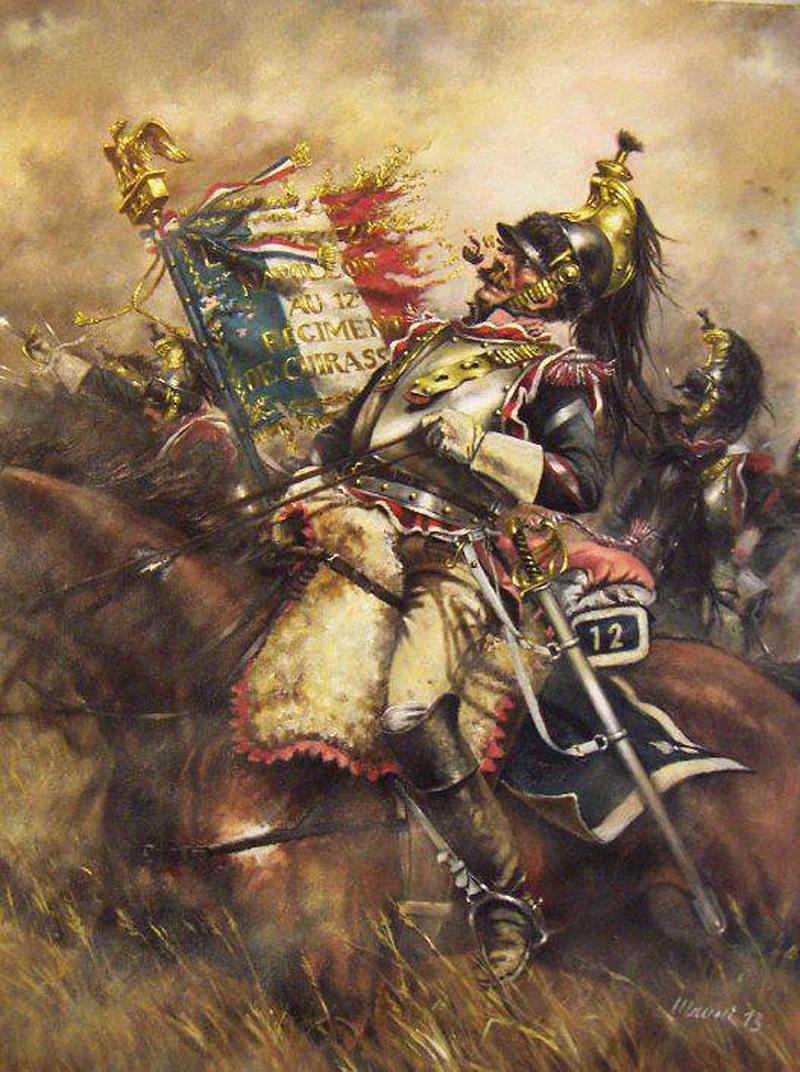
The Cuirassiers Heavy Cavalry Regiments used the largest men in France, recruited to serve in the greatest and noblest cavalry France has ever had. They fought with distinction at their last great conflict at the Battle of Waterloo in 1815, and most of the Cuirassiers pistols now in England very likely came from that field of conflict, after the battle, as trophies of war. This pistol may well have been taken from a vanquished Cuirassier pistol that was drawn for combat on the field of battle. One can imagine this pistol lying freely, or, maybe, even still clasped in his cold desperate hand, or even under his fallen steed, at the field of conflict at Waterloo. Every warrior that has ever entered service for his country sought trophies. The Mycenae from a fallen Trojan, the Roman from a fallen Gaul, the GI from a fallen Japanese, the tradition stretches back thousands of years, and will continue as long as man serves his country in battle. In the 1st century AD the Roman Poet Decimus Iunius Iuvenalis Juvenal
wrote; "Man thirsts more for glory than virtue. The armour of an enemy, his broken helmet, the flag ripped from a conquered trireme, are treasures valued beyond all human riches. It is to obtain these tokens of glory that Generals, be they Roman, Greek or barbarian, brave a thousand perils
and endure a thousand exertions". A truly super Napoleonic pistol. The cuirassiers were the greatest of all France's cavalry, allowing only the strongest men of over 6 feet in height into it's ranks. The French Cuirassiers were at their very peak in 1815, and never again regained the wonder and glory that they truly deserved at that time. To face a regiment of, say, 600 charging steeds bearing down upon you mounted with armoured giants, brandishing the mightiest of swords that could pierce the strongest breast armour, much have been, quite simply, terrifying. Made in the period that Napoleon was Emperor and ruling most of Europe, it was used through the Napoleonic period from 1813, later in the the Royal restoration period, when Napoleon was imprisoned at Elba, and then during the War of the 100 days, culminating at Waterloo .
All Napoleon's heavy Cavalry Regiments fought at Waterloo, there were no reserve regiments, and all the Cuirassiers, without exception fought with their extraordinary resolve, bravery and determination. The Hundred Days started after Napoleon, separated from his wife and son, who had come under Austrian control, was cut off from the allowance guaranteed to him by the Treaty of Fontainebleau, and aware of rumours he was about to be banished to a remote island in the Atlantic Ocean, Napoleon escaped from Elba on 26 February 1815. He landed at Golfe-Juan on the French mainland, two days later. The French 5th Regiment was sent to intercept him and made contact just south of Grenoble on 7 March 1815. Napoleon approached the regiment alone, dismounted his horse and, when he was within gunshot range, shouted, "Here I am. Kill your
Emperor, if you wish." The soldiers responded with, "Vive L'Empereur!" and marched with Napoleon to Paris; Louis XVIII fled. On 13 March, the powers at the Congress of Vienna declared Napoleon an outlaw and four days later Great Britain, the Netherlands, Russia, Austria and Prussia bound themselves to put 150,000 men into the field to end his rule. Napoleon arrived in Paris on 20 March and governed for a period now called the Hundred Days. By the start of
June the armed forces available to him had reached 200,000 and he decided to go on the offensive to attempt to drive a wedge between the oncoming British and Prussian armies. The French Army of the North crossed the frontier into the United Kingdom of the Netherlands, in modern-day Belgium. Napoleon's forces fought the allies, led by Wellington and Gebhard Leberecht von Blücher, at the Battle of Waterloo on 18 June 1815. Wellington's army withstood repeated attacks by the French and drove them from the field while the Prussians arrived in force and broke through Napoleon's right flank. The French army left the battlefield in disorder, which allowed Coalition forces to enter France and restore Louis XVIII to the French throne. Off the port of Rochefort, Charente-Maritime, after consideration of an escape to the United States, Napoleon formally demanded political asylum from the British Captain Frederick Maitland on HMS Bellerophon on 15 July 1815.
Flintlock action a/f, no rammer present, thus priced accordingly. We have another of the same type of original Napoleonic cavalry pistol, also a great pistol, but in better condition. Search for stock code 26197, at £2995.
Code: 26452
1600.00 GBP