
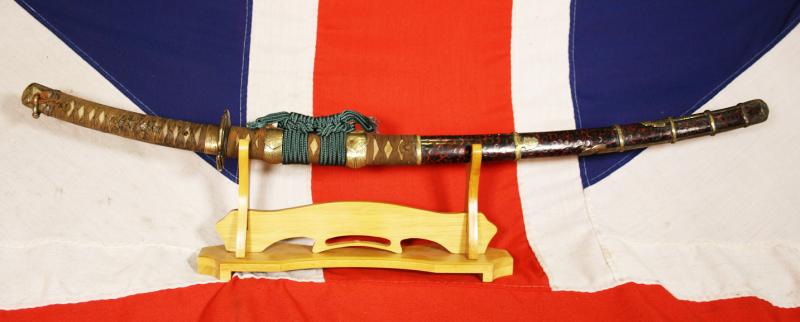
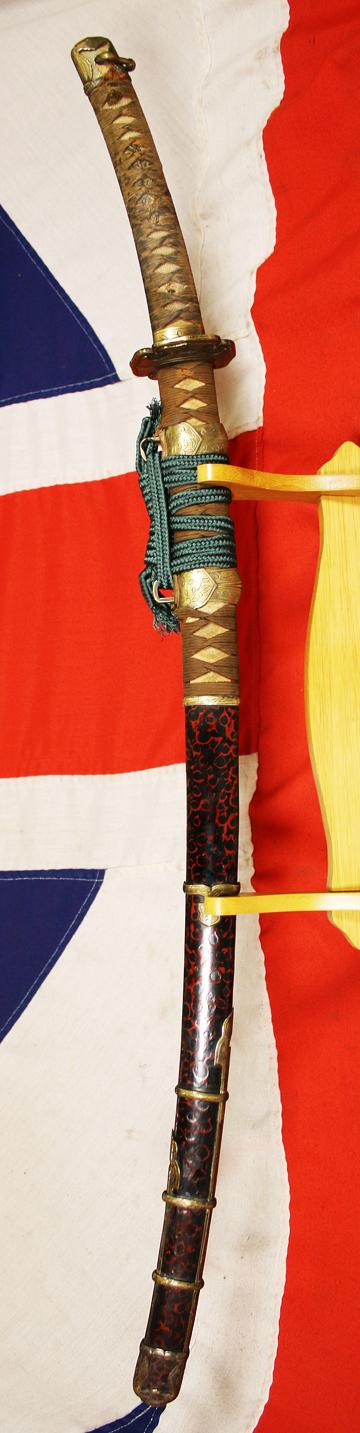
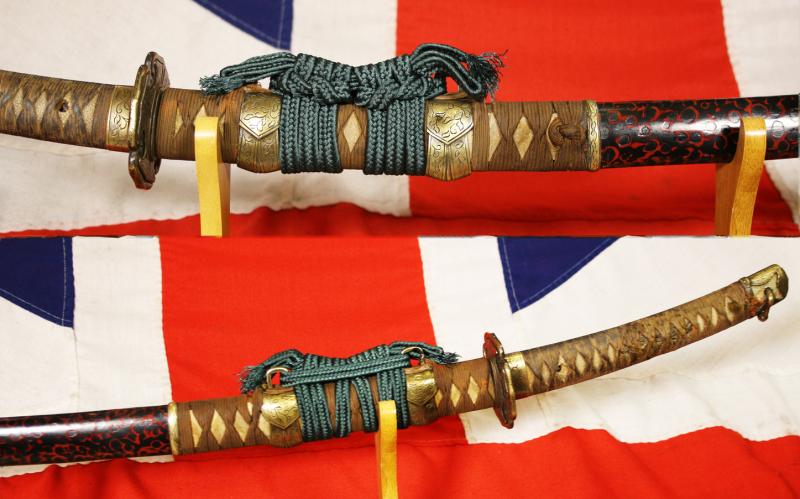
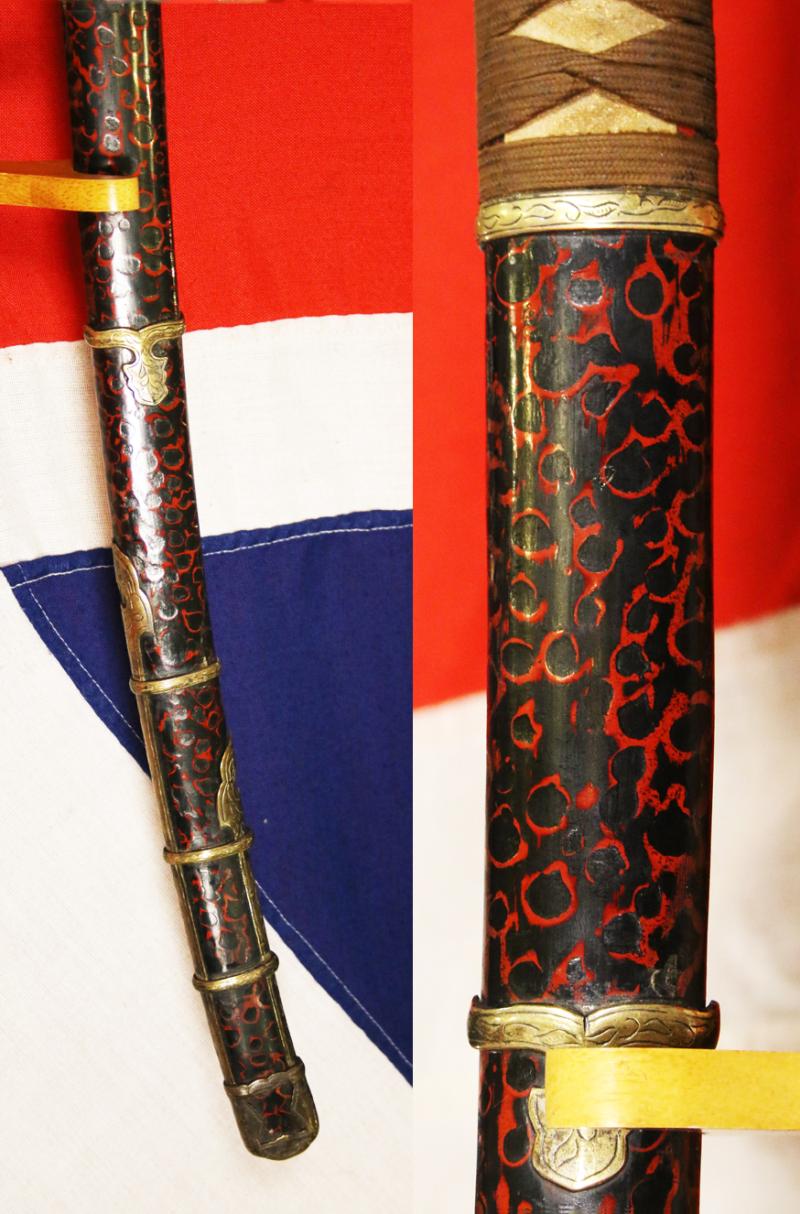
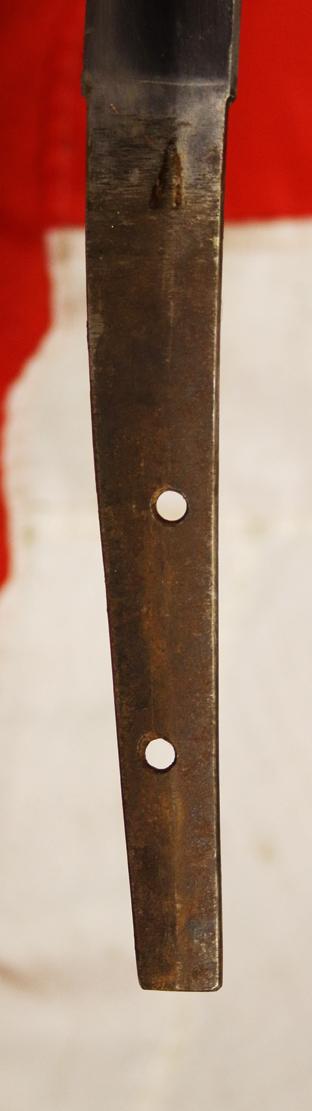
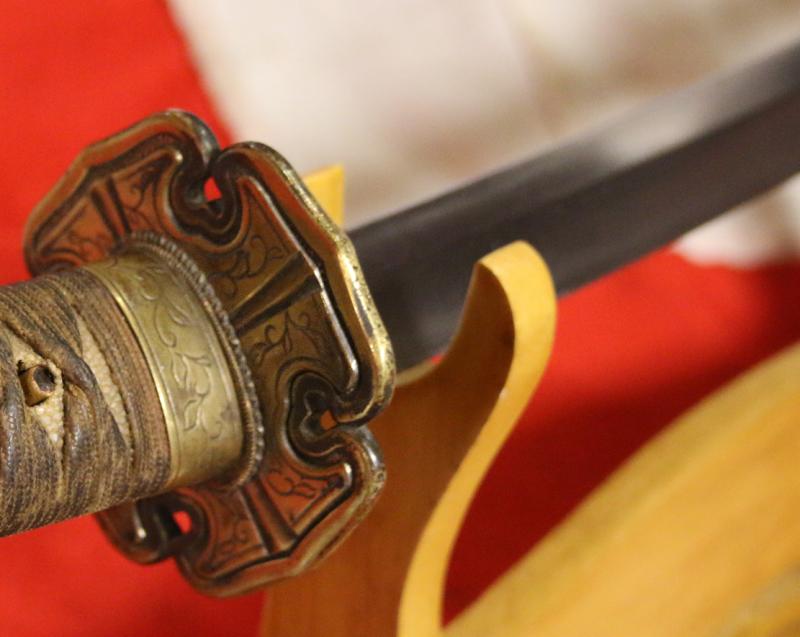


Japanese Koto, Sengoku Period, 500 Year Old Samurai Mounted Combat and Court Sword. Original Edo Era Mounted Ito-Maki No Tachi, With Original Edo Black and Red Tsugaru-nuri (津軽塗) With the Kara-nuri (唐塗) Technique Urushi Lacquer Saya.
Japanese Court Sword Ito-Maki No Tachi, blade cms signed Koto period, straight itame hada and hamon, in tachi koshirae, tape bound same tsuka, engraved brass mounts with fine engraving, gilt dai seppa aoi tsuba with seppas, in its Tsugaru-nuri (津軽塗) lacquered saya with binding and mounts en-suite with hilt.
Traditional Japanese Tsugaru-nuri (津軽塗) lacquerware finish, specifically featuring the Kara-nuri (唐塗) technique in a red and black (Nashi-guro / 梨黒) colourway with metallic powder accents.
Kara-nuri It features a mottled, speckled, or raindrop-like abstract pattern created through a painstaking traditional process involving up to 48 separate steps of applying layers of colored lacquer, drying, and polishing.
Artisans use a specially notched spatula (called a shikake-bera) to carve patterns into the layered lacquer before sanding and polishing it down to reveal the colourful, organic strata beneath.
Tsugaru-nuri is a renowned traditional craft from Aomori Prefecture, Japan, celebrated for its intricate multi-layered application of lacquer, distinctive speckled patterns, and extreme durability.
A tachi (太刀) is a traditional, single-edged, curved Japanese sword worn by the samurai class, predominantly used during the Kotō period (900–1596). It is the historical predecessor to the iconic katana.
Measuring typically longer than the katana, the tachi was designed primarily for cavalry warfare. Its pronounced, deep curvature (especially near the hilt) made it exceptionally effective for delivering powerful, sweeping slicing cuts while riding a horse. Even after the mass-infantry-focused katana overtook it in popularity during the Muromachi period, the tachi remained a highly revered status symbol worn by high-ranking samurai for in the daimyo's or shogun's court.
In the Sengoku period (1467–1615) or the Azuchi–Momoyama period (1568–1600), the itomaki tachi (itomaki no tachi, 糸巻太刀), which means a tachi wound with thread, appeared and became the mainstream of tachi after that. Itomaki tachi was decorated with lacquer decorations with many maki-e and complex coloured threads, and could used for presentation, a ceremony, or an offering to the kami of Shinto shrines.
In later Japanese feudal history, during the Sengoku and Edo periods, certain high-ranking warriors of the ruling class wore their sword tachi-style (edge-downward), rather than with the scabbard thrust through the belt with the edge upward. This style of swords is called handachi, "half tachi". In handachi, styles were often mixed, for example, fastening to the obi was katana style, but metalworking of the scabbard was tachi style.34
With the rise of statism in Shōwa Japan, the Imperial Japanese Army and the Imperial Japanese Navy implemented swords called shin guntō, worn tachi style (cutting-edge down).
Code: 26428
Price
on
Request