
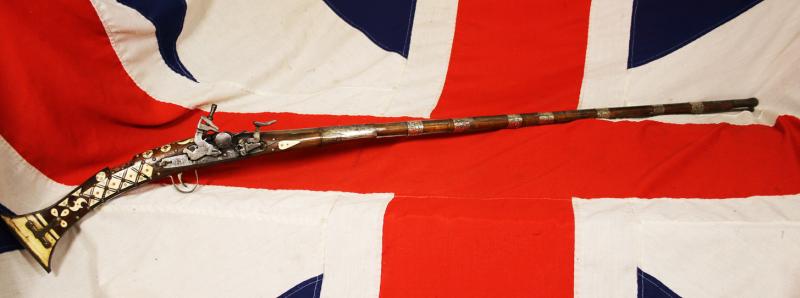
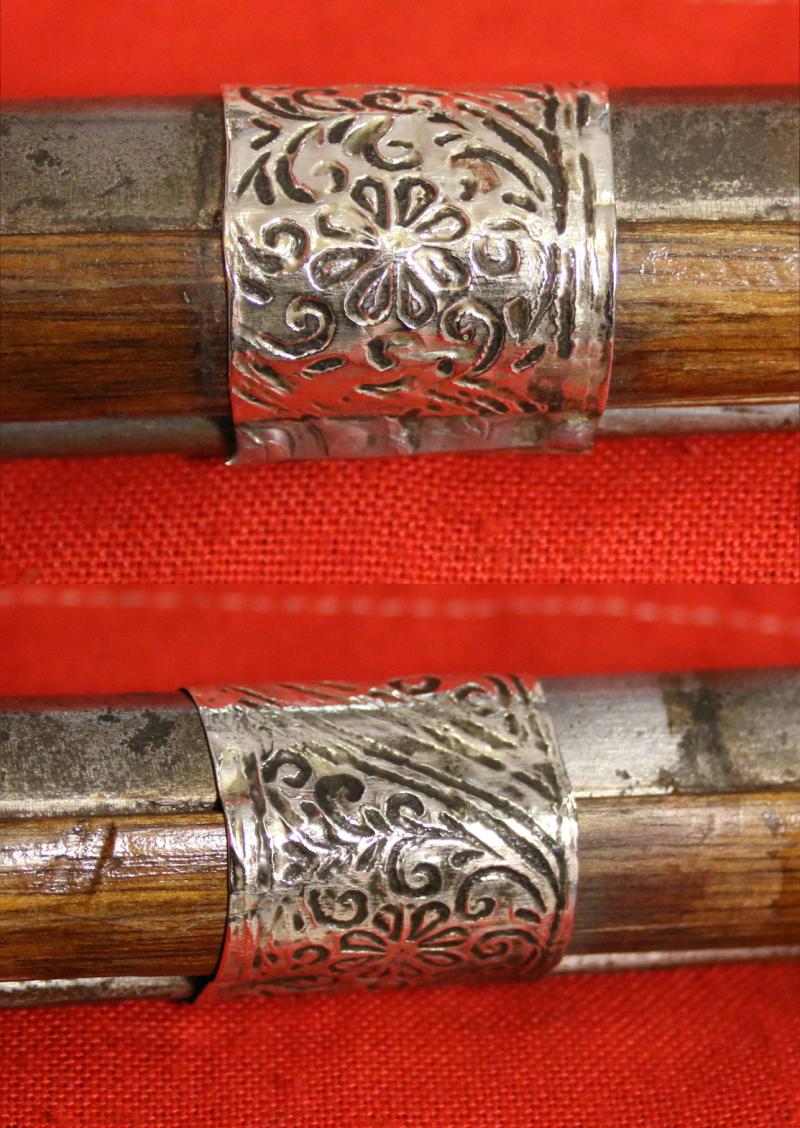
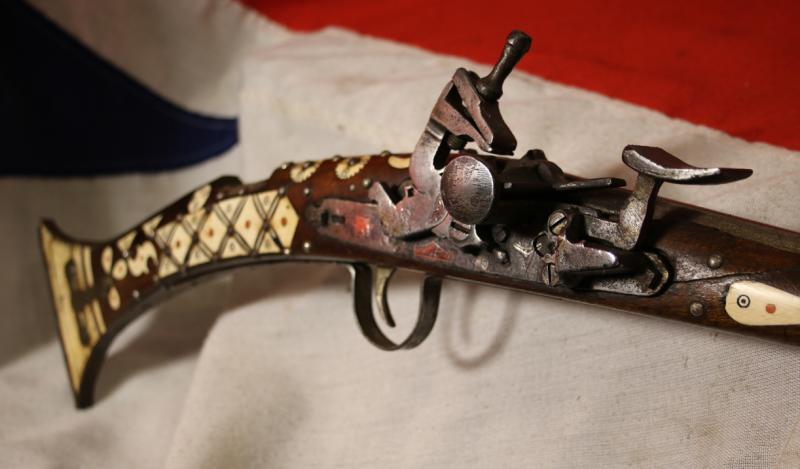
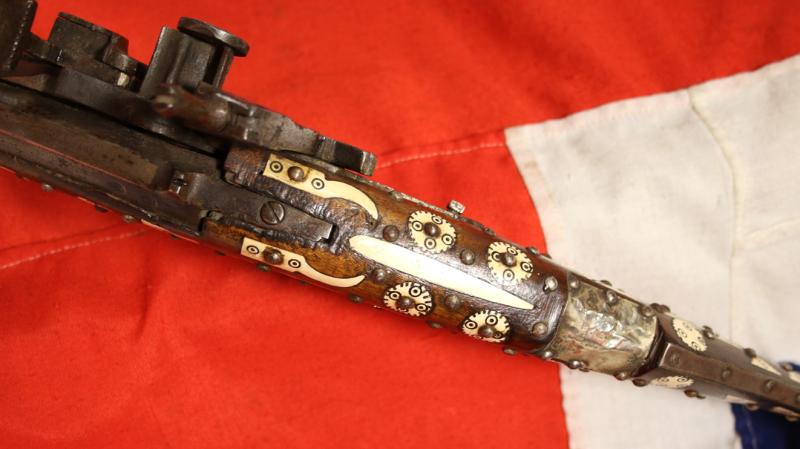
An Original And Beautifully Exotic North African or Arabian Heavily Decoratively Inlaid Snaphaunce Lock Kabyle Musket With Florid Engraved Silver Cappuchines (Barrel Bands Circa 1790 to 1820 with Ivory Butt
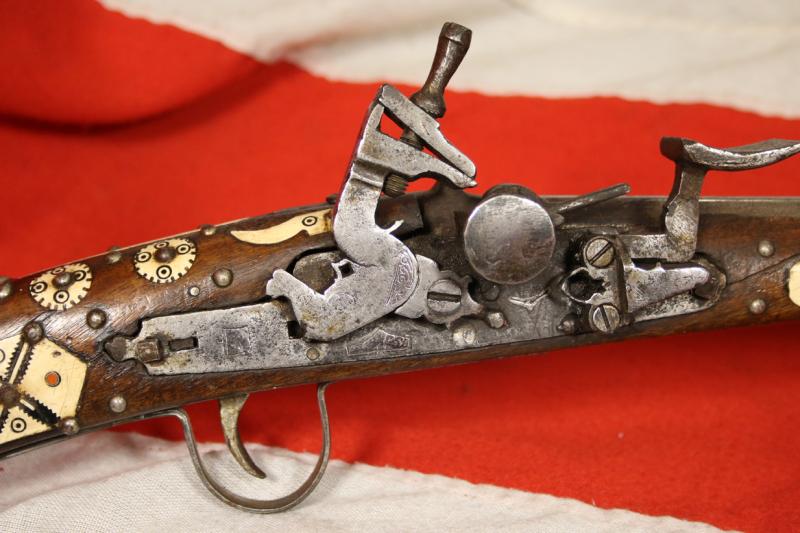
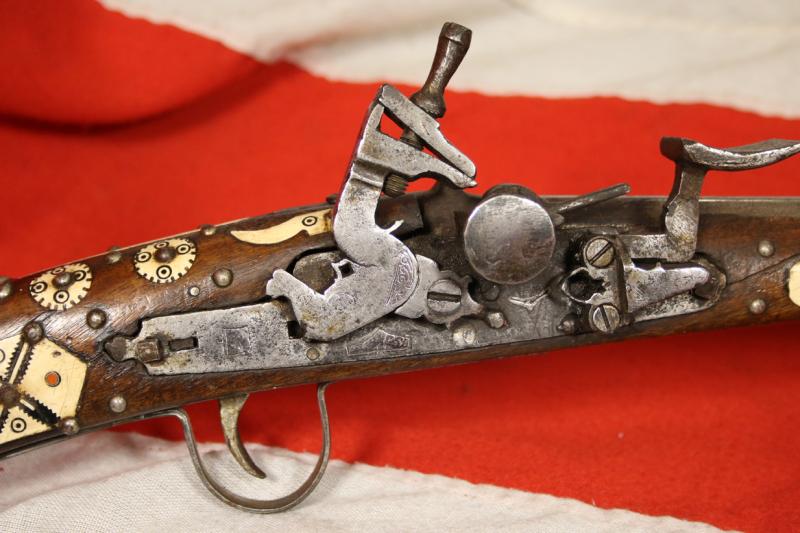
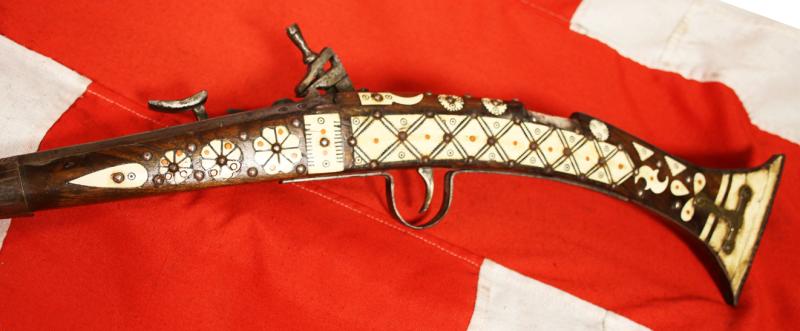
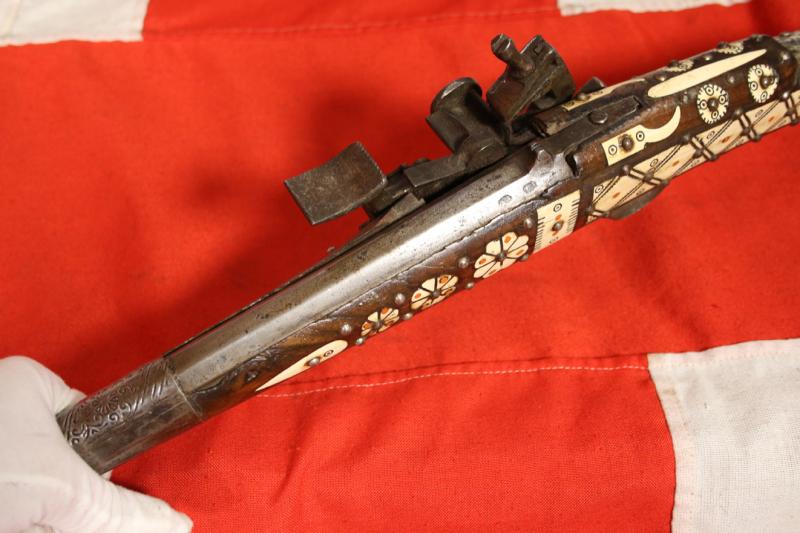
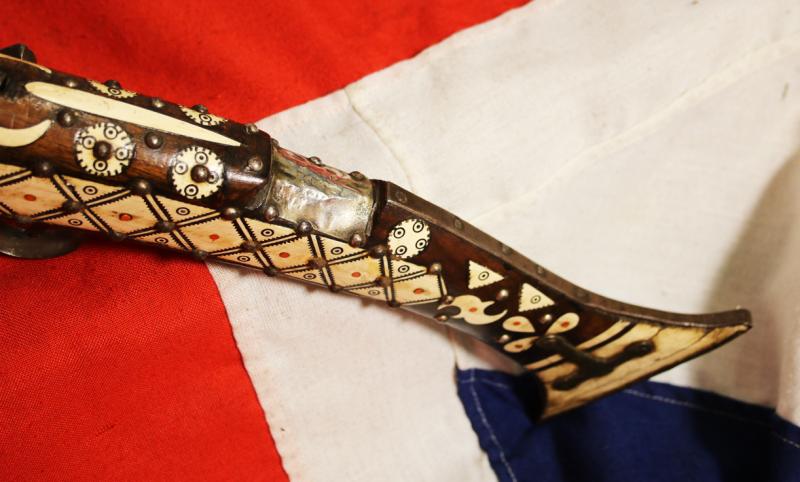
Kabyle Flintlock Musket (Moukhala) with Sheet Silver and Bone Decoration, late 18th C.Steel, wood, sheet silver, bone, brass. Long North African flintlock musket of Moukhala type with smooth round barrel, secured by multiple capucines clad in sheet silver. Flintlock with fine engraving and sheet silver overlay. Straight wooden stock with ivory butt, and rich bone inlay decoration and sheet silver mounts in florid patterns. Ramrod present. Wedge-shaped shoulder rest with characteristic ribbed structure and bone appliqués. The stock and trumpet-shaped butt is enhanced with a carved ivory butt.
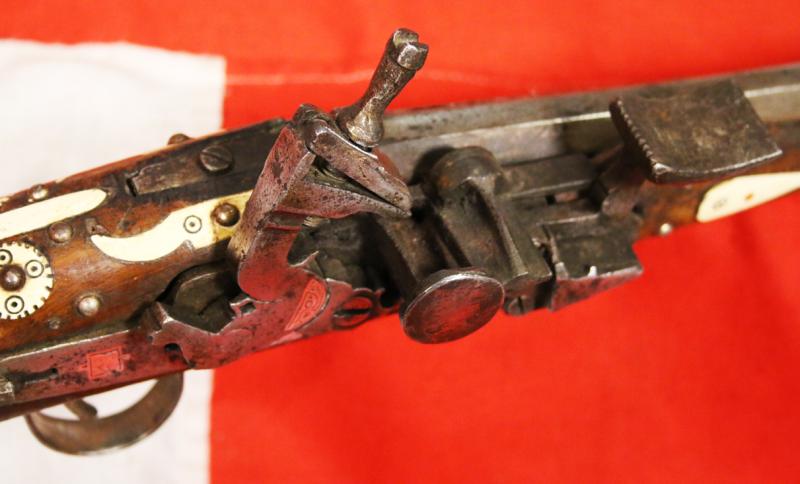
With a good Snaphaunce lock of 17th century style form, fine detailed engraving around the stock, distinctive deep flattened butt, and the stock is inlaid.
Two systems of gunlock prevailed in Kabyle guns, one, which derived from Dutch and English types of snaphance lock, usually with a thicker lockplate. Half cock was provided by a dog catch behind the cock. At full cock, the sear passing through the lockplate engaged the heel of the cock. The other mechanism was the so-called Arab toe-lock, a form of miquelet lock, closely allied to the agujeta lock (which required a back or dog catch for half cock) and the Italian romanlock. The term miquelet is used today to described a particular type of Snaplock. The miquelet lock, in all varieties, was common for several centuries in the countries surrounding the Mediterranean, particularly in Spain, Italy, the Balkans, and the Ottoman Empire domains including the coastal states of North Africa. The type of musket would be described as a Kabyle snaphance
The Moukhala is the traditional flintlock musket of the Berbers and Kabyles of North Africa, particularly the Algerian Kabylia region. The elaborate decoration with sheet silver mounts and bone inlays identifies this as a high-quality piece, possibly intended as a ceremonial or prestige weapon. The flintlock shows influences of the Miquelet type, which reached North Africa via the Spanish and Italian arms-making traditions. Comparable examples are held by the Metropolitan Museum of Art, New York, and the Royal Armouries, Leeds.
This example is all locally made, and probably originates from anywhere from Morocco in the West to Saudi Arabia in the East. It features a very attractive snaphaunce style lock.
King Philip III of Spain signed an EDICT OF EXPULSION in 1609 to purge the nation of over half a million "Moors" who had arrived in Spain over the previous 500 years. These unfortunates were compelled to return to their ancestor's lands in North Africa. When leaving they took many "Western Skills" learned in Spain with them. Gunmaking was one such skill and a contingent of Muslim Gunsmiths set up in the City of Tetuan in what we now call Morocco.
They continued to make the latest style of firearms then dominant in Spain which was the Snaphaunce system, a forerunner of the traditional flintlock soon to be introduced in France.These Arab made long guns intended for use from the saddle of a Camel were smooth bored but surprisingly accurate and production of the same ignition system continued for over 200 years and more even through the late Victorian era.
What we offer here is a beautiful example of the snaphaunce muskets made between 1800 and 1820 using the finest materials available in the region, and enhanced in masses of Coin Silver most likely smelted from Spanish 16th and 17th century "Treasure" looted or mined in South America.
In Europe these most distinctive and elaborate Snaphaunce guns gained great favour in the Elizabethan era and their influence was greatly felt in Arabia, originally along the eastern trade routes, that were travelled and used by early Europeans in order to buy the finest eastern silks, gemstones & spices. They were continually used in the Middle East and the Maghrib long after they had become unfashionable in Europe. One of the most renown Berbers in history was Saint Augustine it is said of him "Of all the fathers of the church, St. Augustine was the most admired and the most influential during the Middle Ages ... Augustine was an outsider - a native North African whose family was not Roman but Berber ... He was a genius - an intellectual giant" Interestingly this gun would have been likely last used in the resistance battle against French colonial conquest of Algeria, and one of the most famous was a woman, a warrior leader called Lalla Fadhma n'Soumer (born Fadhma Nat Sid Hmed in Abi Youcef, Algeria c.1830) She was an important figure of the Algerian resistance movement during the first years of the French colonial conquest of Algeria. She was seen as the embodiment of the struggle. Lalla, the female equivalent of sidi, is an honorific reserved for women of high rank, or who are venerated as saints. Fadhma is the Berber/French spelling of the Arabic name Fatima, which is colloquially pronounced Fatma in most Arabic dialects as well as Berber
One of a Kind. The Kabyle (sometimes Jezzail from the Arabic) is a simple, cost-efficient and typically handmade muzzle-loading long arm commonly used in the Middle East region in the past. These were all highly personalized, so no two were alike.
Barrel 43.5 inches long, overall 58 inches
Not suitable for export. UK mainland sale only.
Code: 26425
1345.00 GBP