
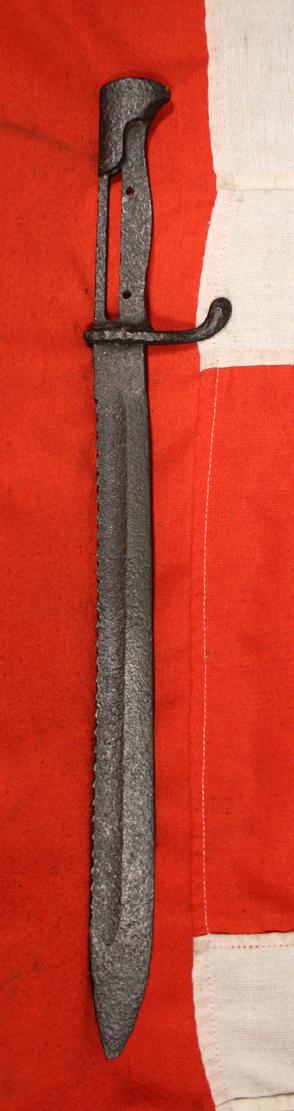
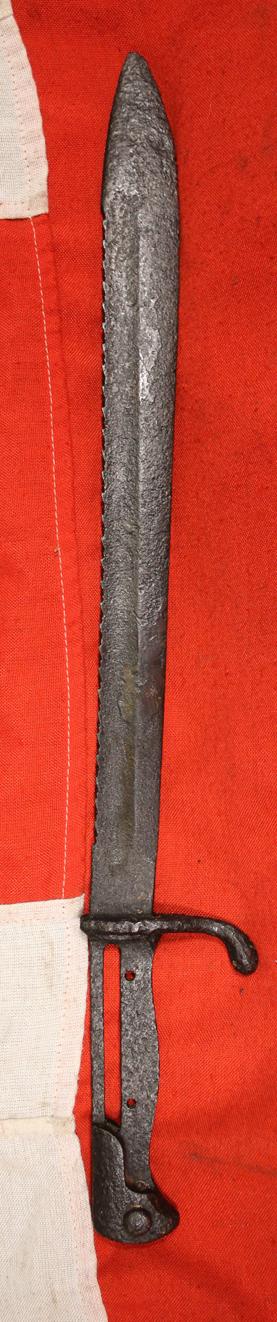
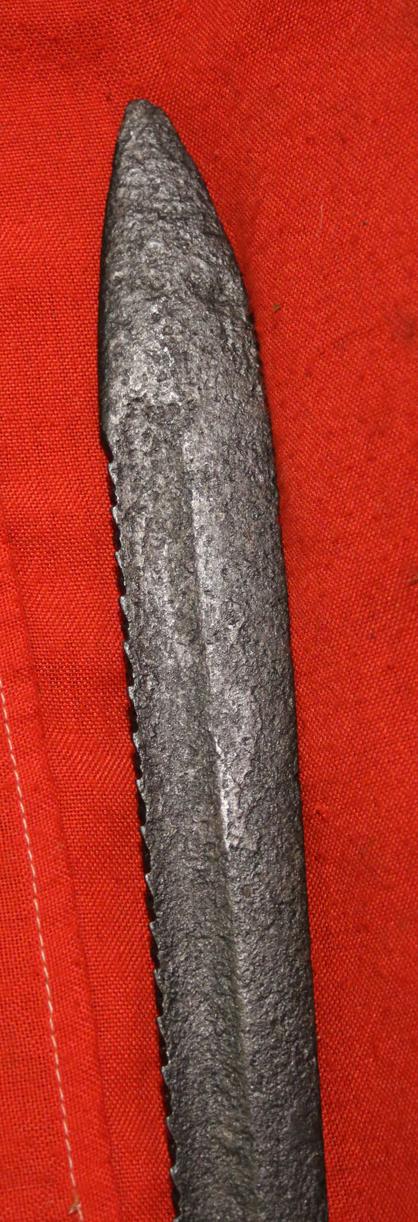
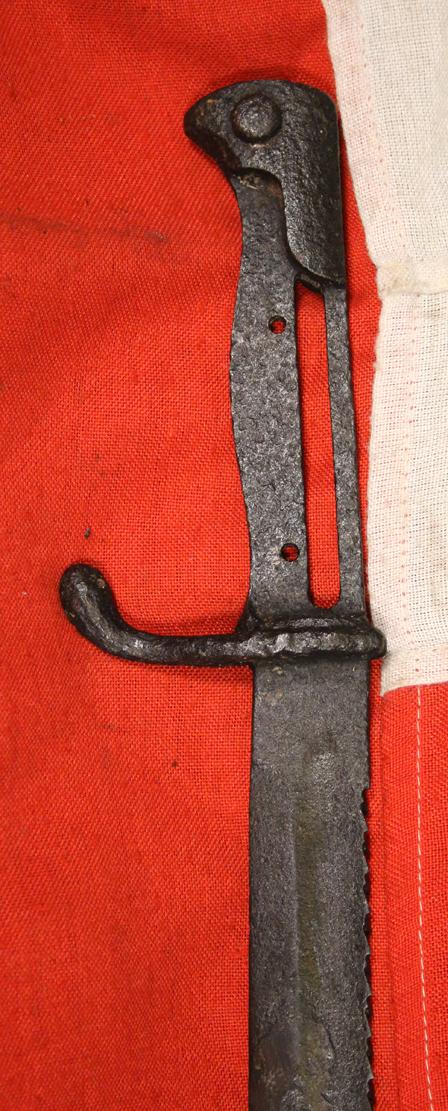
A S98/05 S or m.S.'Sawback'. The Infamous German WW1 'Sawback' Mauser Butcher Bayonet. A Recovered Relic From The Somme. Only 6% Of The Mauser Bayonets Were Fitted With Sawback, and 99.9% Of Those Later Officially Removed in 1917
The Somme Offensive
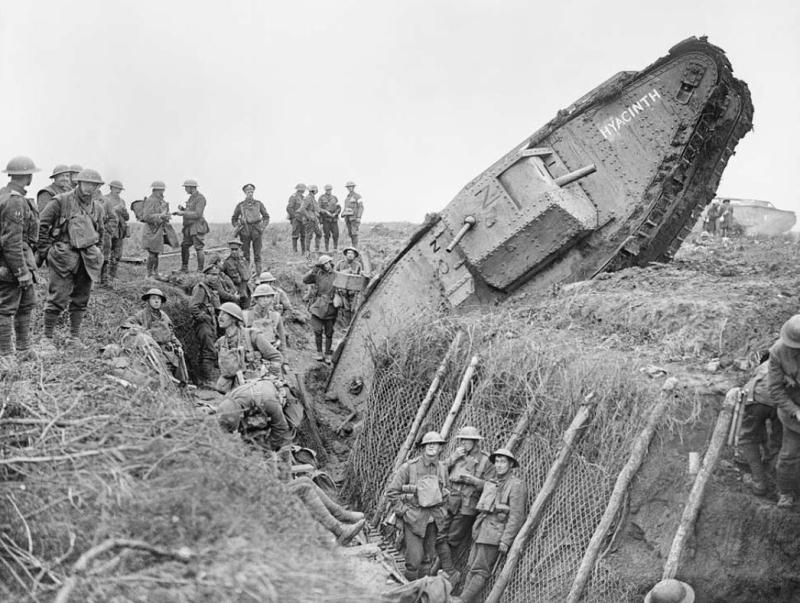
The First Battle of the Somme (July 1 - November 18, 1916) was an Anglo-French offensive whose objective was to overstretch and wear down the German army on the Western Front. Originally, the French were to lead the attack, with the British Expeditionary Force (BEF) providing support. Yet after the French army was devastated at Verdun, the British were left to take the principal role. British training was far from complete, and their strategy was also flawed; thinly spread artillery, defective munitions (largely British-produced), and inexperienced troops led to a disastrous initial British assault – some 57,000 casualties. In comparison, the French army, with plenty of combat experience from the engagements at Ypres and Verdun, took its objectives with 1,600 casualties. After a significant Allied advance followed by a period of stagnation in the face of strong German defensive positions, powerful and successive French and British offensives drove the German army back, but failed to break their lines. Only the coming of winter ended the offensive. In its incredible violence, The Somme came to represent the terror and senselessness of the Western Front. The German army suffered heavy losses: more than 500,000 casualties and a serious crisis of morale. The British suffered 420,000 and the French 202,000 casualties. Yet the battle ultimately provided Allied commanders with the strategic experience they needed in order to be successful in the future.
The Mauser Gew98 Sawback 'Butcher' bayonet was issued in WW1 but was soon altered by the German soldiers, by way of the removal of the sawback edge.
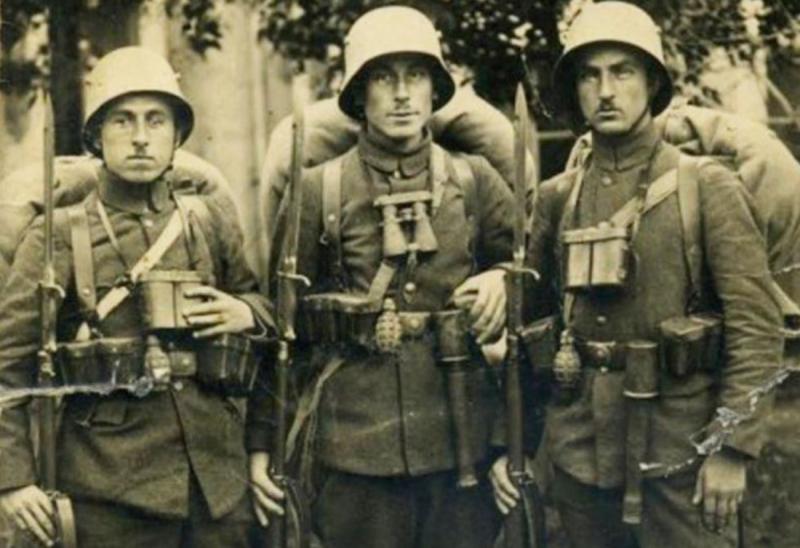
It was commonly alleged that a German soldier captured alive with his 'Sawback' intact would be immediately killed by his allied captors, as the gruesomeness of the bayonet was much resented by the allied soldiers. This bayonet however is completely unaltered and it's sawback is intact, despite being in relic condition.
Germany used a wide variety of bayonets on the Mauser Gew-8 and Kar-98 rifles. They entered World War 1 issuing the 1898/05 or ‘Butcher Blade’ model. As the war progressed the shorter blade types and the ersatz models were introduced.
A small percentage of German bayonets were made with a saw back. They were only to noncommissioned officers or pioneer troops.
The Seitengewehr 98/05 has a wood handle and swept back quillon. 14.5-inch single edge butcher blade, marker marked on the ricasso. Early versions have the saw back as does ours. The saw back was phased out during the war due to negative Allied propaganda. Most had the saw back ground off and re-issued. The first scabbards were leather with steel fittings, followed by all steel.
At the beginning of the Great War, the M1898/05 came with high ears and without flash guard. Pioneers and machine gunner crews used this version because of its suitability to chopping down bushes. The sawback was a favoured tool among German Military units.
The Seitengewehr 98/05 was introduced into the Prussian army in late 1905, as a replacement for the 98/02 for engineers and pioneer troops, as the 98/02 was deemed to long and heavy for it's intended purpose and one and a half times the length of the 1898/05. Initial production was in two versions, the first plain backed, and the second with 29 double teeth. The bayonet, as typical of German blades, did not have more than a vestigial muzzle ring, relying on the length of the hilt mounting to fix the blade to its rifle. The plain back version was identified as the S98/05 or S98/05 o.S. (ohne Säge - without saw) and the saw back as the S98/05 S or m.S. (mit Säge - with saw). About 6% of blades made were fitted with the saw back
At the beginning of WWI it was found that the S98/05 had a problem when used with the Karabiner 98 rifle, the shorter barrel on this model led to burning and damage to the grips as the barrel finished before the vestigial muzzle ring, so in1915 it was decided to fit a steel flash guard (Schutzbleche) to the back of the bayonet to protect the grips. The bayonet was modified by removing most of the muzzle ring remaining, reducing the back of the tang and adding the flash guard.
The sawback version of the bayonet soon became very unpopular on both sides of the frontline. When plunged into the enemy, this style of blade pulled out the victim’s insides when removed causing exceptional pain, suffering and inevitably death. It was communicated to the German army that French and British soldiers would torture and then killed their troops if found with a sawback blade on their bayonet. Therefore an order was issued in 1917 that all sawbacks be removed from service . A super rare piece.
Code: 26407
140.00 GBP