
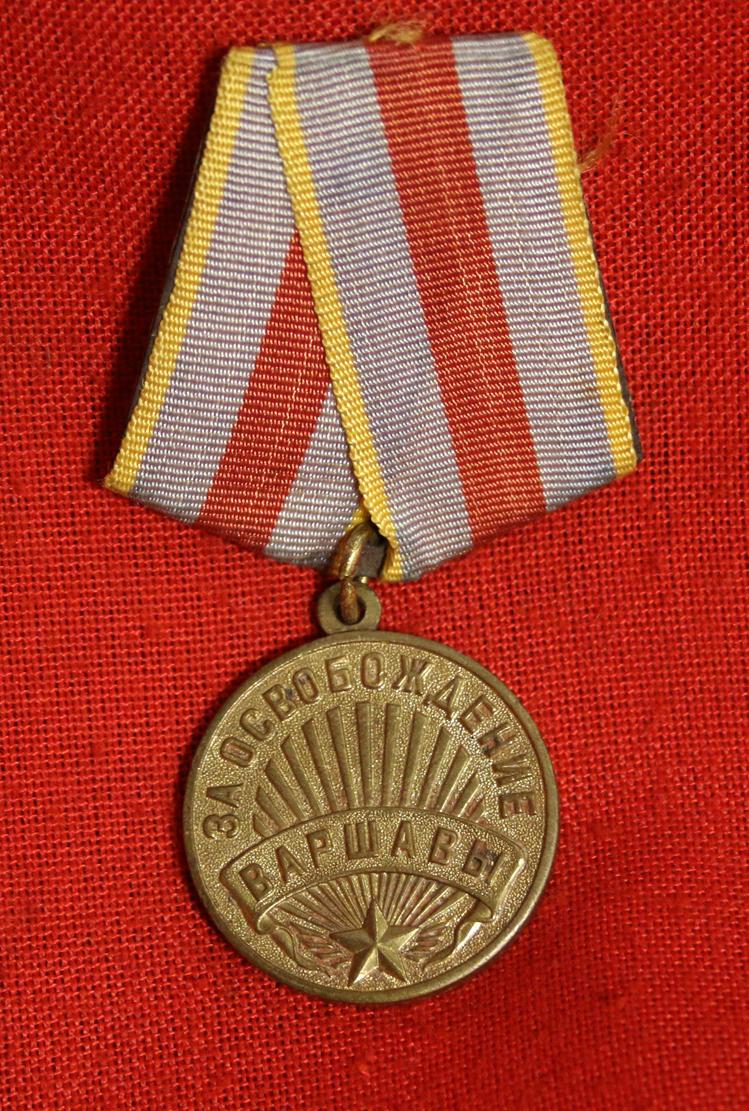
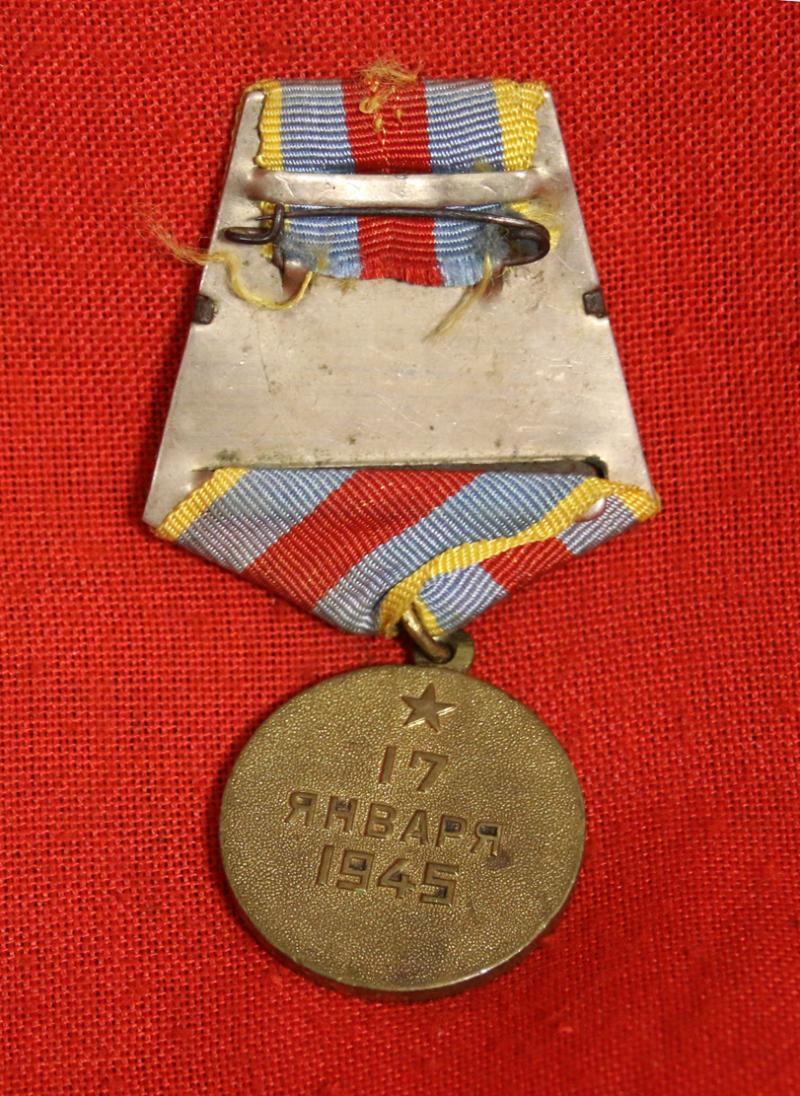
Soviet USSR Liberation Of Warsaw Medal "ЗА ОСВОБОЖДЕНИЕ ВАРШАВЫ" (For the Liberation of Warsaw)
Awarded to Soviet military personnel and partisans who directly participated in the capture and liberation of Warsaw between January 14 and January 17, 1945.
Made of brass, featuring the inscription "ЗА ОСВОБОЖДЕНИЕ ВАРШАВЫ" (For the Liberation of Warsaw) encircling a radiating starburst and laurel wreath at the bottom.
From a small former intelligence officer's collection of original surviving WW2 psychological warfare propaganda leaflets and post war, Cold War period Soviet medals we were delighted to acquire.
A blue silk moiré ribbon with a wide red stripe down the center, flanked by narrow yellow edge stripes
Vistula–Oder Breakthrough: Marking Warsaw’s Liberation, January 1945
Instituted in the first weeks after victory in Europe, the Medal for the Liberation of Warsaw honoured Red Army, Navy, Air Force, NKVD, and Polish People’s Army personnel who took part in the operation that freed Poland’s capital on 17 January 1945.
Fought as part of the Vistula–Oder Offensive, the campaign combined river crossings, armor thrusts, and urban clearance. For collectors, this liberation medal pairs classic late-war Soviet design with substantial documentation potential and award numbers that sit between the largest victory issues and the scarcer city medals.
The Red Army liberated Warsaw on January 17, 1945, during the Soviet Vistula–Oder Strategic Offensive.
However, there is an important and vital historical backstory.
On August 1, 1944, the Polish underground Home Army (Armia Krajowa) launched the Warsaw Uprising to liberate the city from Nazi occupation before Soviet forces arrived.
The Warsaw Uprising triggered another stage of destruction. The Germans introduced artillery (including rocket artillery) and aviation into the fight. The insurgents did not have the strength to counteract these attacks. In turn, the German forces aimed to demolish as many houses as possible in order to destroy the insurgent resistance points. The Wehrmacht organized special units whose task was to set fire to Warsaw tenement houses.
After the uprising was suppressed, the Germans began systematic demolition of the remained buildings. Valuable home furnishings were transported inside Germany. It is estimated that the Germans used about 45,000 train wagons to move the goods stolen in Warsaw.
The Soviet Red Army halted its advance on the eastern bank of the Vistula River (in the Praga suburb) and remained idle for months while German forces brutally crushed the 63-day uprising, literally within view of the USSR armed forces
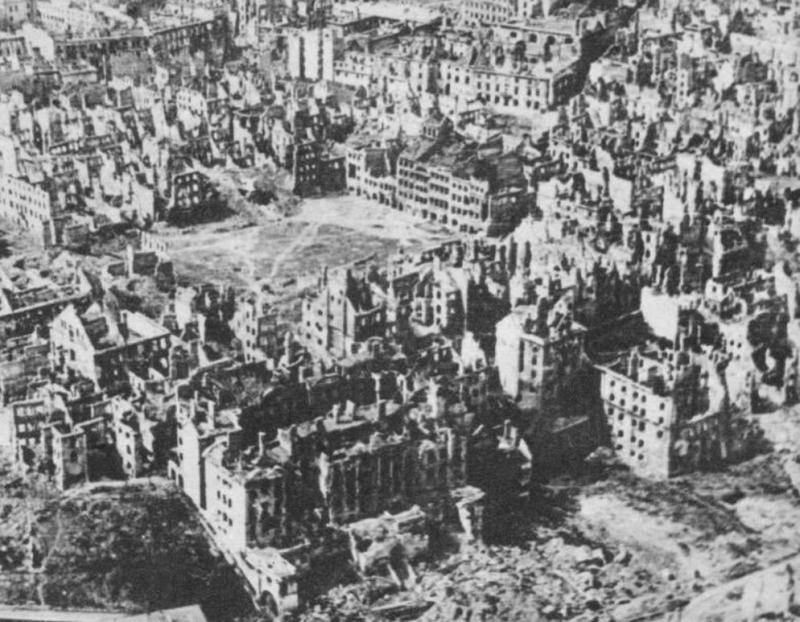
After the Polish resistance surrendered on October 2, 1944, German forces systematically razed and destroyed most of Warsaw
The losses caused by the uprising were not prevented in any way by the Red Army although its artillery and air force were stationed at hand. Stalin, for purely political reasons, allowed the destruction of the Poland’s capital city. According to propaganda messages, the Soviet forces did not have the necessary strength to counteract from the left-bank of Vistula. But meanwhile the Soviets found time and resources to create a terror apparatus to capture Polish soldiers from the Home Army who were tortured in the NKVD headquarters in Strzelecka or Władysław IV streets.
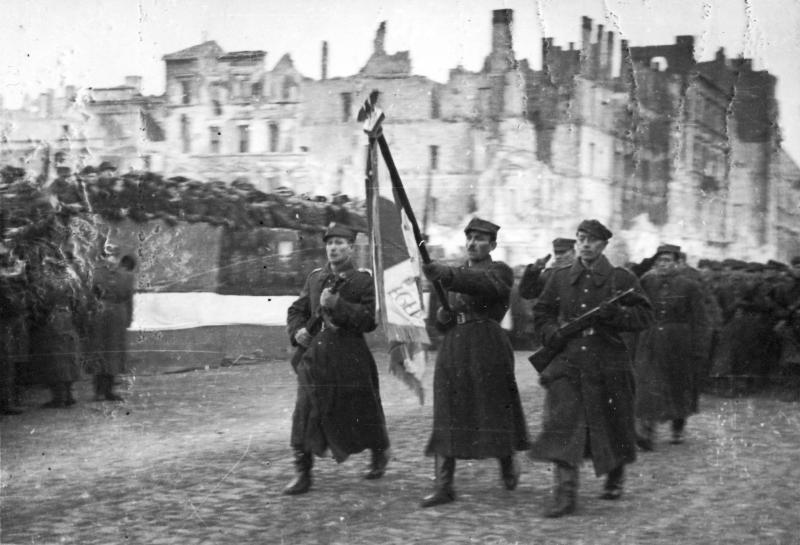
On January 12–14, 1945, Soviet and Polish allied forces resumed a massive offensive Troops from the 1st Belorussian Front and the 1st Polish Army entered the ruined city and took full control within three days on January 17, 1945 Years of occupation and final demolition reduced Warsaw's population from roughly 1.3 million before the war to a mere 150,000–162,000 survivors.
The capture, after the Germans were left undisturbed in order to destroy much of Warsaw, which allowed the Soviet Union to install a pro-communist Polish administration rather than restore the London-based Polish government-in-exile, leading to decades of communist rule.
Warsaw was ruined in 84% when the Red Army troops entered on 17 January 1945. The destruction was also a result of the Soviet’s indifference. Throughout the years of the People's Republic of Poland, this information was carefully censored. After the World War II, Warsaw had to put its homes on the altar of the Polish-Soviet friendship. In order to build the Stalin’s Palace of Culture and Science, 170 tenement houses were further demolished, and their inhabitants were relocated to the district of Muranów.
Code: 26397
90.00 GBP