
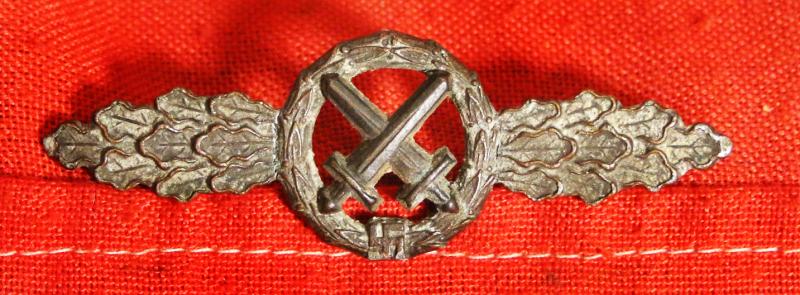
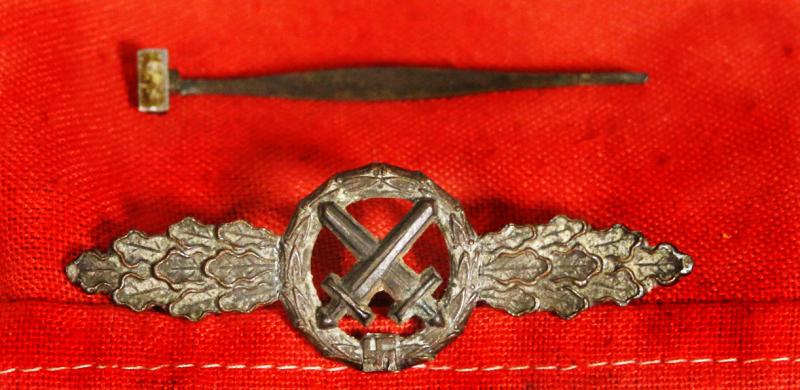
Most Rare, WW2 Issue, Frontflugspange für Schlachtflieger. The Luftwaffe Squadron Clasp for Air-to-Ground Support Pilots. Established by Reichmarshal Hermann Göring in 1944
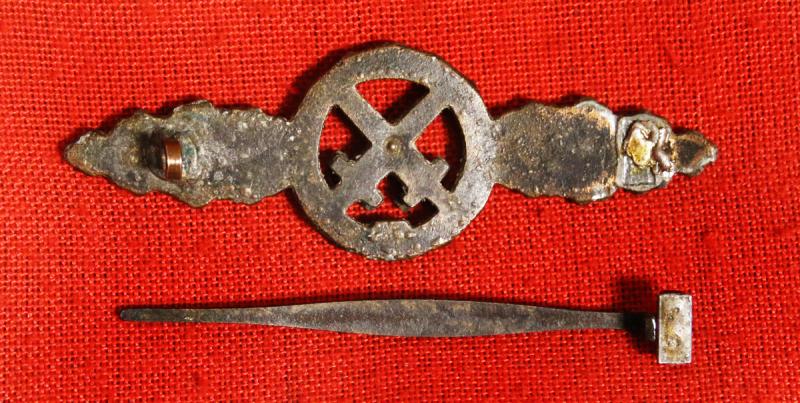
Silver grade, with single riveted centre. A most rare Frontflugspange fuer Schlachtflieger Front Flying Clasp for Heavy Fighters of the Luftwaffe, un-marked, late war zinc issue. Third Reich WWII military decoration award of Nazi Germany air force. Damaged. The pin is seperated from old repair, and a hair line crack by left oak leaf branch as it meets the wreath. However, priced accordingly. Due to their rarity, and being issued so late in the last year of the war 1944-45, they are one of the most collectable luftwaffe awards granted for combat missions specifically to Ground Attack pilots
Established in April 1944 as the war demanded specialized recognition for ground-attack units; prior to this, these aircrews received the general Front Flight Clasp with an inverted winged arrow.
Features a pair of crossed swords encircled by a laurel leaf wreath, set between stylized oak leaf wings with a swastika at the base.
• Bronze: Awarded for 20 operational flights.
• Silver: Awarded for 60 operational flights.
• Gold: Awarded for 110 operational flights (though baseline general clasps started gold at 110/100 depending on early/late criteria).
Hans-Ulrich Rudel: The most decorated German serviceman of World War II and the premier ground-attack pilot, credited with destroying over 500 tanks, a battleship, and hundreds of ground vehicles while flying over 2,000 combat missions in the Junkers Ju 87 Stuka and Focke-Wulf Fw 190
Alfred Druschel: A prominent ground-attack leader and commander within Schlachtgeschwader 1 (SG 1) and SG 4, who flew over 800 to 1,000 missions and earned the Knight's Cross with Oak Leaves and Swords before going missing in action on January 1, 1945.
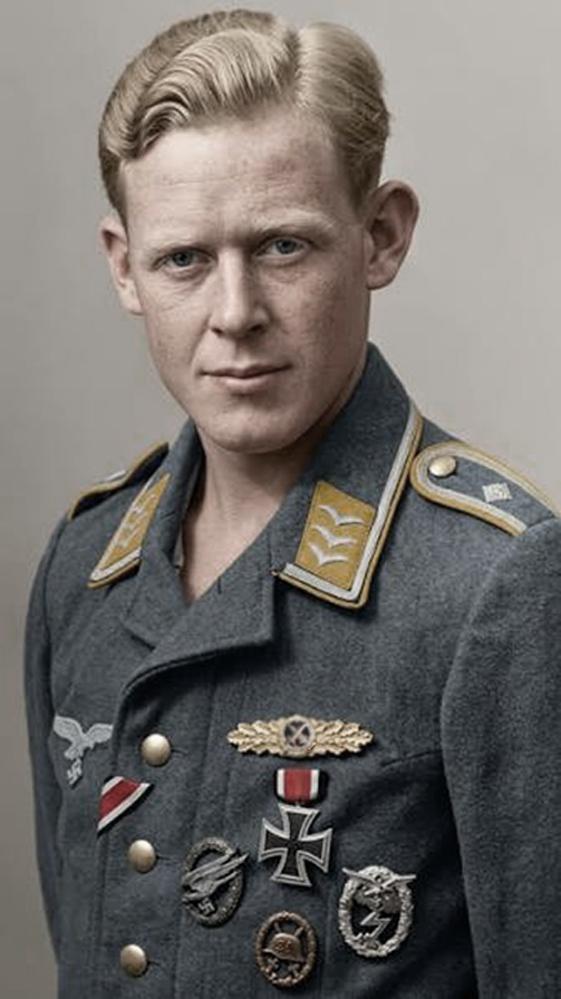
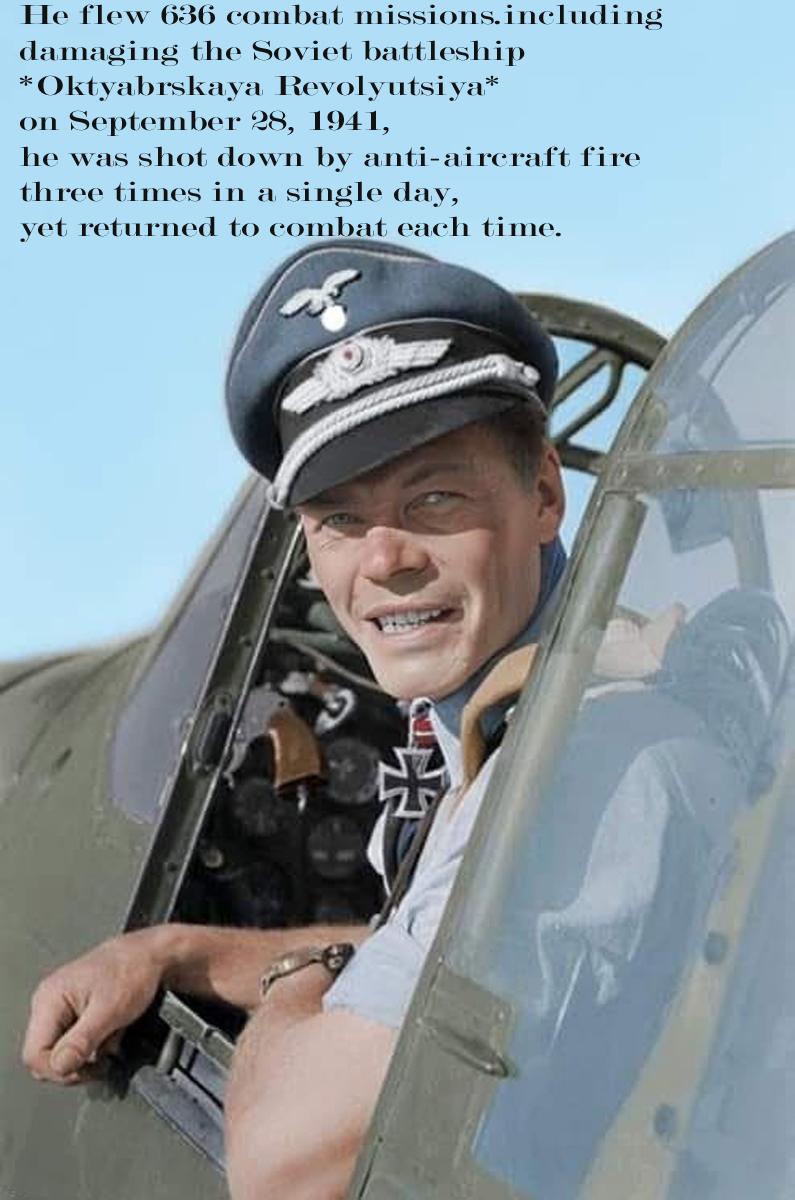
German Luftwaffe pilot and ground-attack aviation commander Dr. Ernst Kupfer. He flew 636 combat missions on the Eastern Front and in other major theatres, commanding Sturzkampfgeschwader 2 (StG 2) "Immelmann" during the Kuban bridgehead and Operation Citadel.
Primary Aircraft: Included the rugged biplane Henschel Hs 123, the twin-engine tank-buster Henschel Hs 129, the Junkers Ju 87 Stuka, and later ground-attack variants of the Focke-Wulf Fw 190
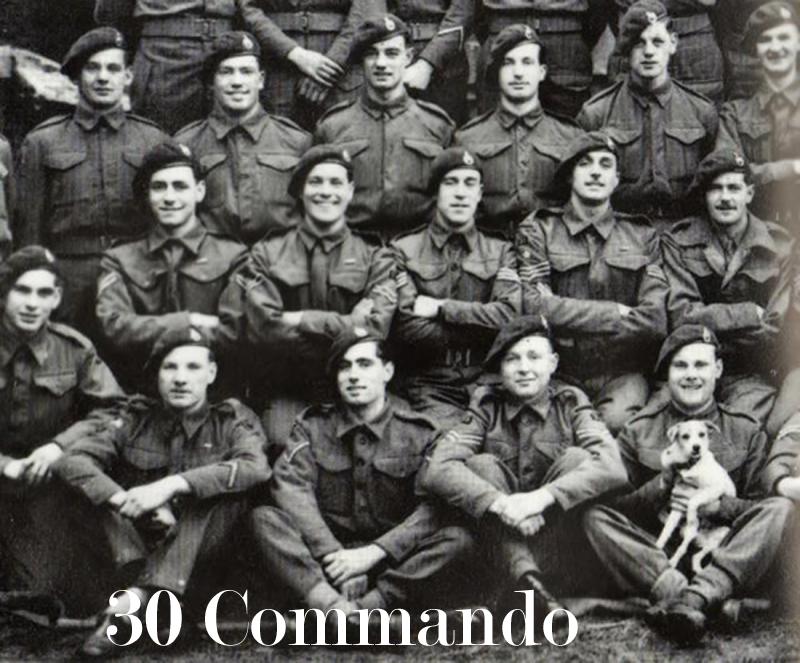
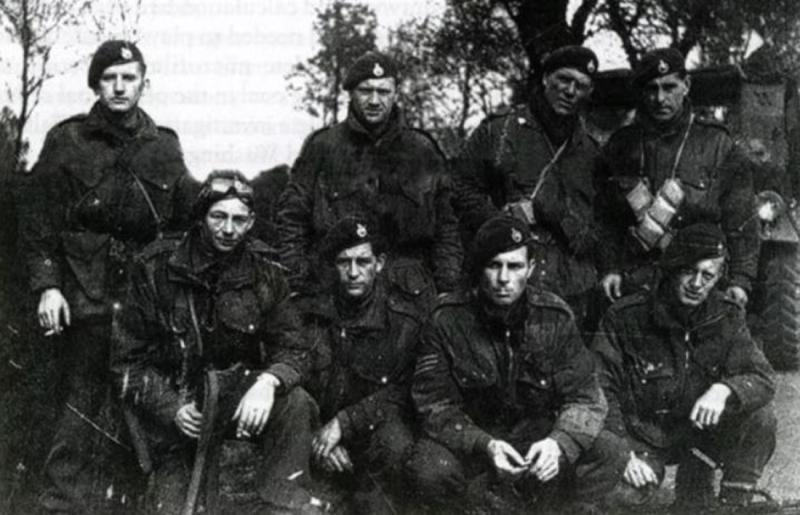
Originally taken by a commando of 30 commando X troop while on clandestine missions as part of 30 Commando reconnaissance and sabotage.
From a former special engineering unit {Ian Fleming’s so called ‘Red Indians} in wartime Europe were a vital part of clandestine warfare, and all parts of the units combat service were then trained in recognising enemy mines, booby traps, handling of explosives, demolitions, counter-demolitions, bomb disposal, and combined with recognition of enemy uniforms and equipment for intelligence gathering. Reporting all elements of their findings back to CoCO, and by them to the Admiralty. Fleming referred to such brave men as his ‘Red Indians’. see Casino Royale for reference.
The brain child of naval commander Ian Fleming & Lord Louis Mountbatten, 30 Commando, this wartime unit was a secret well kept for over 50 years after the war by the Official Secrets Act, some remains classified. At the time, officially, they didn’t exist. The members of this unit were forbidden to discuss or document their activities, a pledge that many of the men kept even many years after the war was over, or even for their entire lives!
Due to the fact these men operated in very small groups on ‘need-to-know’ basis it is very difficult to get clear picture of everything they were doing.
Fleming’s/NID30AU secretary Miss Margaret Priestley (a history professor from Leeds University) played a vital role in the running and administration of 30AU and became his inspiration for Miss Petty Pettaval - the original character name that became Miss Moneypenny.
As revealed here for the first time! (see Beau Bête)
Miss Preistley transferred over to NID30AU during the winter of 1943-44 from DNR - (Department of Naval Research) where she worked as a civilian, although there were obvious links between DNR and NID30AU as intelligence on enemy targets was collected for Fleming’s ‘Black List’.
Also Known as: Fleming's 'Red Indians'
Fleming himself referred to the men of the unit as behaving like 'Red Indians'. (A reference he also used when referring to his character, James Bond, four times in his first novel Casino Royale. Which effectively makes this unit the ‘literary James Bond’s wartime unit’.)
Formerly:- (NID30 Command Office at Admiralty),
Special Engineering Unit.
'RED' Marines.
Latterly:- 30 Assault Unit,
30 Advanced Unit, 30AU
and incorrectly as 30th Assault Unit.
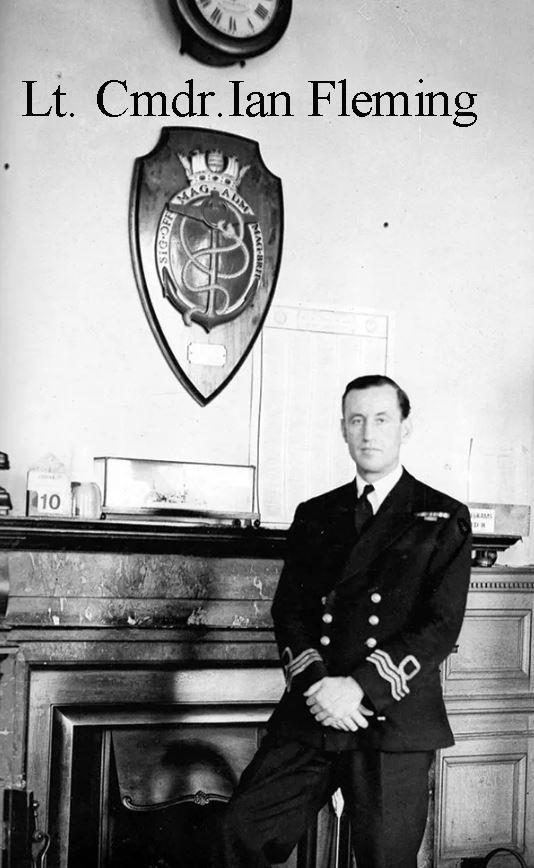
The number '30' was used for no better reason than it was NID/Miss Priestley’s Office Door number at the Admiralty. (Fleming’s Office was No. 39, see photo in the gallery of Fleming in room 39 of the Admiralty) 'Assault Unit' was 'overt' cover for the fact that they were intelligence gathering.
Date Founded: 30 September 1942
Date Disbanded: 26 March 1946
Date Reformed: February 2010 - 30 Cdo IXG
Mission When Founded:
The collection of technical intelligence and personnel from enemy headquarters and installations. Ahead of allied advances and before enemy could destroy it, to ‘Attain by Surprise’.
30 Commando consisted of Royal Marine, Army and Royal Navy elements that were organised into three Sections: No. 33, No. 34 and No.36 respectively. Initially code-named the Special Engineering Unit, the unit reported to the Chief of Combined Operations, though the Admiralty retained ultimate control of No.36 Section. No.35 Section was left vacant for the RAF to utilise but they never raised a troop to participate in 30 Cdo. Although they did supply intelligence officers and specific targets to pursue after D-Day for ‘Operation Crossbow’.
Unit members were given general commando skills and weapons training, and were then trained in recognising enemy mines, booby traps, handling of explosives, demolitions, counter-demolitions, recognition of enemy uniforms and equipment. Parachute training, small boat handling, recognition of enemy documents, search techniques including lock picking and safecracking, prisoner handling, photography and escape techniques were also taught.
A significant number of the initial recruits were formerly policemen. Although at least one ‘expert’ was recruited straight from prison, thought by the police to be the best safe-breaker in England at the time.
30 Cdo’s operational tactic was to move ahead of advancing Allied forces, or to undertake covert missions into enemy territory by land, sea or air, to capture intelligence, in the form of equipment, documents, codes or enemy personnel. 30 Cdo often worked closely with the Intelligence Corps' Field Security sections. More often than not each team consisted of two special operations Jeeps (As used by the SAS and 30AU) manned by one Naval Commander in possession of a ‘Black Book’ which listed targets from Ian Fleming’s famous ‘Black List’. The Naval Commander was the only man in each team who knew where and what the targets actually were. This Naval Commander was usually accompanied by at least one weapons expert or scientist who he relied on to evaluate the information or equipment they encountered. There were also usually at least six Royal Marines and one RM Officer whose main job was to do any fighting required and to keep the Naval Commander and any experts alive and out of trouble. (For details Reading section.)
The individual Sections served in all the Mediterranean and NW European operational theatres, usually operating independently, gathering information from captured facilities. The unit served in North Africa, the Greek Islands, Norway, Pantelleria, Sicily, Italy, and Corsica, 1942-1943 as 30 Commando.
As the Allies broke through 30AU split into many ‘Field Teams’ and these were responsible for capturing many and varied targets throughout Germany.
Team 2 under Curtis captured Prof. Helmut Walter, designer of the Me163 Rocket Plane and Midget Submarines at Kiel. (Kept by the British!).
Team 5 under USN Lambie captured Prof. Herbert Wagner (Handed to US Agents) designer of the guided flying bomb Hs293, already used to sink HMS Egret and to kill over 1000 troops on HMT Rohna. He went on to work for the US Navy. He did not surrender in Bavaria with Dornberger and the von Braun brothers as the Allied military would have us believe..
The capture of Prof. Magnus von Braun (Martin) V2 fuel chemist. (Handed to US Agents). He did not surrender in Bavaria as the Allied military want us to believe.
The capture of the designer of the Nazi V2 (who went on to the NASA Saturn V), Prof. von Braun and his brother. (Some men were convinced they were some of the scientists they caught!) Did they surrender in Bavaria as the Allied military want us to believe or was that staged afterwards? (see Beau Bête for details and FREE preview PDF, in Reading)
Team 55 under Glanville captured the entire Nazi Naval records collection at ‘Tambach Castle’.
Team 4 under Job(e) captured the Bremen dockyards with type 21; 25 submarines and destroyers. Then took the surrender of Bremerhaven and captured Naval HQ SS Europa and Z29 Destroyer. (All handed over to US Agents).
Team 2 Postlethwaite captures the Torpedo testing facility at Ekenförde.
Another team captured Admiral Dönitz (as Führer).
Portrait photo of German Luftwaffe pilot and ground-attack aviation commander Dr. Ernst Kupfer in the cockpit of his fighter.
Code: 26382
475.00 GBP