
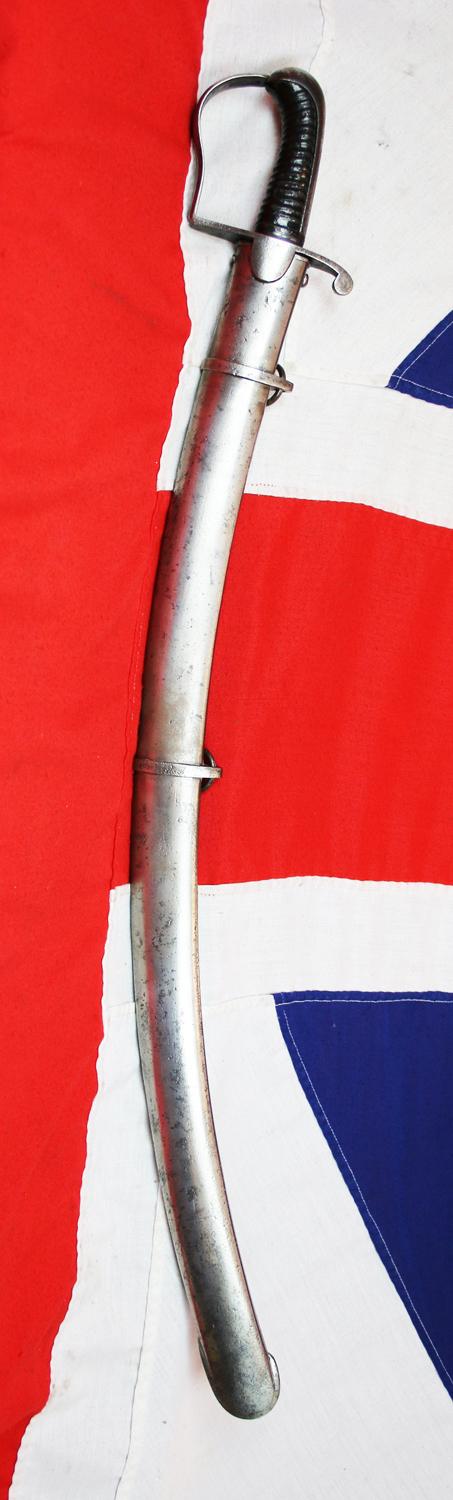
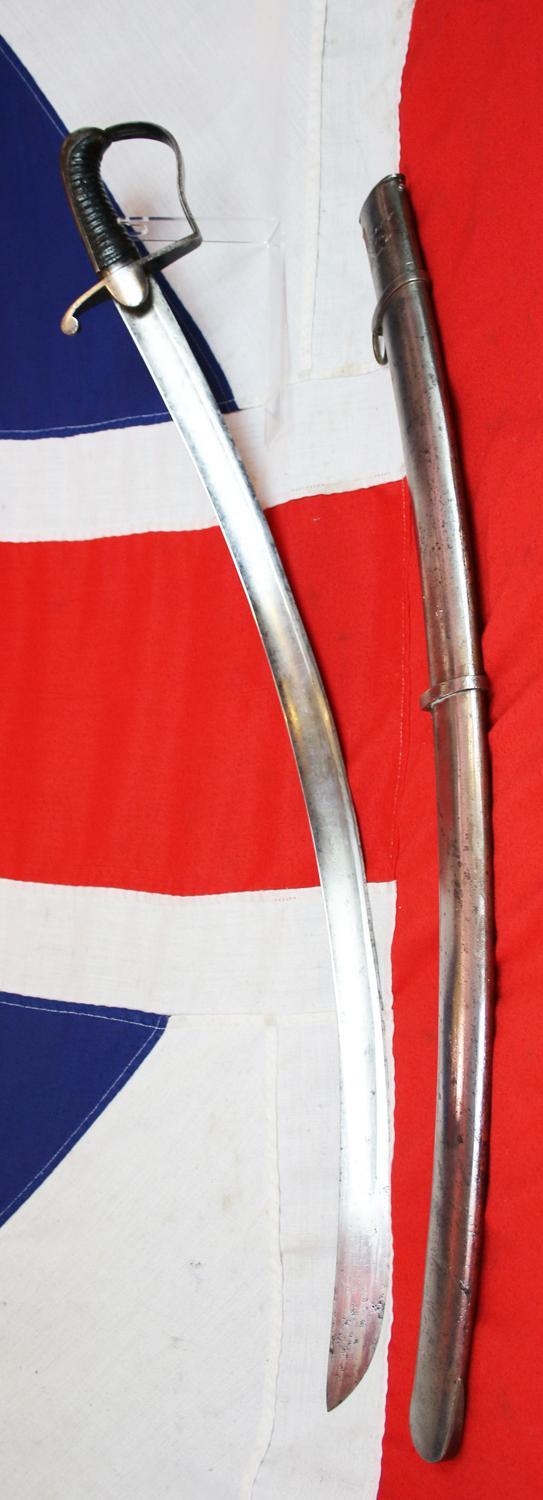
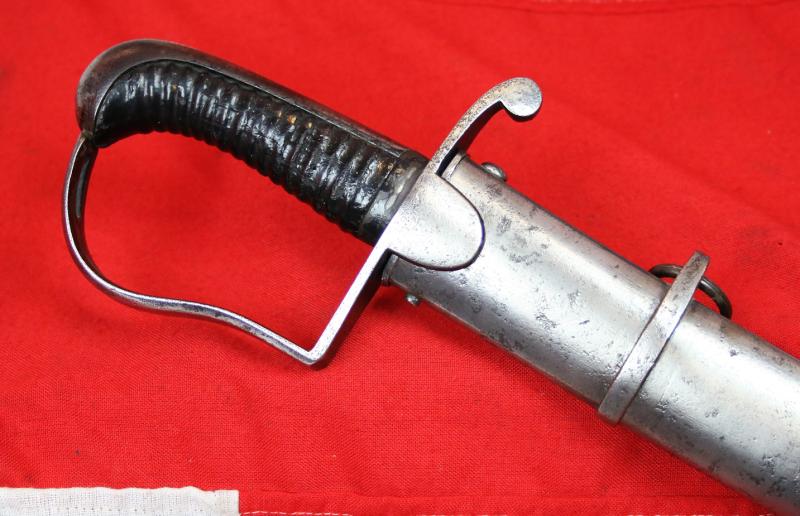
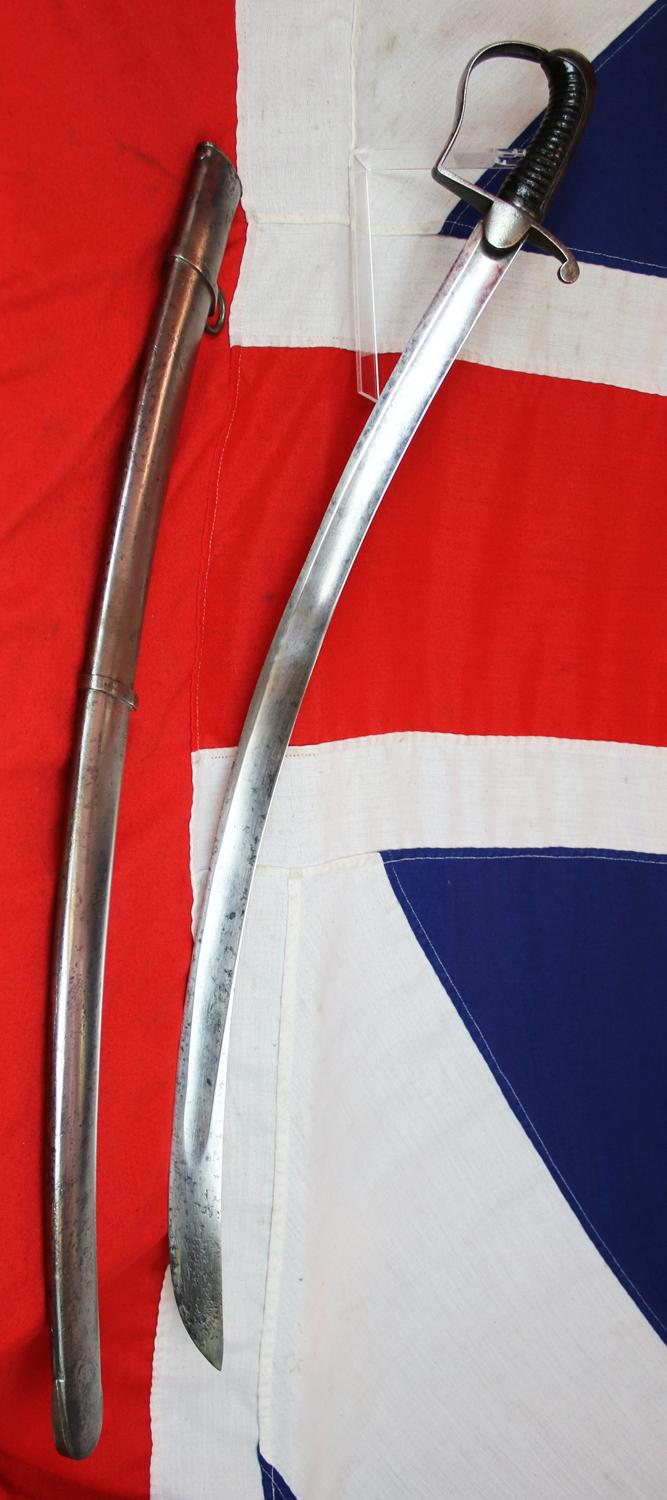
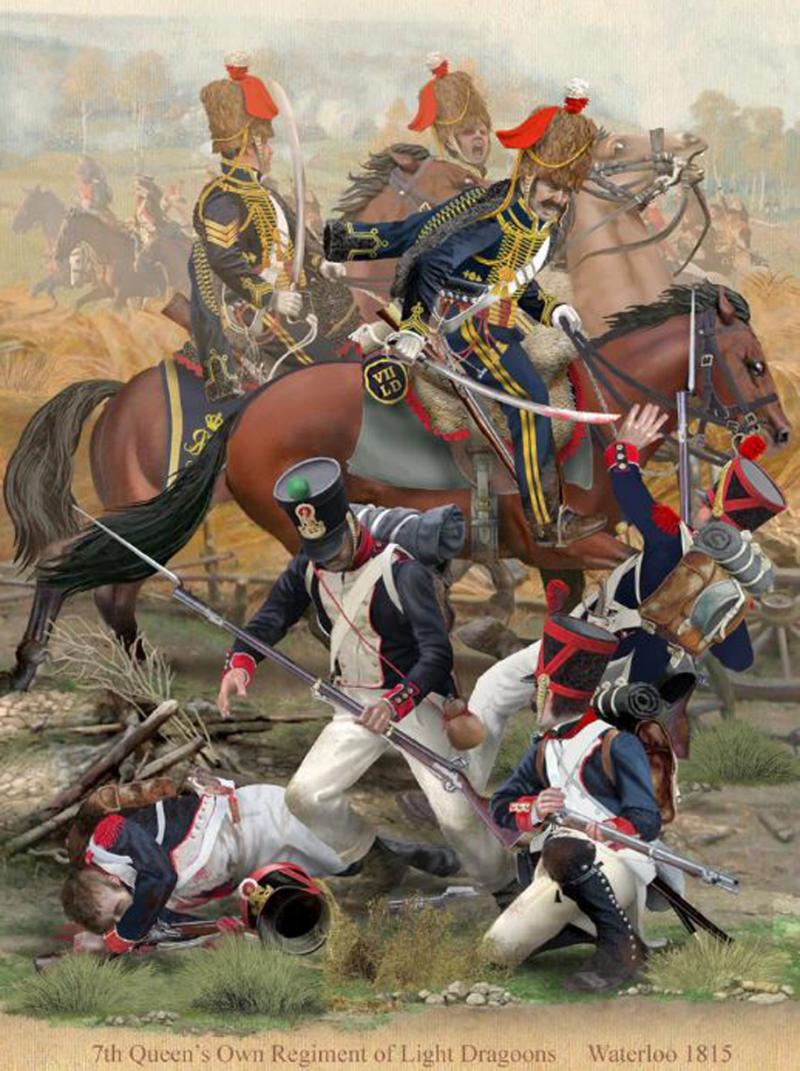
A Very Good Peninsular War and Battle of Waterloo Use British Napoleonic Regulation, Ordnance, Front Line Rank Issue, 1796 Light Dragoon Trooper's Sabre by Wooley & Co. An Ordnance Supply Contractor from the 18th and early 19th Century
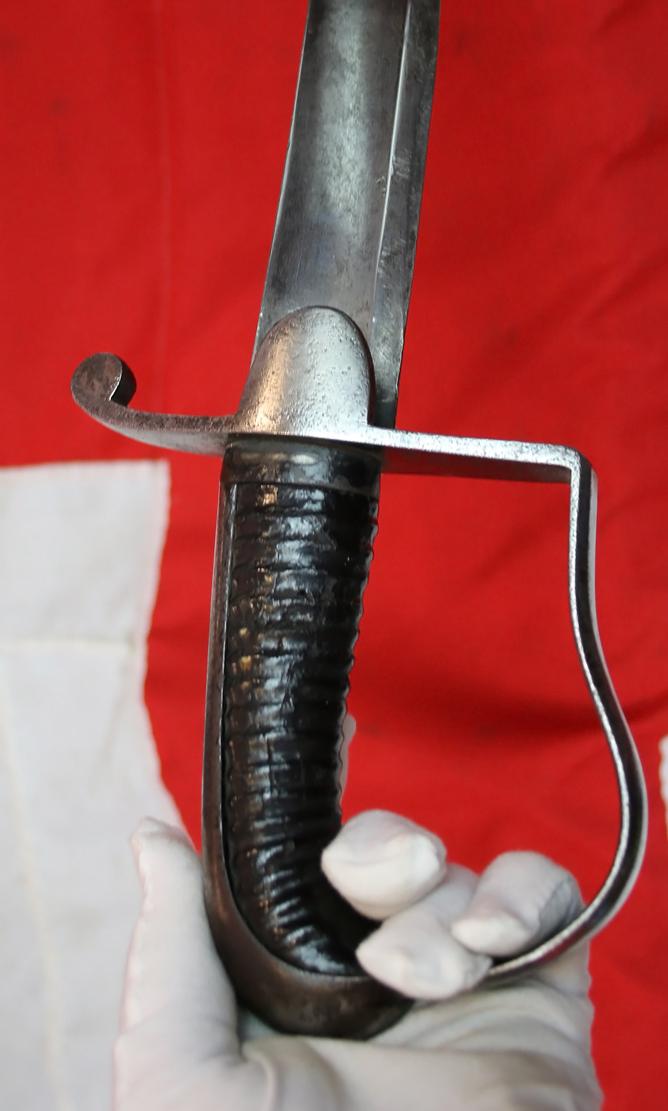
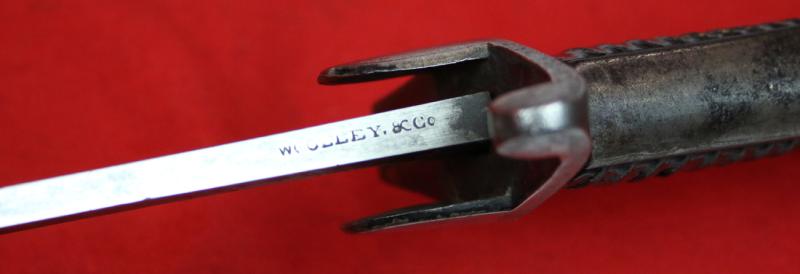
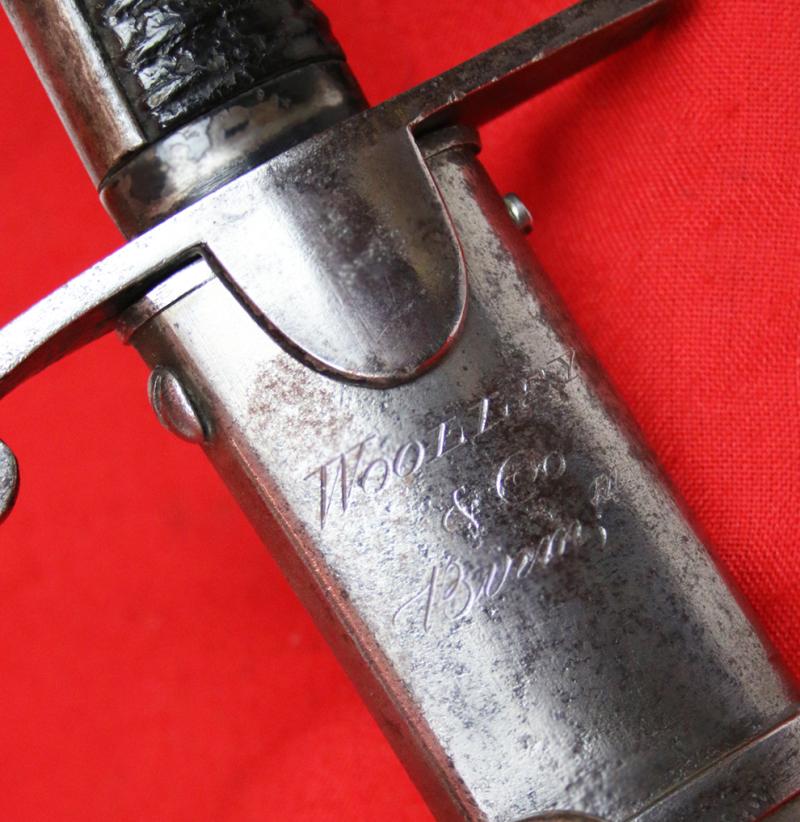
All steel, original issue matching scabbard, with steel P hilt and leather bound grip, maker engaved at the top near the throat. The blade is very good indeed, and nicely bright overall, and with the ordnance maker's Wooley stamp on the blade spine. Overall very nice condition for age, it has obviously seen combat service, but it has been cared for very well since it left service over 200 years ago
The mounted swordsmanship training of the British emphasised the cut, at the face for maiming or killing, or at the arms to disable. This left masses of mutilated or disabled troops; the French, in contrast, favoured the thrust, which gave cleaner kills. A cut with the 1796 LC sabre was, however, perfectly capable of killing outright, as was recorded by George Farmer of the 11th Regiment of Light Dragoons, who was involved in a skirmish on the Guadiana River in 1811, during the Peninsular War:
"Just then a French officer stooping over the body of one of his countrymen, who dropped the instant on his horse's neck, delivered a thrust at poor Harry Wilson's body; and delivered it effectually. I firmly believe that Wilson died on the instant yet, though he felt the sword in its progress, he, with characteristic self-command, kept his eye on the enemy in his front; and, raising himself in his stirrups, let fall upon the Frenchman's head such a blow, that brass and skull parted before it, and the man's head was cloven asunder to the chin. It was the most tremendous blow I ever beheld struck; and both he who gave, and his opponent who received it, dropped dead together. The brass helmet was afterwards examined by order of a French officer, who, as well as myself, was astonished at the exploit; and the cut was found to be as clean as if the sword had gone through a turnip, not so much as a dint being left on either side of it"
The blade is remembered today as one of the best of its time and has been described as the finest cutting sword ever manufactured in quantity. Remarkably, this sword still has its original wooden scabbard liner.
For example of the type regiment that would have used this sword we give an example from the 10th Light Dragoons / Hussars
The regiment action at the Battle of Sahagún in December 1808 and the Battle of Benavente later in December 1808 during the Peninsular War. At Benavente the regiment captured General Charles Lefebvre-Desnouettes, the French cavalry commander. The regiment then took part in the Battle of Corunna in January 1809 before returning to England.
In 1813, having landed once more in Spain, the regiment fought at the Battle of Morales in June 1813. During the battle the regiment destroyed the 16th French Dragoons between Toro and Zamora, taking around 260 prisoners. The regiment also fought at the Battle of Vitoria later in the month while still in Spain and then, having advanced into France, fought at the Battle of Orthez in February 1814 and the Battle of Toulouse in April 1814. As part of the 6th Cavalry Brigade, the regiment charged the French cavalry and infantry at the Battle of Waterloo in June 1815.
The night of the 17th/18th June 1815 is well known for being extremely wet, so that the men had to mount up with wet clothes and march through boggy ground. The 6th Brigade was placed on the extreme left of the whole army. Vivian requested the 10th to supply a reconnaissance party which was ordered to locate the advance parties of the Prussians, This party, under Major Thomas Taylor, reached as far as Ohain, and met with a Prussian patrol and discovered that General Bülow was at St Lambert. Back at the battlefield, the French began their advance, and Hougoumont came under attack at 11.30am. Vandeleur’s brigade of Light Dragoons were on the right of Vivian’s regiments, and they, together with the 10th Hussars were positioned to confront the French troops. Meanwhile the heavy cavalry were sent in to charge against enemy cavalry and infantry. Ponsonby’s Union Brigade found themselves in difficulties when they were charged by Lancers and Chasseurs, so the 12th and 16th Light Dragoons of Vandeleur’s Brigade dashed through a column of French infantry to attack the left flank of the Lancers and forced them to withdraw.
The 10th and 18th Hussars who for several hours had withstood the French artillery barrage were ordered to move to the right along a hollow way but did not go into action at this stage. During the late afternoon, Vivian’s Brigade moved further to the right. As they took up a new position Colonel Quentin was wounded in the ankle, and his place taken by Lord Robert Manners.
The brigade were drawn up behind infantry units of Brunswick and Nassau which were wavering. The Nassau troops fell back so that they were almost touching the heads of the 10th’s horses. Due to strong encouragement and persuasion these German soldiers were discouraged from further retreat. Vivian then ordered the KGL forward to link up with the Hanoverians and other German allies. This gave heart to the faltering men of Nassau and a forward movement took place. The 10th followed in support but were unable to attack as cavalry should, so were vulnerable to enemy musketry. They sustained many injuries including three officers.The brigade cantered forward with the 10th Hussars leading. As they passed Vandeleur’s Light Dragoons and Maitland’s brigade of Guards, they were cheered on. Vivian saw masses of French troops on the left of La Belle Alliance and decided to concentrate the attack there. The 10th were ordered to incline to the right and the 18th and KGL to support them. The squadrons formed line and charged in echelon so that the right squadron under Major the Hon Frederick Howard, were first in action. The force of their charge pushed the French back and sent them off in all directions so that as the other squadrons came up they pursued fleeing troops. Vivian, having seen how the Scots Greys had charged too far, earlier in the day, called a halt and rally.
The Tenth, having been ordered to halt, came under attack from cuirassiers. Howard’s squadron bore the brunt of the attack but could not be supported by the other two squadrons as they failed to hear the order to halt and carried on with their pursuit under the command of Lt-Col Manners. Vivian caught up with Howard who, it seems, had beaten off the cuirassiers, and ordered the squadron to charge a square formed by the Grenadiers of the Guard. This was a forlorn hope as the French Grenadiers were seasoned troops and well able to fend off the attack with a wall of bayonets. It was supposed to be a coordinated attack together with a unit of infantry but the infantry commander declined to cooperate. According to Captain Taylor, Howard consulted with him about the proposed attack and Taylor advised against it. ‘Major Howard said that having been ordered to attack he thought it a ticklish thing not to do it, and gave the order accordingly.’ Major Howard was killed in this action, shot through the mouth and having his head beaten with a rifle butt. With two other officers wounded (Lieuts Arnold and Bacon), and another killed (George Gunning), the squadron was extricated by Cornet William Hamilton. There is no mention of whether Captain Taylor took part. Even though the attack failed, the enemy square was forced to fall back as part of a general retreat.
Final Charge of the 10th
Meanwhile the two pursuing squadrons continued to a point southeast of Hougoumont, driving back cuirassiers. They then came upon the enemy infantry in retreat and recognised men of the Imperial Guard in their tall bearskins who covered the retreat by forming a defensive position. They fired on the squadrons, so Manners halted the men at a distance of 40 paces, formed the men into line and sounded the charge. The impact of the 10th against the French defence was too great and the veterans of the Imperial Guard were forced to give way. Vandeleur saw what was happening and brought his brigade to support the right flank of Vivien’s men. The infantry of Adam’s Brigade, on the left of the Tenth, made great progress and were soon led by Wellington himself to put the final nail in the French Army’s coffin. Napoleon quit the field and his army was in full retreat. Adams’s men were halted at La Belle Alliance, Vandeleur’s Brigade bivouacked at the woods of Cellois. But Vivien’s Brigade were led some distance further, to Hilaincourt.
The last photo in the gallery shows a photograph of one section of the collection in the museum of Waterloo, taken in around 1900, showing all the weapons of Waterloo en situ, including all the protagonists {British, French, Prussian and Belgian muskets, swords, pistols, armour uniforms, etc}. The museum was founded and owned by a veteran of the 7th Hussars that fought at Waterloo.
Code: 26319
1795.00 GBP