
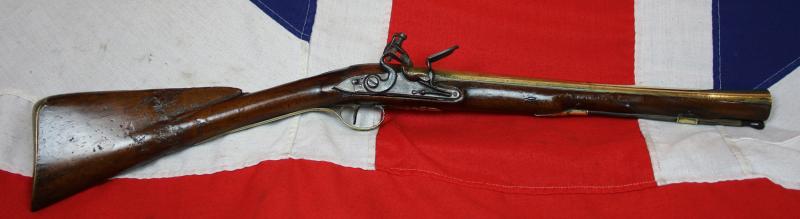
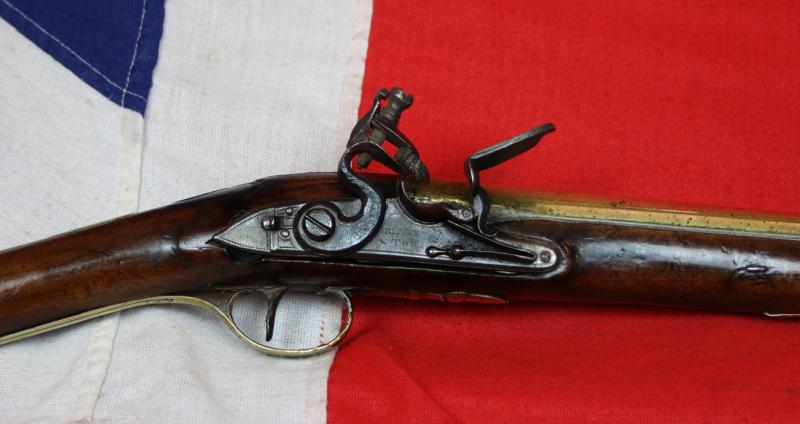
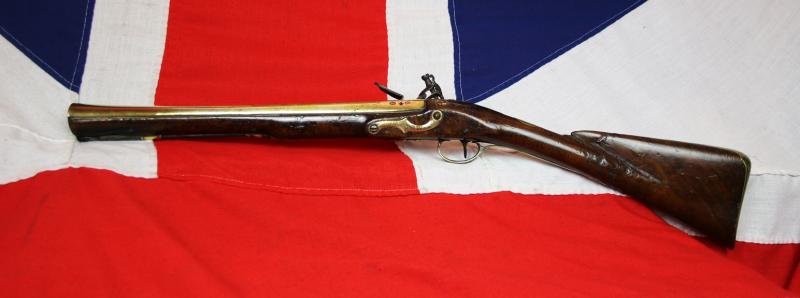
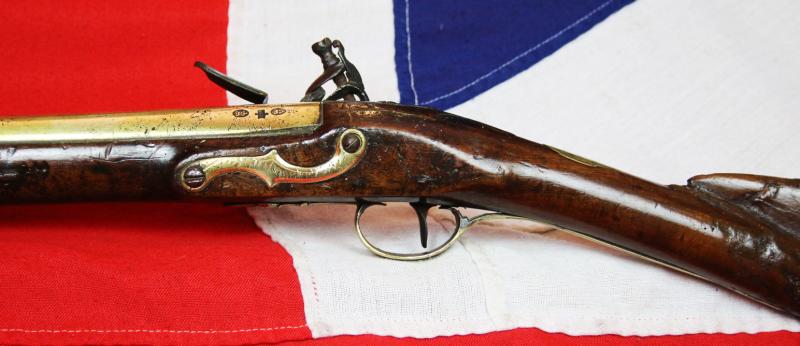
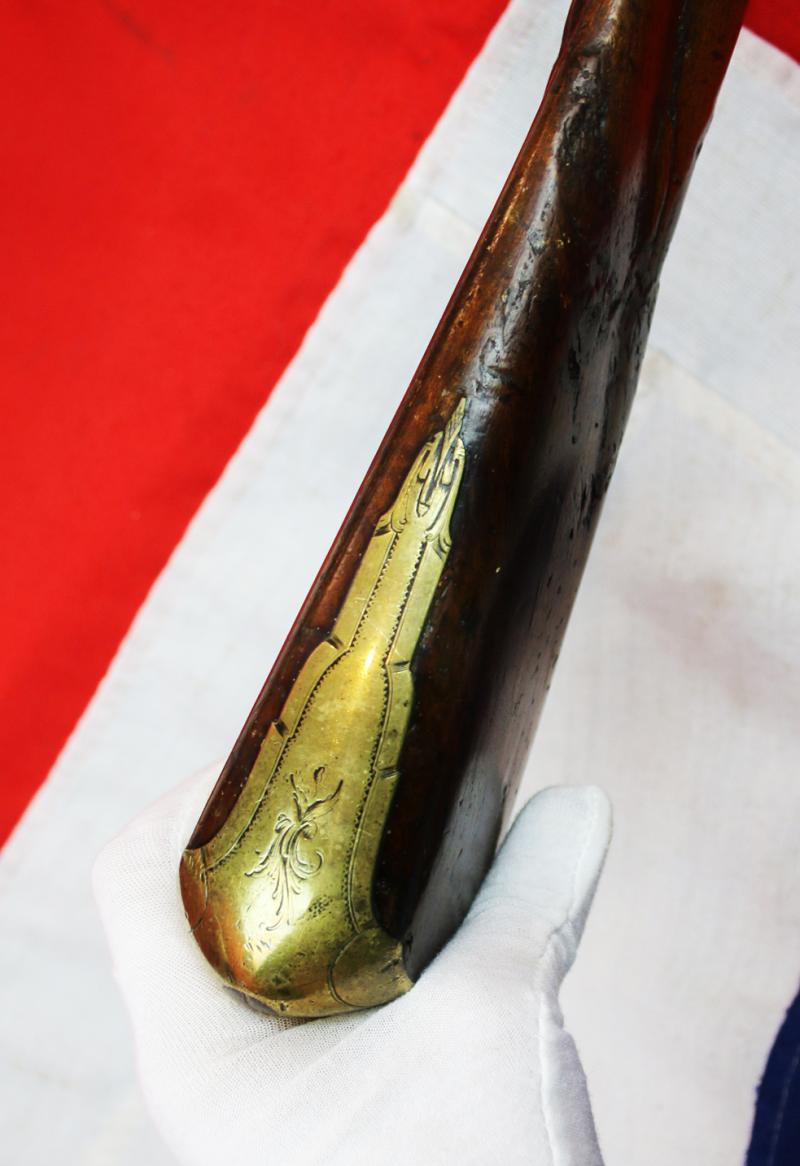
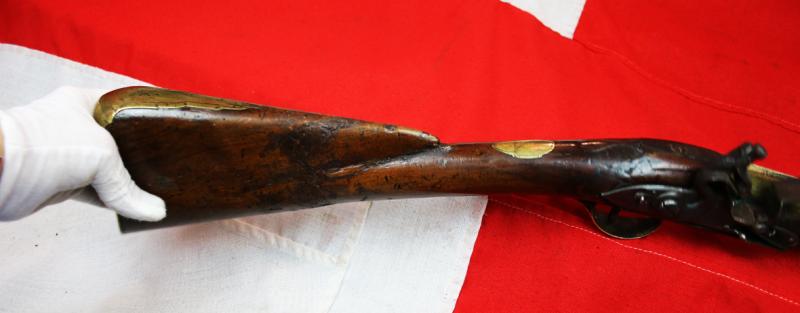
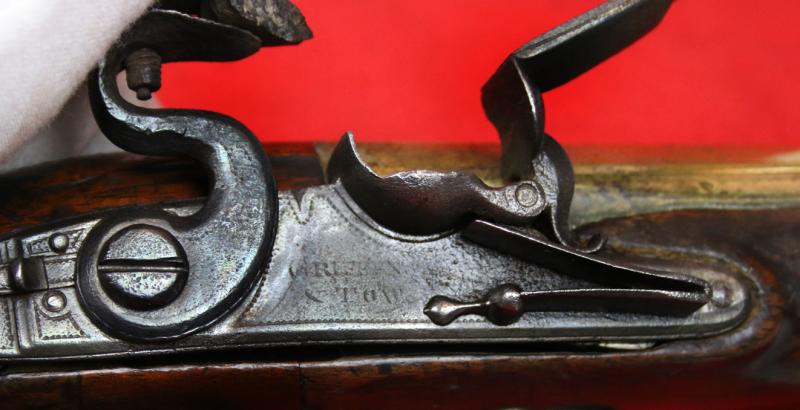
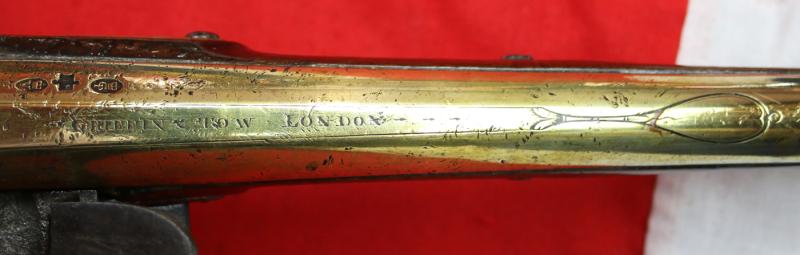
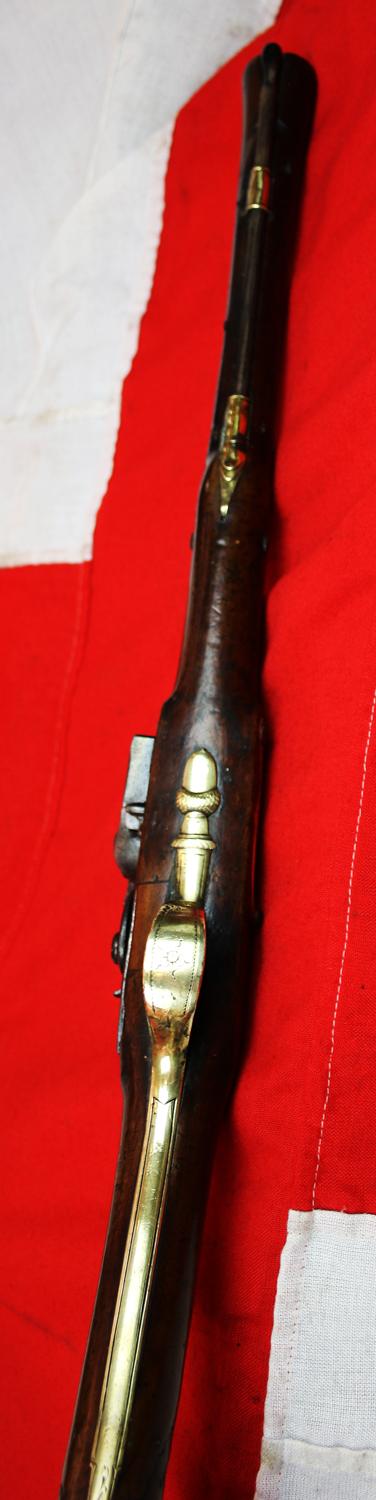
A Fine 18th Century Historic Blunderbuss With Brass Flared Mouth Barrel, Fine Walnut Stock and Engraved Brass Furniture. By Griffin and Tow London Circa 1775. One Of England's Great Gunsmith Partnerships
Joseph Griffin opened his business in 1739 in Bond Street London, and went into partnership with Tow in 1773 to form the well known gunmakers Griffin and Tow.
This is an incredible brass barreled blunderbuss, of great age, around 250 years old, and with immense character. It has clearly seen combat service and use, but it is now just so beautiful still as an original artifact of the American Revolutionary War period, by one of the great gun partnerships in Georgian England. It has accumulated fabulous patination on the both the stock and barrel through the centuries of cleaning and polishing, interspersed with close combat use in the war, in fact, probably several wars, and potentially dozens of battles, either at sea, or on land, in its working life of around 80 years.
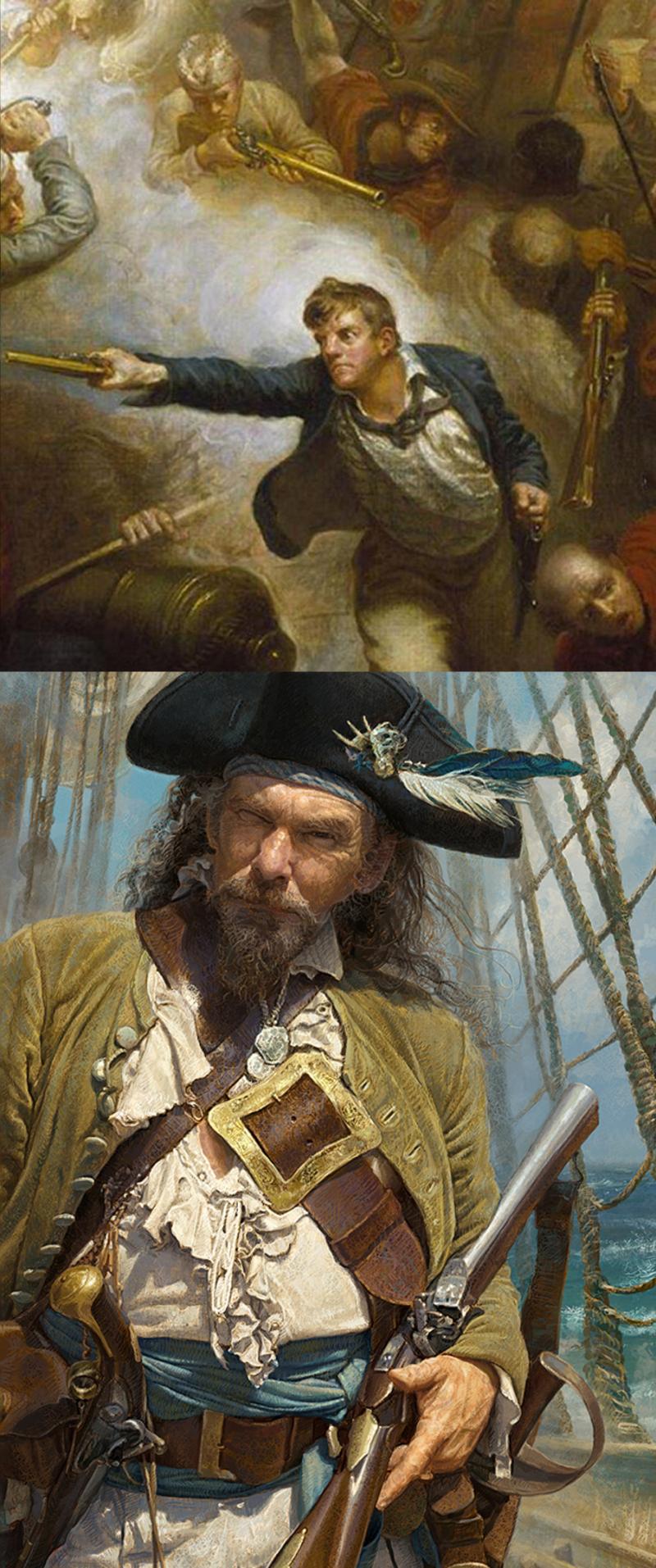
During this use period it has had close quarter combat injury, likely caused by its use as a club, after its load was discharged and their was no time for re-loading. It is around the stock, at the butt, and it has seen a typical, contemporary 'field service' combat repair, probably by the ship's carpenter, that has actually acquired its own age patination, through constant polishing. The barrel is excellent, with Joseph Griffin's own proof stamp, between the regular proof-house stamps, with numerous very small combat service markings, likely from sword or cutlass impacts. If you observe picture 10 in the gallery, you will note at the top portion of the painting, a sailor about to fire his brass barrel blunderbuss into the boarding enemy, and that sailor is using his blunderbuss as a club, holding the barrel as its handle.
In the 18th century, naval forces, privateers, and pirates used the blunderbuss as a short-range, large-bore combat weapon designed primarily for chaotic close-quarters boarding actions.
Naval blunderbusses often featured brass barrels instead of iron or steel because brass resisted corrosion and was practically impervious to salty sea spray.
The iconic trumpet-shaped muzzle was not actually designed to scatter shot widely, but rather to act as a built-in funnel for quickly pouring in black powder and lead balls while on a rolling ship deck.
While military loads typically used lead balls, swan shot (large pellets), or iron slugs, sailors could improvise by loading with rock salt for psychological effect without the likely-hood of fatal injury being inflicted
For use as boarding weapons they were ssued to naval officers, marines, and pirate crews, standard shoulder-stock blunderbusses easily cleared enemy decks during intense close-quarters fighting.
The Blunderbuss (born of the Dutch word "Donderbus", appropriately meaning "Thunder Pipe" or "Thunder Gun") came to prominence in the early part of the 18th Century (1701-1800) and was more akin to the modern day shotgun than a "long gun" musket or heavy pistol of the time. As such, she excelled in close-in fighting, be it within the confines of naval warfare or walled nature of the urban environment, where her spread of shot could inflict maximum damage to targets at close ranges. Its manageable size, coupled with its spread shot, ensured some level of accuracy for even the novice user and its appearance was rather intimidating to those unfortunate enough to be staring down the business end. As with modern firearms, the Blunderbuss also made for an excellent security-minded weapon and soon found popularity amongst all matter of operators - military, civilian and, of course, criminal parties - by the middle of the 1700s. Even George Washington championed the Blunderbuss for Continental Army "Dragoon" units of the burgeoning American military as opposed to the carbine this being nothing more than a full-featured long gun of lesser overall length, proving suitable for horse-mounted handling. In fact, the short-form version of the Blunderbuss came to be known as the "Dragon", giving rise to the term "Dragoon" for such gun-wielding cavalrymen. Dragoons went on to form specialized units of mounted infantrymen within their respective armies during the end of the 17th Century and into the middle of the 18th Century - in a way, becoming an evolutionary step of the fabled mounted knight of the Middle Ages. Their use of Dragons soon gave way to the widely-accepted carbine musket. The Blunderbuss was also known as the "Blunderbess" As with all our antique guns no license is required as they are all unrestricted antique collectables
Griffin and Tow was a prominent 18th-century London gunmaking partnership renowned for crafting high-quality flintlock sporting guns, officers' pistols, and blunderbusses.
Joseph Griffin began his independent gunmaking career in 1739 on Bond Street, London. He worked alongside his father until 1770 and built a strong reputation for producing exceptional flintlock firearms. Joseph Griffin entered into a partnership with an individual named Tow in 1773, officially establishing the firm Griffin and Tow.
The business operated out of London during the height of Georgian flintlock craftsmanship, active through the late 18th century (roughly spanning the 1740–1790 era when including Griffin's individual work before the partnership).
They specialized in fine flintlock weapons, including double-barrelled sporting shotguns, private officer pistols, and brass-barreled muzzleloading blunderbusses.
Surviving pieces from the firm, in the great museum collections today—often featuring intricately engraved brass or steel, and walnut stocks and are highly valued collector's items today.
Their operational history and specific surviving serial/named pieces were meticulously cataloged in the seminal 1989 text British Gunmakers: Messrs. Griffin and Tow and W. Bailes, 1740-1790 by W. Keith Neal and D.H.L. Back
Code: 26310
3350.00 GBP