
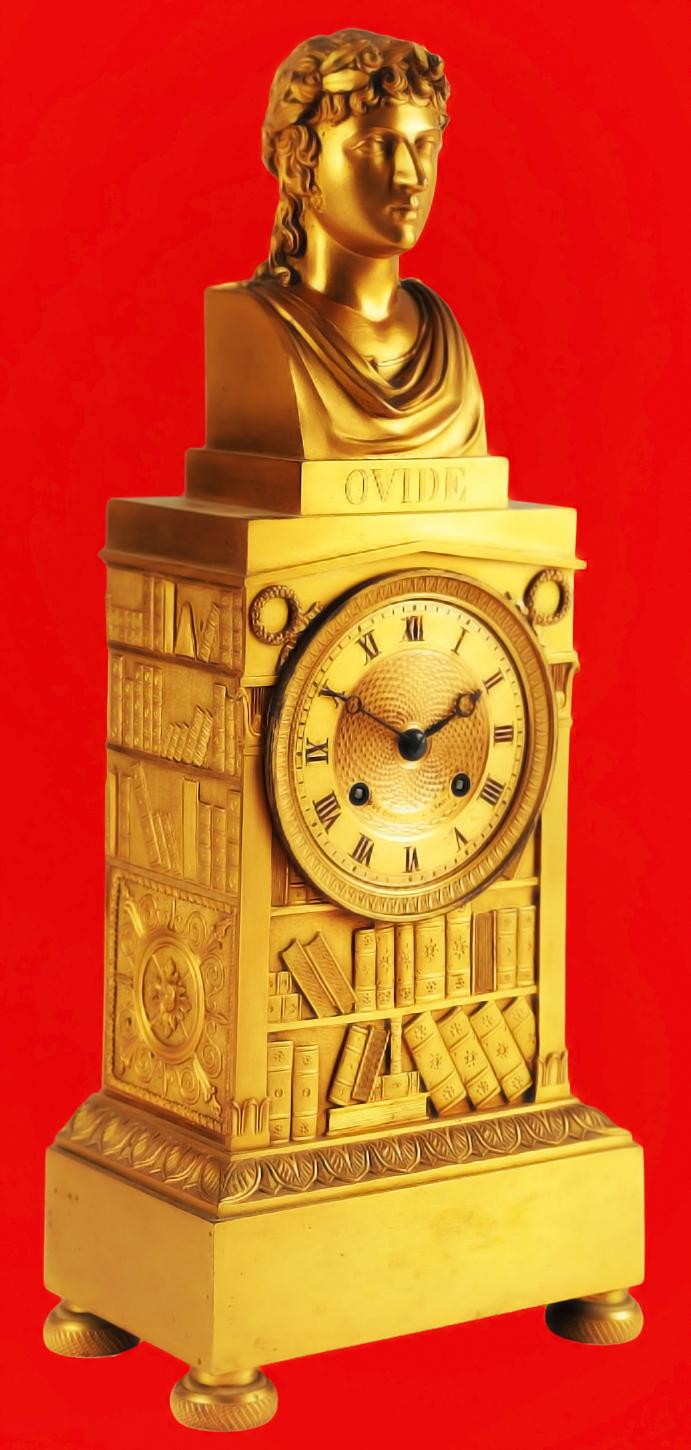
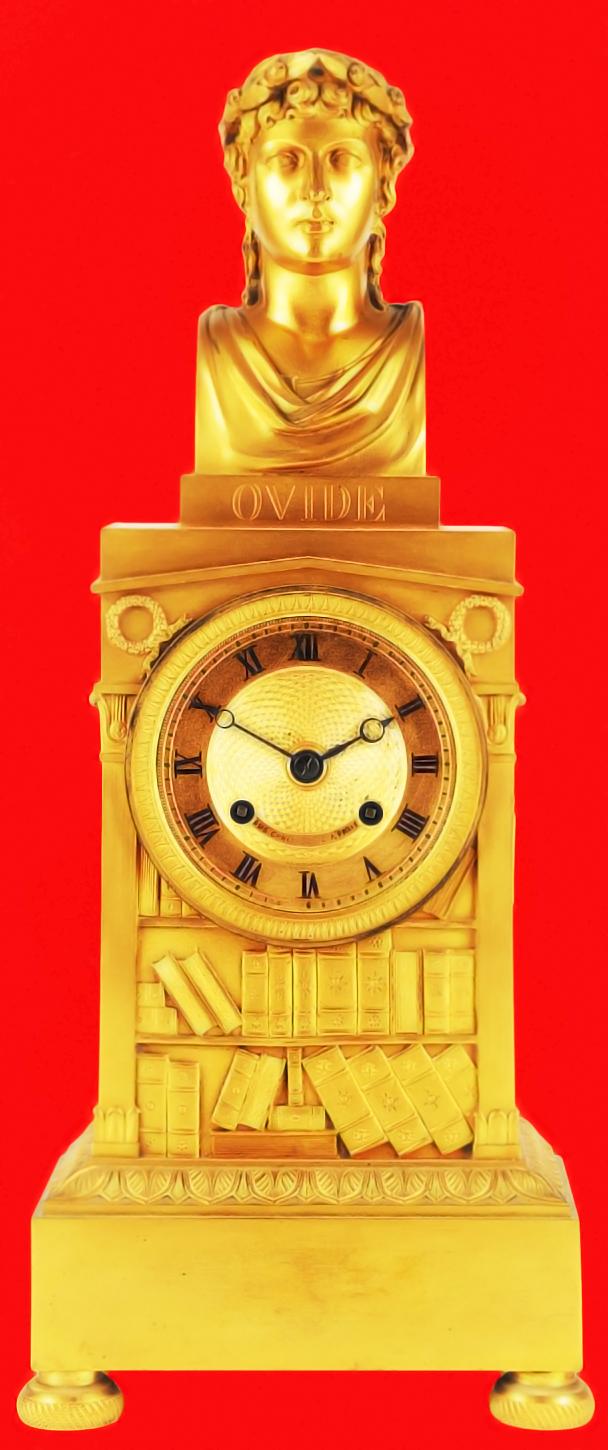
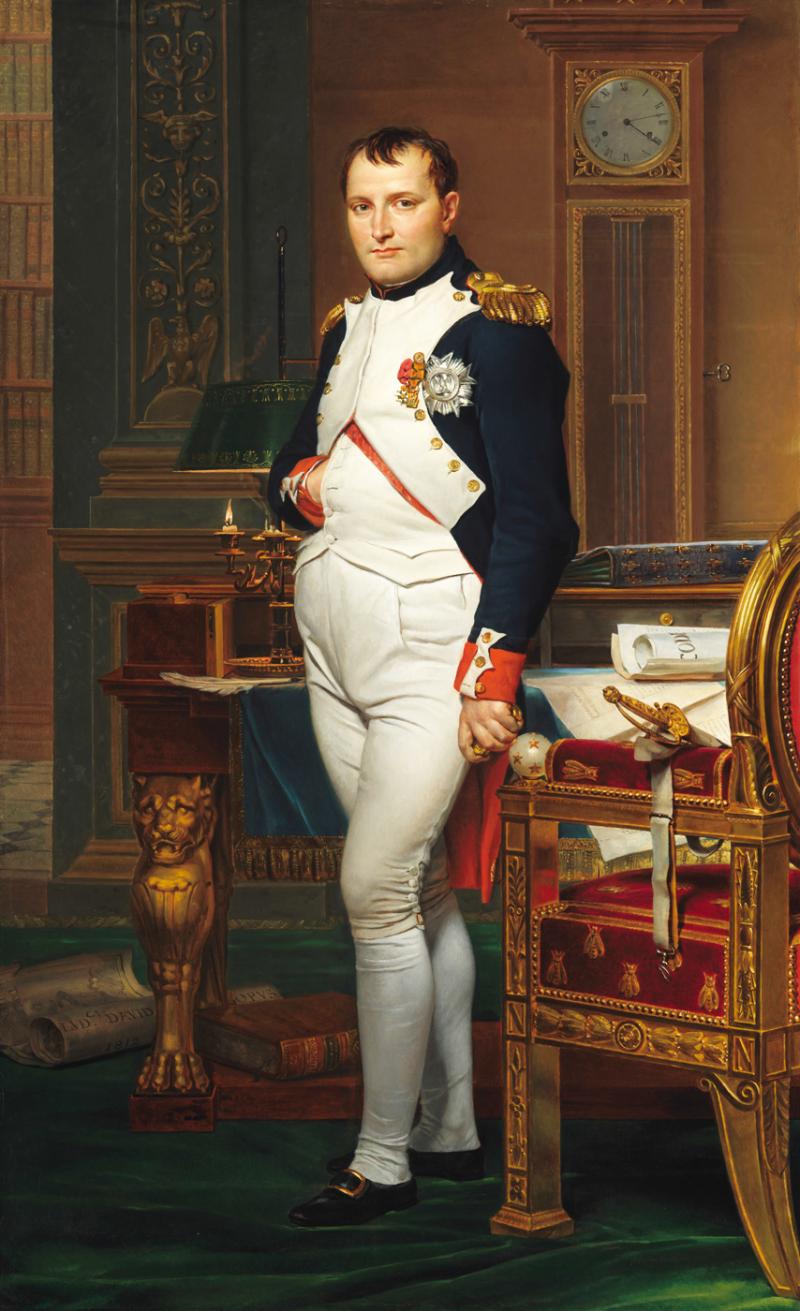

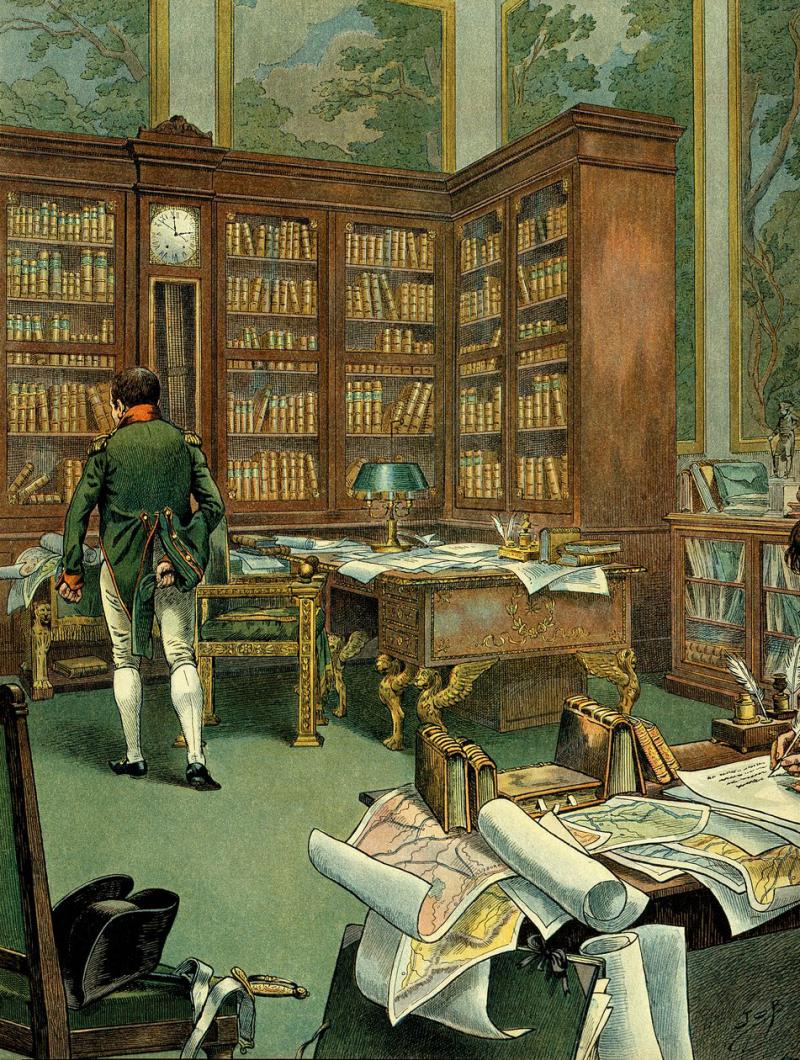
An Absolutely Stunning Napoleonic Ist Empire Mercurial Gilt Library Clock From Paris, Circa 1804, Depicting the Bust of Roman Poet Ovid (Publius Ovidius Naso) Atop A Library Bookcase In Napoleon's Working Cabinet, in The Tuileries Palace
A fabulous statement centrepiece for a collector of original Napoleonic antiques and arms and armour from the 1st Empire of France
The 'working cabinet' is an early term for a working office library, hence the now well known term of the cabinet, and 'The Cabinet Office' in 10 Downing St.
This is exactly the kind of timepiece one would find in the palaces and chateaux libraries and offices, of the great statesmen and marshals of France during Napoleons early empire period
Napoleon Bonaparte and the Roman poet Ovid (Publius Ovidius Naso) are connected by the historical irony of their exiles. Ovid famously suffered banishment to Tomis on the Black Sea by Emperor Augustus, and this theme of exile—specifically their own downfalls—became intertwined in history.The shared connection largely revolves around the geography of their punishment and historical reflections:Elba to Tomis:
Ovid's fate is often juxtaposed against Napoleon's. In a twist of historical irony, Ovid discovered his ultimate fate in exile on the island of Elba, which later became the exact location of Napoleon’s first exile in 1814.The "Carmen et Error":
Both men saw their lives defined by a combination of political indiscretions and fateful errors. While Augustus exiled Ovid for what the poet vaguely called a "poem and a mistake," Napoleon was permanently exiled to Saint Helena after losing his empire.
Napoleon was known to have a classical education, and scholars sometimes compare the isolation experienced by Ovid in Dacia to Napoleon’s own attempts to learn English while captive in Saint Helena.Pierre Jean Louis Ovide Doublet: In a less direct note, a French administrator named Pierre Jean Louis Ovide Doublet served as the Secretary General to the Commission of Government installed by Napoleon Bonaparte during his capture of Malta in 1798
The Roman poet Ovid was born in 43 BC at Sulmo, near Rome. At the age of 50 he was exiled to Tomis on the Black Sea where he died in the year 17 AD. Delacroix imagines what Ovid's exile was like in his painting Ovid among the Scythians. Ovid was banned and never ever made it back to Rome. He spent the rest of his life writing letters begging to be allowed back home, and he never was. He died nine years later in Tomis
He is chiefly famed for the 'Metamorphoses', a long verse narrative which retells ancient Greek and Roman legends, unifying them as a sequence and through the theme of the title. The poem, originally written in Latin, was translated and much admired in the Middle Ages; it subsequently provided a rich source of subject matter for artists as diverse as the Pollaiuolo brothers, Titian and Poussin.
Other well-known poems by him include the 'Fasti', which describes the rites of the pagan Roman calendar, and the 'Ars Amatoria' (the 'Art of Love').
A tangible connection to the artistic and political ideals of early 19th-century France.
Timeless Aesthetic: These clocks complement both traditional and modern interiors with ease.
Value: With their artistic merit and historical relevance, Empire clocks tend to retain, and often increase, their worth over time.
French Empire mantel clocks reflect the ideals of the time through their stately architectural forms, rich ornamentation, and use of precious materials. Symmetry, grandeur, and the radiant sheen of mercury-gilded bronze (ormolu) define the style. These clocks were designed as centrepieces for refined interiors, admired not only for their precision but for their narrative power and sculptural finesse.
Technically advanced, the movements were often produced by master clockmakers such as Bazile-Charles Le Roy, Louis Moinet, Louis Berthoud and Jean-Simon Bourdier, while master bronziers like Claude Galle, Pierre-Philippe Thomire, André-Antoine Ravrio, Pierre-Victor Ledure and Jean-André Reiche.
Following Napoleon’s proclamation as Emperor of the French, France entered a new cultural era known as the Empire period (1804–1815). This epoch marked a flourishing of the decorative arts, culminating in what we now recognise as the Empire style. Closely associated with Napoleon himself, this aesthetic drew heavily upon the classical world, particularly Greco-Roman architecture, sculpture, and mythology.
Possibly By Thomire, Pierre-Philippe (French, 1751-1843)
Mercurial gilding or fuming was already used in antiquity, treats the bronze design with 'gold amalgam' - gold powder dissolved in mercury under heating. The mercury is then driven off with a flame. The gold forms a compound (alloy) with the bronze. This process was then repeated several times to obtain a gold layer of sufficient thickness.
The poisonous mercury fumes released during fire gilding were particularly unhealthy, which is why the technique was banned around 1830.
The applied gold layer is thick but contains pores, which gives a matt appearance. The pores can be rubbed closed so that a high-gloss surface is created. This technique is called bruncheren. The alternation of high-gloss and matt parts is a characteristic of fire-gilded objects.
Mercurial or Fire-gilded clocks like this were only owned by the richest and most important citizens at the time, as a result of the artistry of various master craftsmen.
During the Ancien Régime (the period before the French Revolution), reading books was mainly aimed at acquiring knowledge.
8 day silk suspension movement striking on a bell
Code: 26285
Price
on
Request