
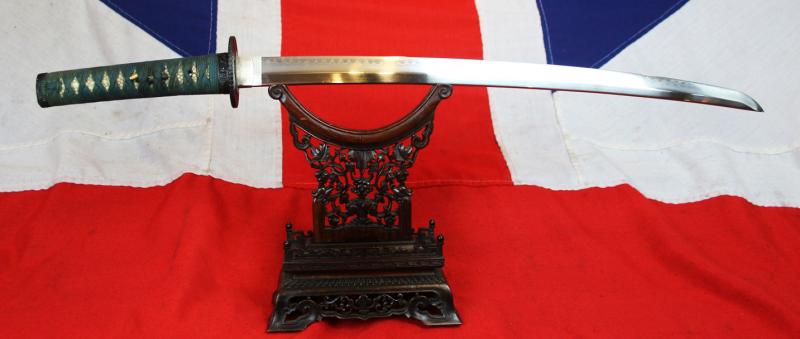

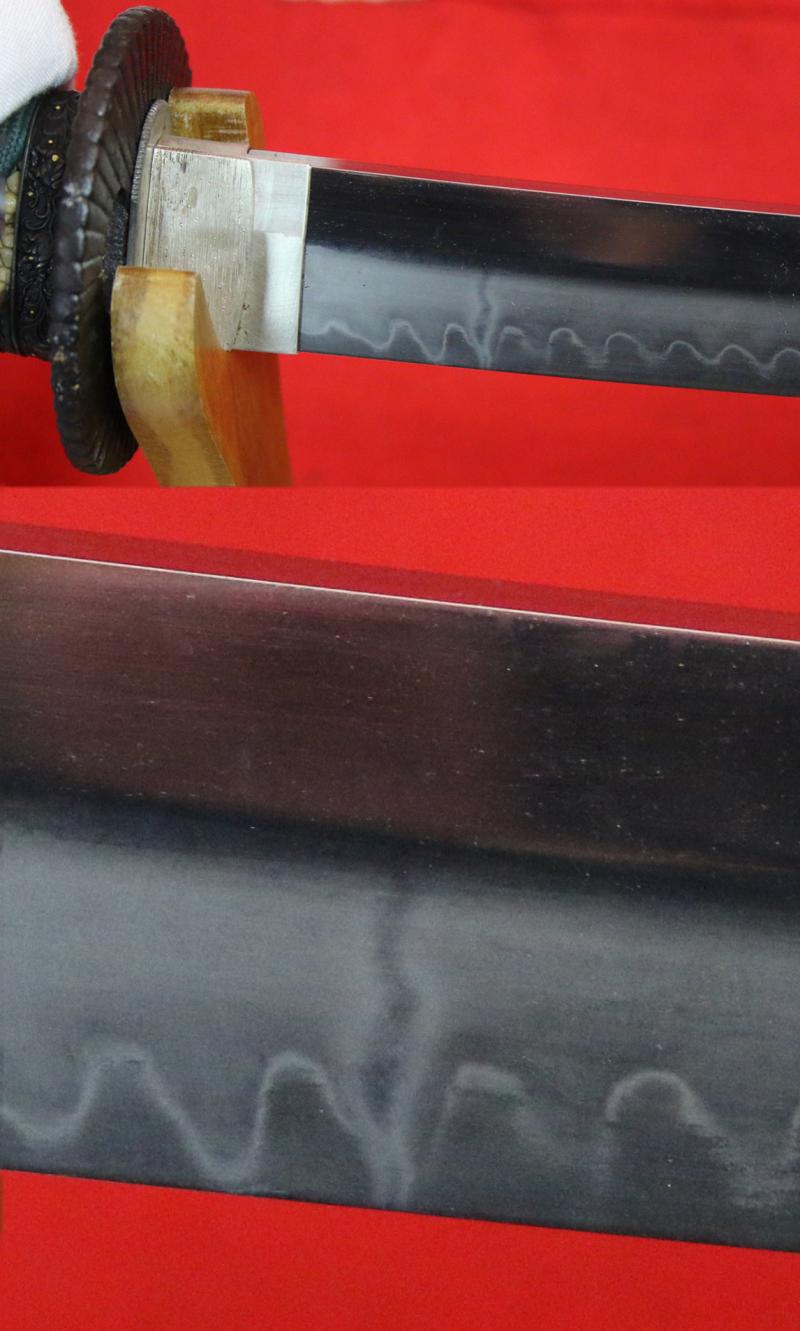
A Superb 16th Century Koto Wakazashi Signed Kanemoto, Of The Renown Mino School, Muramachi Period, With Fabulous Hamon Single Sharp Rise That Appears Like A Spinning Cyclone Emerging From the Hamon
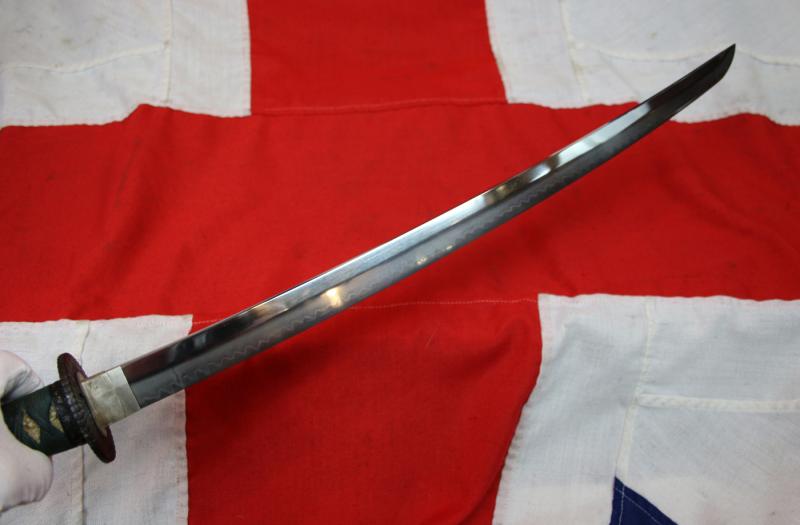
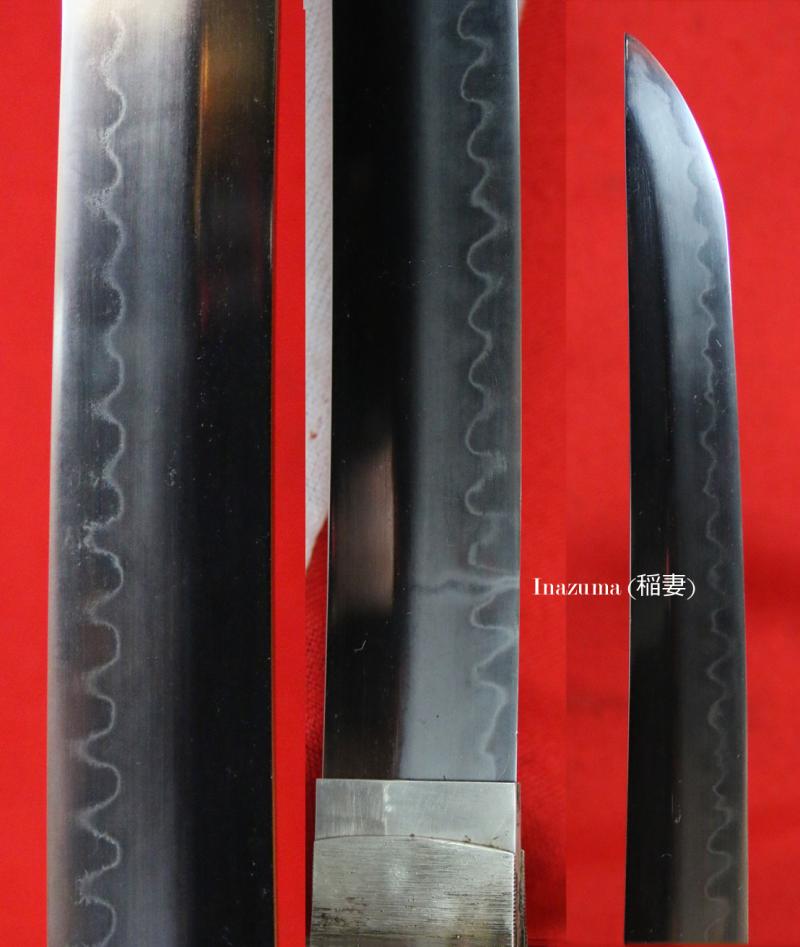
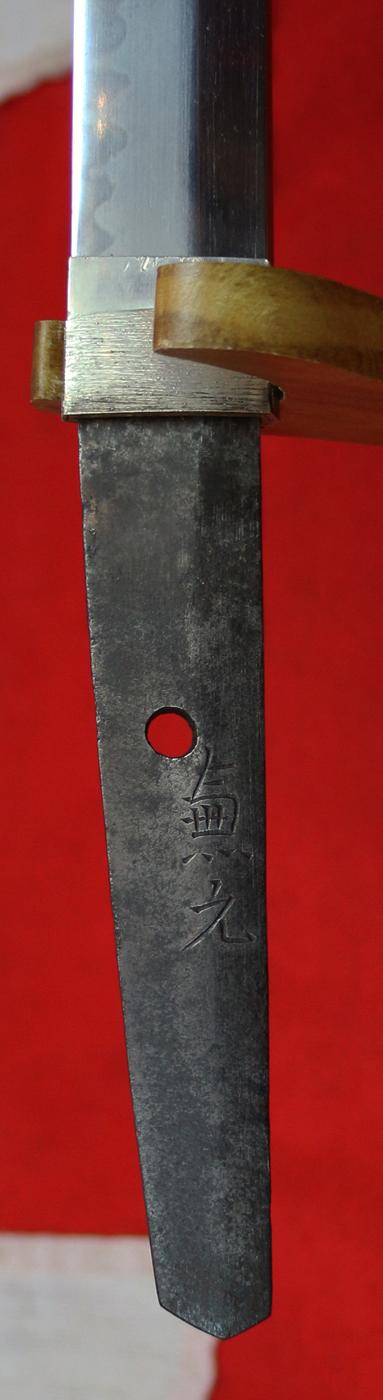
A Mino School wakazashi, around 500 years old, signed Kanemoto, with a deep gully gunome hamon, & an exceptionally unusual hamon sharp high peak that resembles a cyclone, and with all original Edo fittings. Including a two part silvered habaki {always a sign of fine quality}
Signed Kanemoto, Muromachi Period (16th Century)
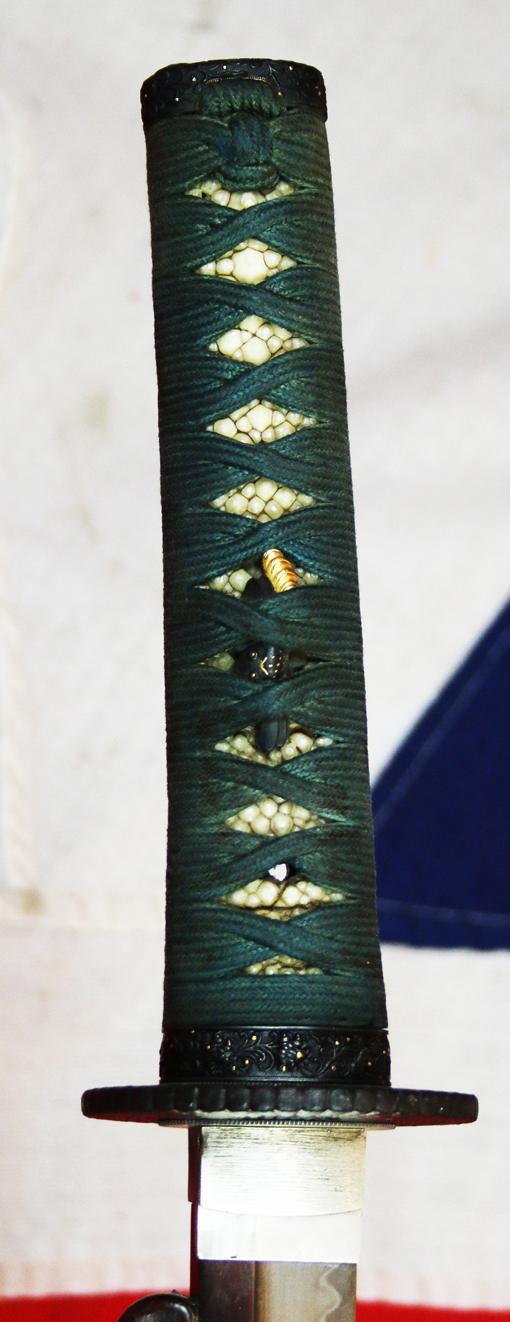
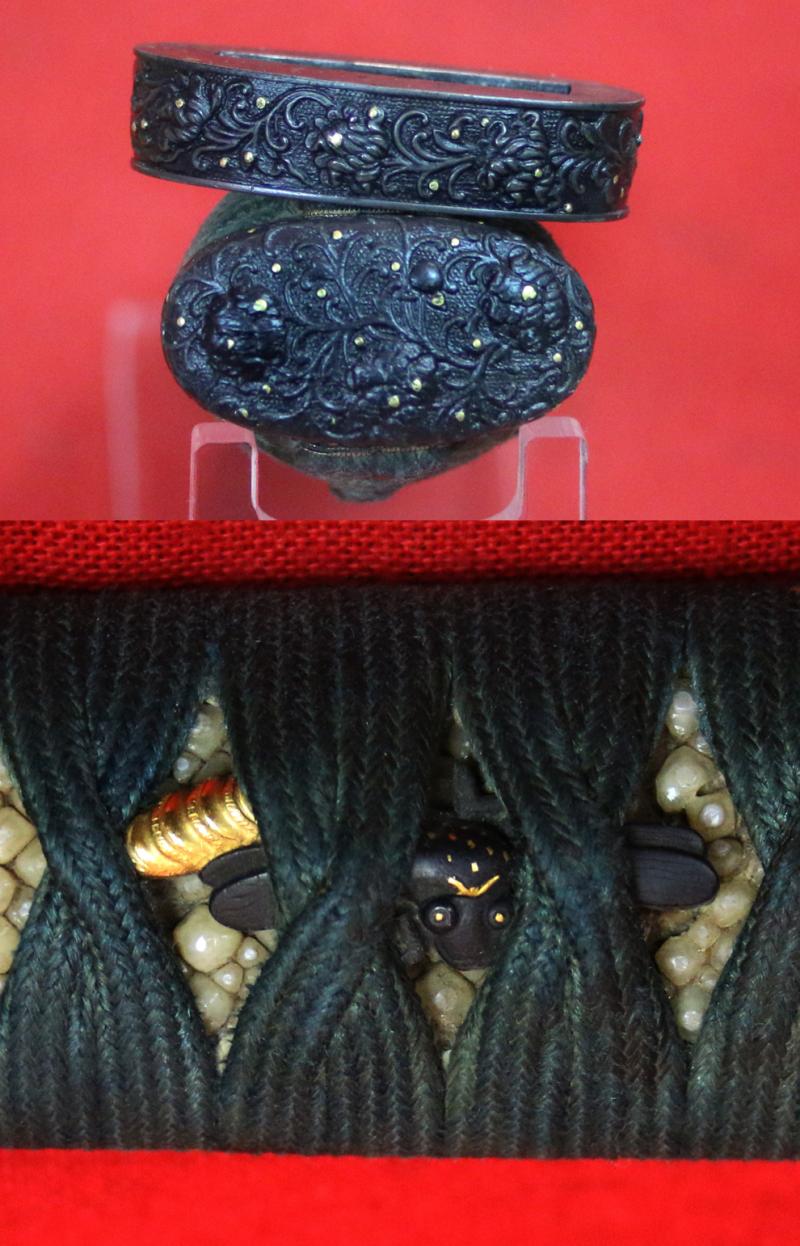
Sugata configuration: honzukuri, iori-mune, toriizori. the nakago {tang} is ubu, with a single hole. With a 'Rays of Buddha' tettsu tsuba of Amidayasuri carving representing the halo emanating from Amida Buddha. the fuchigashira are shakudo takebori chrysanthemums with droplets of pure gold throughout. the menuki beneath the original edo period tsuka-ito, and above the samegawa, are menuki of takebori dragonflies with pure gold eyes, antennae, and thorax.
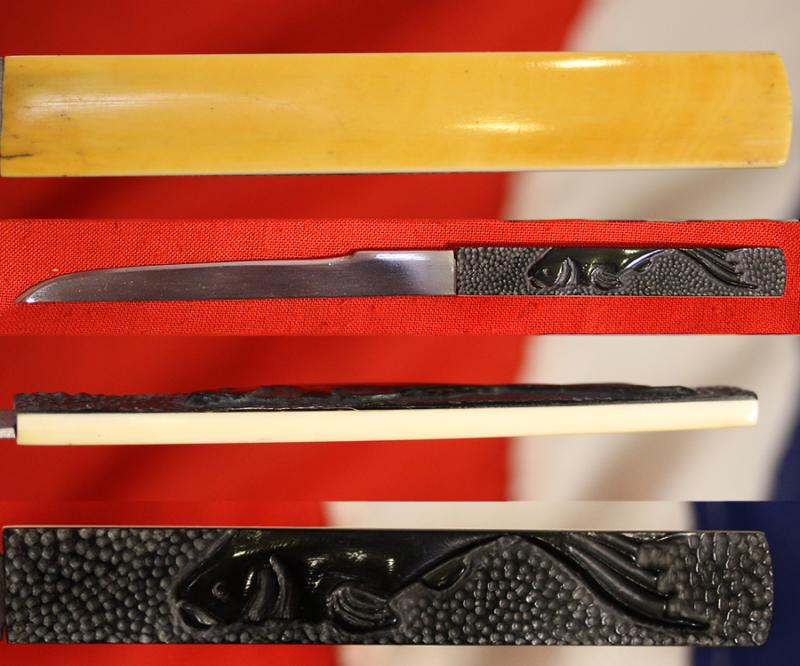
The saya is absolutely stunning with green ishime lacquer, polished carved buffalo horn fittings and a kozuka of a carved black buffalo horn with a takebori carved carp, and the reverse kozuka handle is a panel of zōge 象牙
This fabulous blade has a single zig zag, hamon type decor, emerging at right angles from the deep gully gunome hamon. Thus creating an image of somewhat akin to a cyclone in the middle of a violent stormy sea.
We have had many thousands of original Japanese swords in the past 100 odd years, and we can not recall ever seeing its like before.
The early Mino-Den period will find swords done in nie-deki, with abundant nie and thick nioi. The nie and nioi are bright and large nie will be found sometimes. Widths vary greatly. The pattern is o-midare, o-gunome midare, notare-midare, etc. Kuzure, sunagashi, and kinsuji will be found. In the middle period, the hamon will be wide and o-midare or gunome-midare, with nie. The hamon may have an area that produces togari-ba and sunagashi.
This blade was signed by Kenemoto (兼元) during the late Muromachi period (Late 15th-Early 16th century).
The swordsmith name “Kanemoto” lasted 27th generations from the Muromachi period(early 16th century) to the Heisei period(modern-day).
It is said the most skilled Kanemoto of all is the second-gen, also known as Magoroku, who was one of the most famous Mino swordsmiths from the Muromachi period. He forged swords in the Mino province, which is renowned for a particular sword style called Mino-Den. Each generation was good at creating swords with Sanbon Sugi tempering line (Hamon in Japanese). Sanbon Sugi tempering line resembles a small cedar tree/forest growing horizontally. Highly refined craftsmanship have been passed down for many generations.
Mino-Den exceedingly prospered during Sengoku Jidai (Warring State period) due to the high demand for weapons. And the location of Mino province beat others. Akechi Mitsuhide controlled Mino province, and Nobunaga Oda ruled Owari province. Tokugawa Ieyasu was the lord of Suruga (Neighboring areas). There was high demand from those powerful feudal lords and their retainers.
Furthermore, so many wars occurred between the Kanto region and the Kyoto area. Mino is located in the middle, making feudal lords feel convenient to order swords from Mino-Den. The blades forged in Mino provinces also had the reputation of their practical design and sharpness. Many feudal lords demanded swords forged in the Mino province. This highly skilled sword-forging technique has been passed down for generations. The smith’s name “Kanemoto” was one of the most famous even after the warring state ended.
Polishing the hamon in Japan in the Edo period and beyond.
Japanese swords go through a basic polish called shitaji where the blade is ground to shape. In this stage, factes and bevels are shaped properly and the edge is sharpened. The second stage is called shiage where the details in the steel are brought out by polishing with very fine stones. The shiage stage is where the polisher makes specific choices on the finish of the blade. There are basically two types of finish: sashikomi and hadori.
Sashikomi (差し込み)
The sashikomi is the more traditional of the two, also known as the "classical finish" and involves polishing the entire sword with a very fine grit stone. It shows all the details of the sword, but does not emphasize anything in particular and the effect can look a little subdued.
Many of our swords were last polished in the Edo period when this form of polish was much in demand.
Hadori (刃取り)
With the hadori polish, in modern times, the outline of the hamon is brightened using uchigumori polishing stone which is slightly coarser than the finishing stone. Today, it is the most common finish, not in the least because it makes the hamon much easier to photograph.
This kind of polish probably started with the Hon'ami family of sword polishers, most likely Hon’ami Ringa (本阿弥琳雅, 1859-1927) or Hon’ami Kōson (本阿弥光遜, 1879-1955). It marked an increased emphasis on the Japanese sword as an art form.
Hadori polish is also known as keshō (化粧), meaning "cosmetic".
In traditional Japanese bladesmithing, the hamon is achieved by applying clay to the blade, heating the blade, and then quenching it in water. The process is called yaki-ire (焼入れ). Those areas where clay is applied thicker will cool slower, while those coated with a thin layer or no clay at all will cool at a very fast rate, creating hard martensite and pearlite chrystals in the steel.
Nie & nioi
When the crystals are so small that the naked eye cannot make them out individually, and they appear like a whitish mist, it is called nioi (匂), literally "fragrance". Nioi is present to some extent on all blades, but when no or very little nie is present, we speak of nioi-deki (匂出来). When the work shows nie throughout, we call it nie deki (沸出来) where deki means workmanship or interpretation.
The hamon forms due to differential hardening (clay tempering). The smith coats the edge in a thinner layer of clay so it cools rapidly, producing a hard, martensitic steel.
The abrupt temperature changes and specific steel composition cause misty lines away from the edge.
The small cyclone rising from the hamon may well be a 'trademark' type feature that a swordsmith created to symbolise his skill, such as, a very few smiths, created a profile of Mount Fuji within their hamon, and one {on a blade we have} created a rabbit with long ears as his feature.
If one seeks to find a famous, specific sword the legendary Raikirimaru (雷切丸)—"The Thunder Cutter"—is one of the most famous.
Originally named Chidori (Thousand Birds), it was a long tachi belonging to the samurai Tachibana Dōsetsu.
According to legend, Dōsetsu used the sword in 1548 to strike down a bolt of lightning when a storm hit, believing a god had possessed him (or simply surviving a nearby strike that scorched the sword). This gave the weapon its mythical status.
It is a koto (old sword) era piece. It was later shortened (suriage) from a long tachi into a wakizashi (making the maker's signature mumei, or unsigned) and features a nie-laden suguha (straight) hamon with abundant inazuma
Code: 26268
8450.00 GBP