
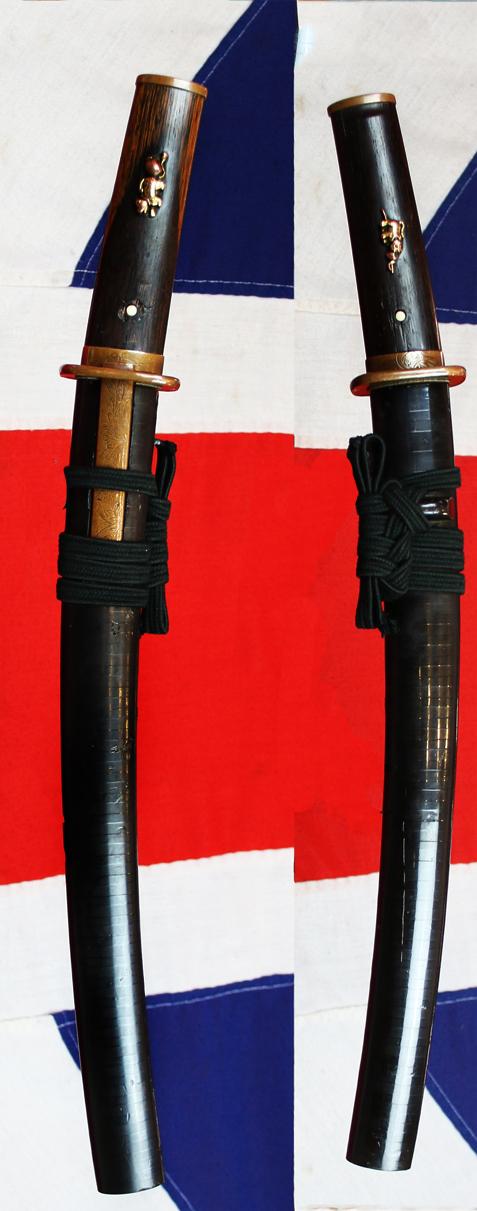
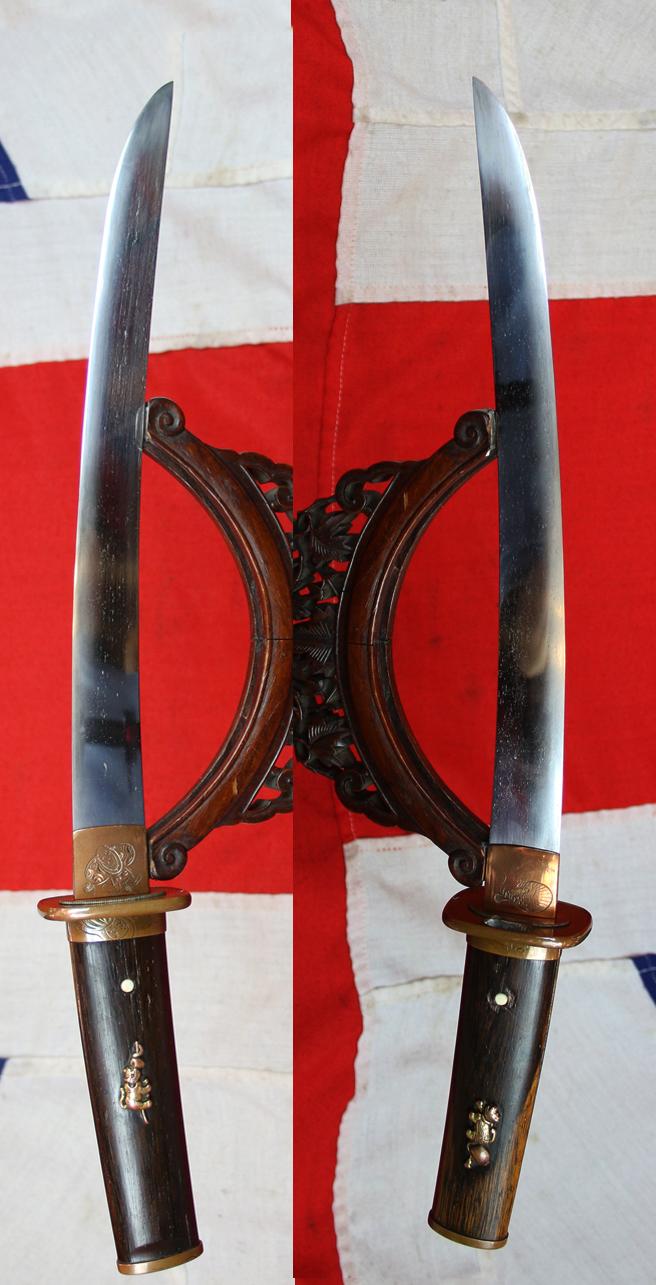
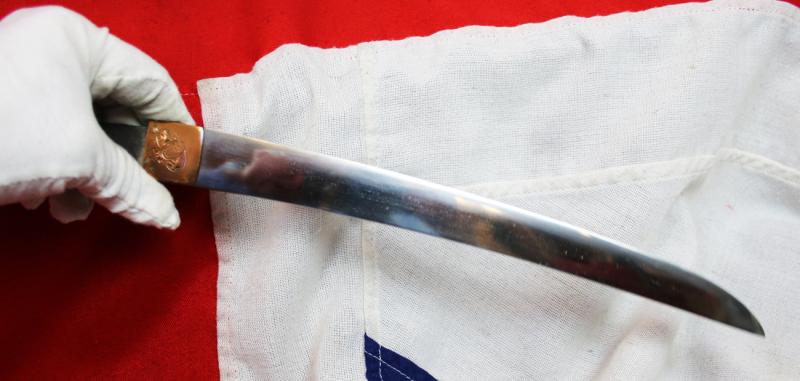
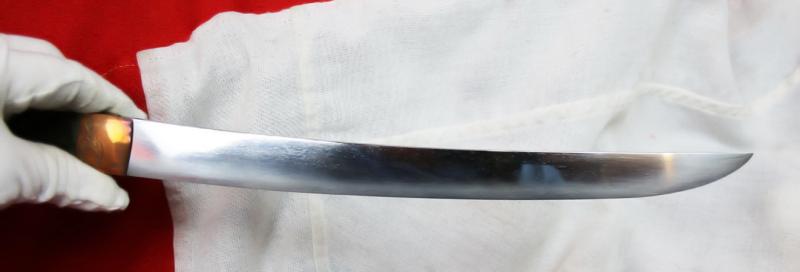
Beautiful Shinto Samurai Folklore Tanto, 1600, With A Wonderful Suite Of Copper Koshirae Engraved With Japanese Legendary Noh Tales. Figures of Folklore Including, Sanbaso, Samurai, Kappa & Yokai The Turtle & Human Face Octopus, Lamp, Fans & Cricket
Made for a samurai devoted to the Japanese historical traditions of storytelling through Noh and Kabuki. Such as the great Miyamoto Musashi, the revered "sword saint" himself, who was not a performer, but he adored kabuki and its culture. And Shogun Tokugawa Ieyasu revered Noh theatre and often performed it himself as shigegaku, an official military performance.
A stunning tanto with delightful patinated suite of original Edo period copper mounts, all finely engraved with an entirely cosmopolitan selection of subjects from bushido, the way of the warrior, and ancient Japanese folklore, based on tales from Noh and Kabuki theatre including legendary figures, trickster deities, shapeshifters and spirits. Although they appear disconnected, they are all together combining the great legends of Noh and Kabuki with Bushido. A most clever convergence of the mystical, with the practical life of the samurai.
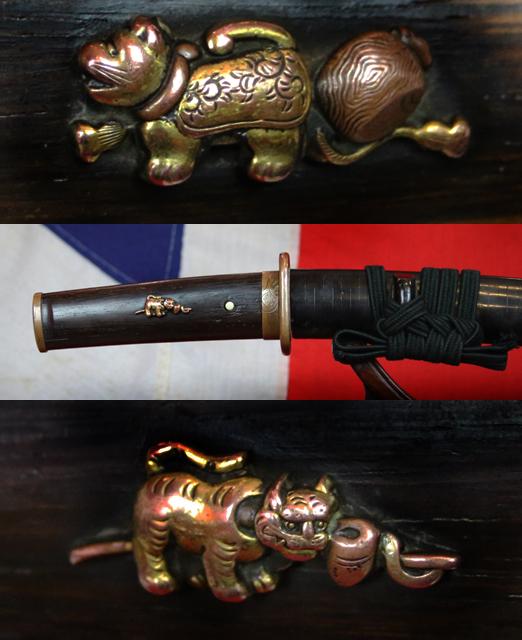
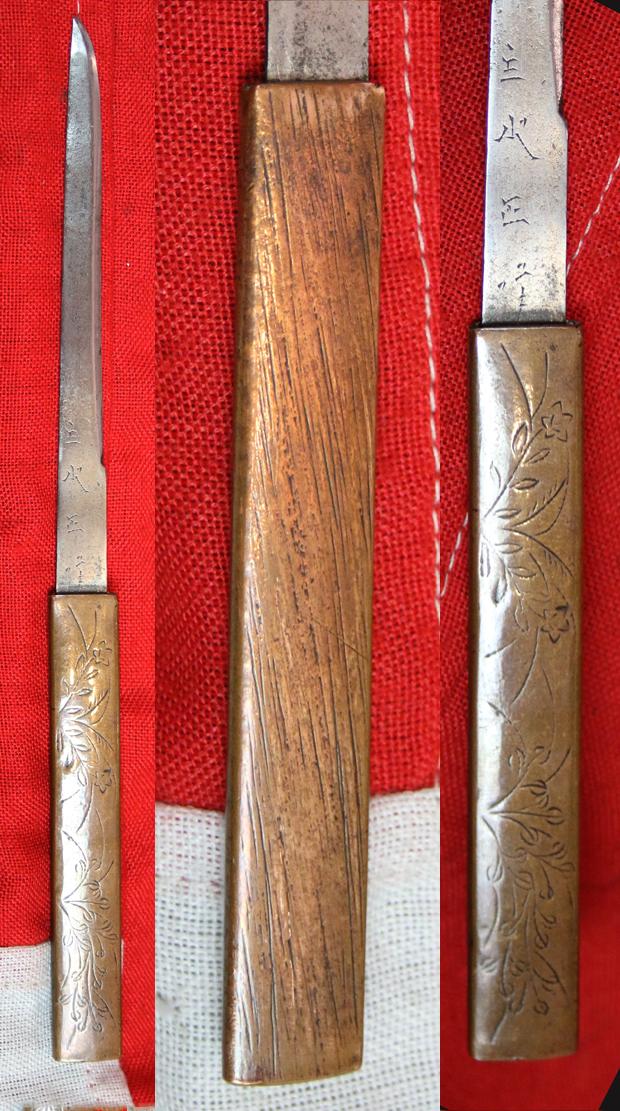
Accompanied fine finely engraved patinated copper kozuka utility knife with signed blade, and fine, original Edo striped urushi black lacquer saya, bound with original Edo silk sageo. The menuki are the tiger with a Ōtsuchi, a six foot war hammer, and a dog with a kaiku war drum. Tigers appear heavily in Japanese folklore, often as symbols of courage and ferocity. They are intrinsically tied to Kabuki through legendary plays. And, the Kai Ken is an incredibly rare, indigenous breed of Japanese dog often nicknamed the "Japanese tiger dog.
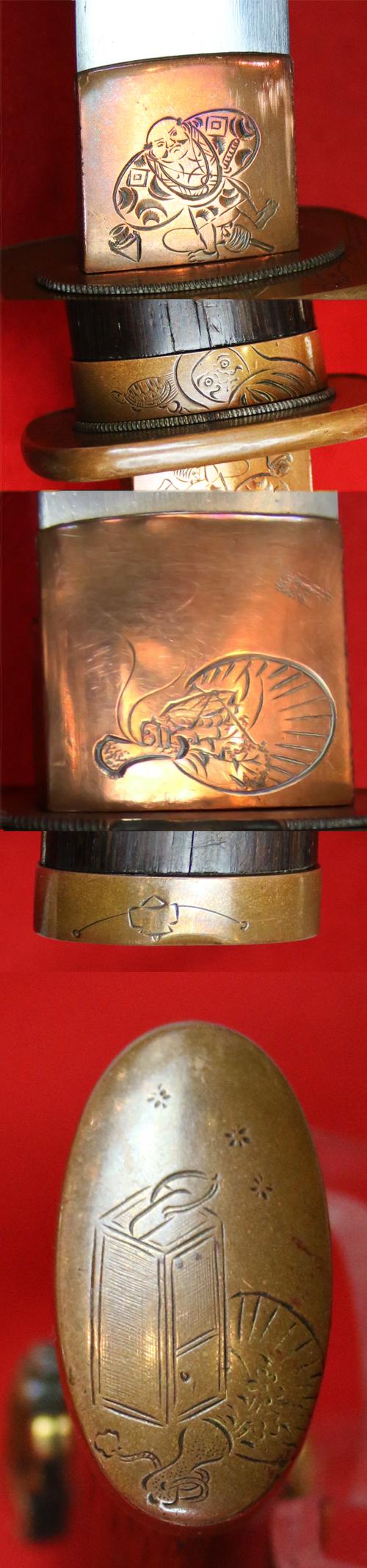
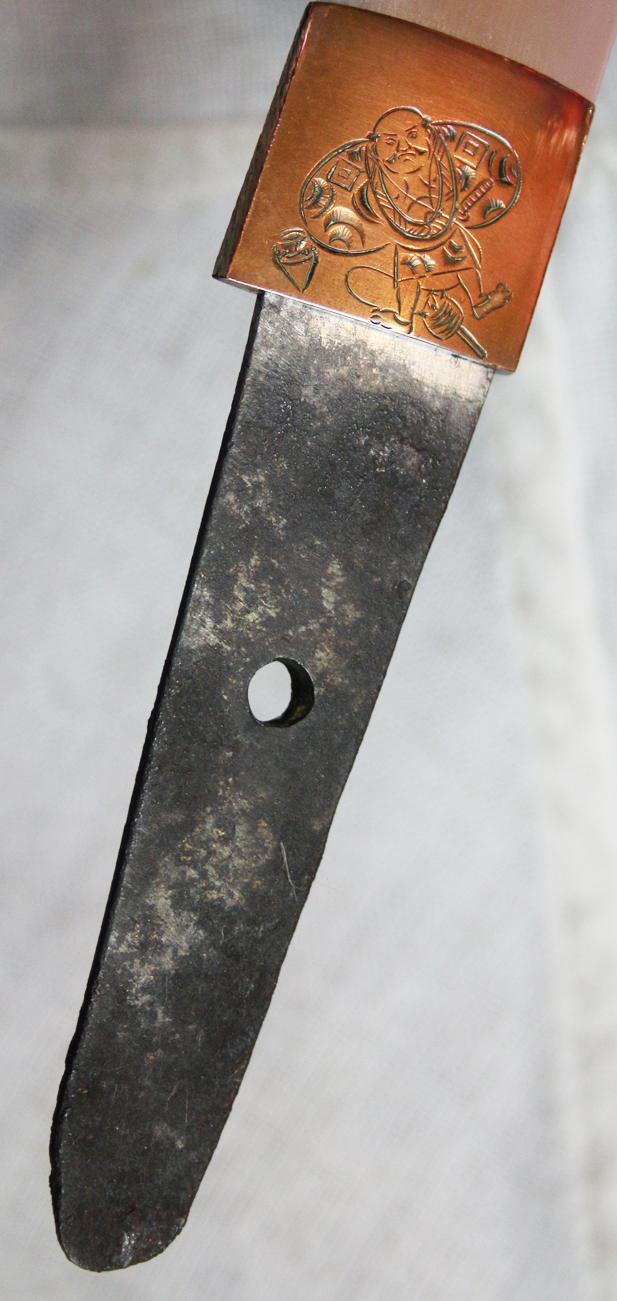
On the habaki is the fine engraving of a samurai on one side and of a cricket on a war fan on the other. Placing a cricket on a war fan was a visual reminder of Bushido (the way of the warrior), which demanded that a samurai cultivate a deep appreciation for art, poetry, and nature, alongside martial discipline. The Duality of Life, Together, they represent the philosophical balance of the warrior's life: the need for both brute strength on the battlefield and a refined, gentle spirit in times of peace. Of course the war fan resembles the Peony Fan, Oni Ōgi of Noh theatre, yet another subtle convergence.
The kashira is engraved with the two distinct elements in Japanese folklore, the Peony Lantern (Botan Dōrō), which is one of Japan's most famous ghost stories, and the Peony Fan (Oni Ōgi), a traditional prop used in Noh theatre
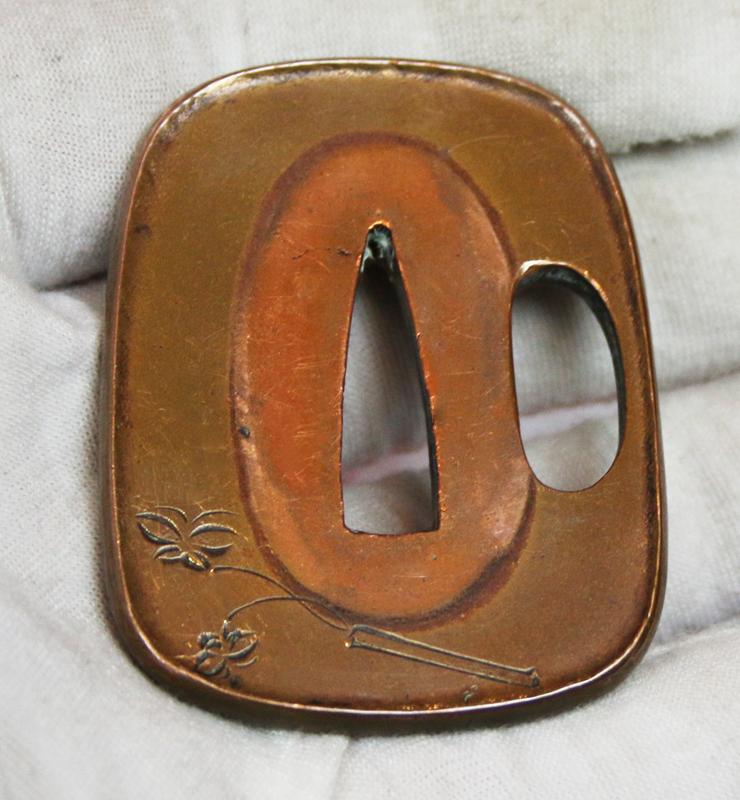
Created for a samurai who had a desire for the sword’s decor to be the embodiment of ancient Japanese folklore tales from Kabuki theatre and Noh, of mystical creatures and oni, each piece, engraved, from the fuchigashira, the tsuba, and the habaki, all of this delightful work was beautifully executed with immense skill.
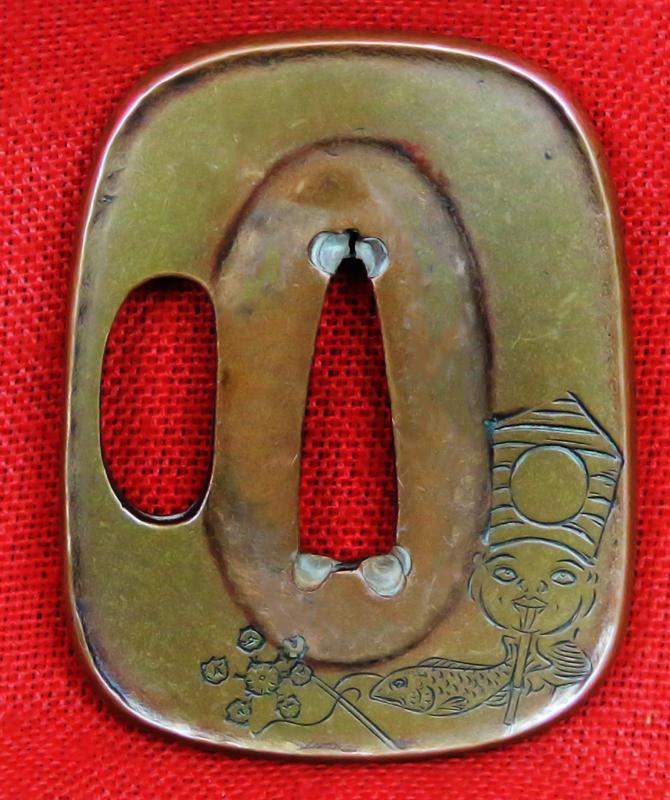
The carving on the tsuba is Sanbaso (三番叟), a sacred, celebratory character from traditional Japanese performing arts like Kabuki and Noh.
The combination of the tall court cap, prominent lolling tongue, pole, and carp corresponds to specific props and rituals performed in the traditional Okina and Sanbaso dances
The Tall Cap (eboshi): Sanbaso wears a rigid black court cap called an eboshi (烏帽子) to signify his high ritual status as a deity who prays for a bountiful harvest and peace: In certain energetic interpretations of the dance, Sanbaso’s face contorts, often displaying a lolling tongue to channel the vibrant, earthly spirit of the gods.The Pole & Carp: He is universally depicted as a jovial, smiling man carrying a traditional fishing rod in one hand, and a large red sea bream (tai) or a giant carp (koi) in the other.
He wears a traditional court cap called a kazaori eboshi (a folded, pointed black cap worn by nobles in ancient Japan)..
The kashira depicts the a lantern is of a romantic but tragic ghost story, it is likely the classic Japanese folktale Botan Dōrō (The Peony Lantern).
A handsome samurai named Hagiwara falls in love with a beautiful woman named Otsuyu. She visits him every night carrying a distinctive paper lantern that glows with a pale, ghostly light.
It is eventually revealed that Otsuyu is a ghost and her companion is an equally dead spirit. The samurai is warned to stop seeing them, but he succumbs to his love and is eventually found cold and dead in his room, his servant blowing out the weird, yellow flame of the peony lantern.
The fuchi is In Japanese folklore, the specific combination of a human-faced octopus and a turtle usually points to the infamous Tako Nyūdō, a human-faced octopus yōkai, and a Kappa, the legendary turtle-like water monster. Together, they represent the eerie and highly revered shapeshifters of the deep water.The Turtle: The KappaThe Kappa is one of Japan's most celebrated yōkai. Known as "river-children," they live in the lakes and streams of Japan. They resemble a mix of a human child and a turtle, with scaly or slimy skin, webbed hands and feet, and a hard turtle-like shell (carapace) on their back. On their head, they have a shallow depression or "dish" (sara) filled with water. This water is their source of power and life; if it spills or dries out, the Kappa becomes severely weakened.
Kappas are known as mischievous trickster water deities who enjoy sumo wrestling and eating cucumbers. However, they can also be deadly, occasionally dragging unsuspecting humans or animals into the water to drown them.
Countless samurai revered the performing arts, and several even left the warrior class to become professional kabuki actors, or established theatres of their own. Famous warriors with direct ties to kabuki include, Sakata Tōjūrō I a former samurai who founded the sophisticated wagoto (soft style) romantic acting in 17th-century Kyoto.
Ichikawa Danjūrō, an actor and son of a low-ranking samurai who created the dynamic, bombastic aragoto acting style.
The great Miyamoto Musashi, the revered "sword saint" himself was not a performer, but he loved kabuki and its culture. He became a popular subject for plays during his own lifetime.Many other historical figures became the very subjects of kabuki, which often served as a subversive way for the public and actors to praise legendary samurai. Notable legends adapted for the kabuki stage include:
Minamoto no Yoshitsune, a tragic, iconic general and the subject of several classic plays.The 47 Ronin, a legendary tale of masterless samurai avenging their fallen lord.Sakura Sōgorō: A historical farmer-hero whose rebellion inspired Japan's first modern political kabuki play
Three legendary figures of the Sengoku and Azuchi-Momoyama periods—Oda Nobunaga, Toyotomi Hideyoshi, and Tokugawa Ieyasu—are the most famous samurai who revered and patronized Noh theatre. These warlords studied the art, performed it themselves, and established Noh as the official ceremonial performance of the military government.The profound connection between these samurai commanders and Noh is detailed below:Oda Nobunaga (1534–1582), he frequently recited and danced the famous excerpt "Atsumori," which centers on the tragedy of a young fallen warrior from the Gempei War. Nobunaga viewed his own military ambitions in the dramatic and fatalistic light of these Noh epics.Toyotomi Hideyoshi (1537–1598): He took his passion a step further by studying under the Konparu School and performing on stage. He even commissioned new plays that cast himself as the victorious protagonist.
Tokugawa Ieyasu (1543–1616), made Noh the official ceremonial performance (shikigaku) for all state events, which solidified its status among the samurai elite
Overall in very good condition, small saya split under the sageo at the base of the kozuka slot.
Code: 26247
4250.00 GBP