
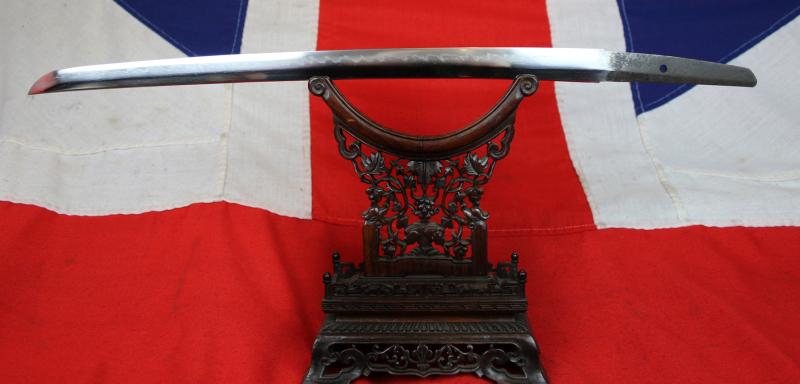

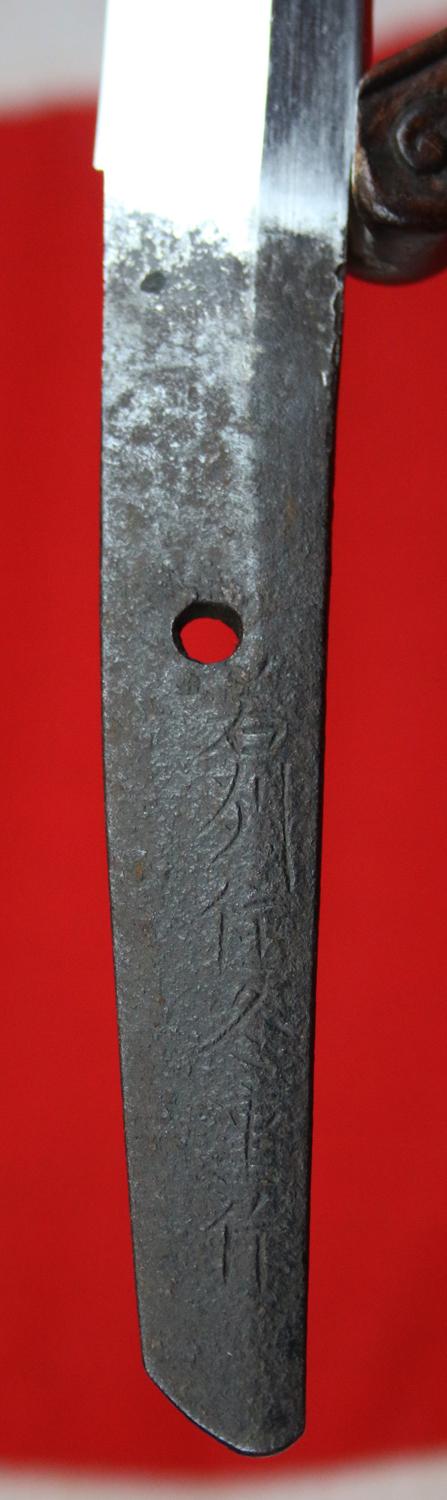
A Super, Early, Ancient Koto Period Samurai Sword Wakazashi, Muromachi Era, Signed Jyakusyuu-jyu Fuyushige Late 14th to Early 15th Century. According to Sensei Roald Knutson, It’s Last Owner, It Is A {Nagamaki Naoshi} Wakazashi
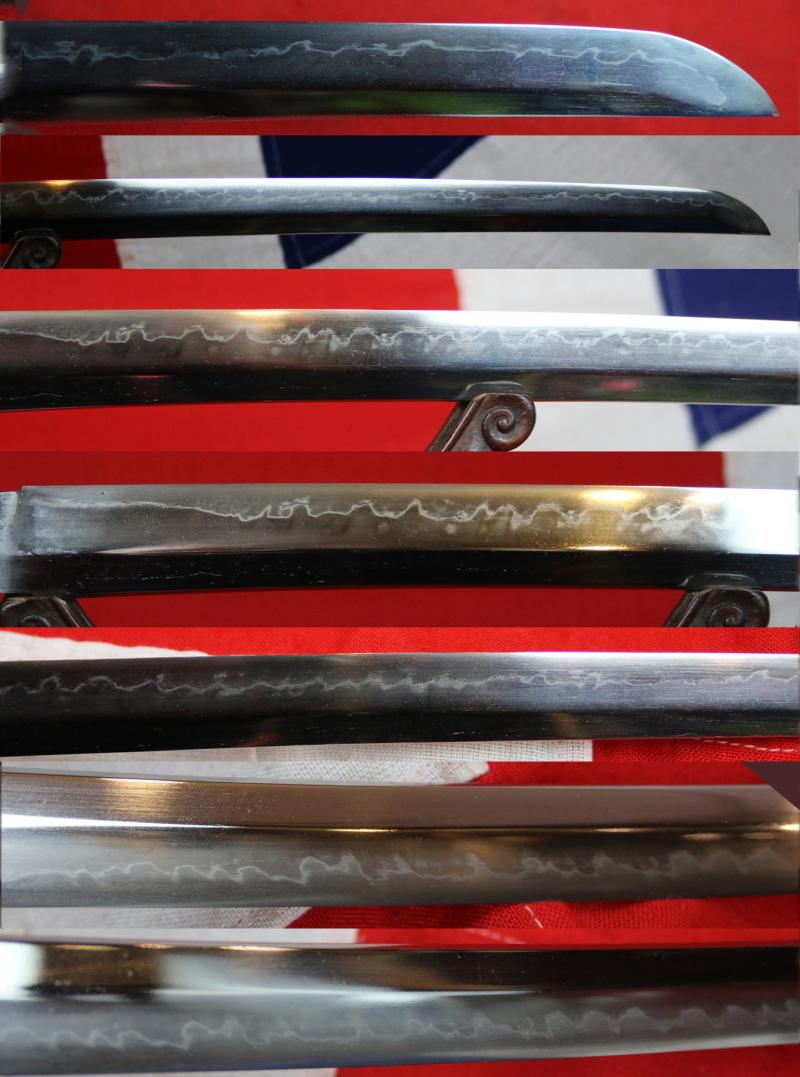
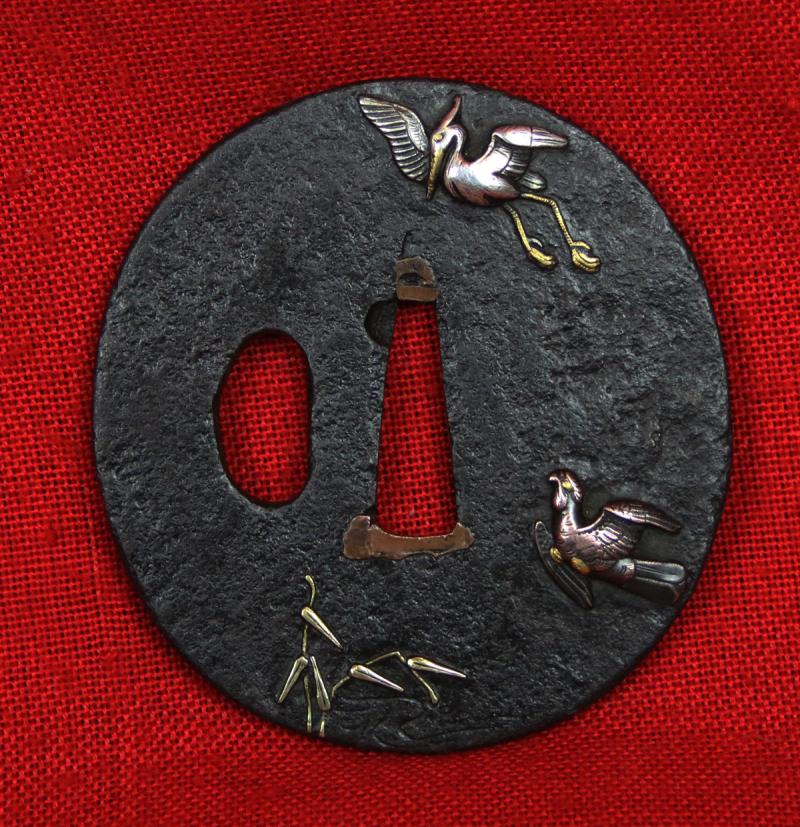
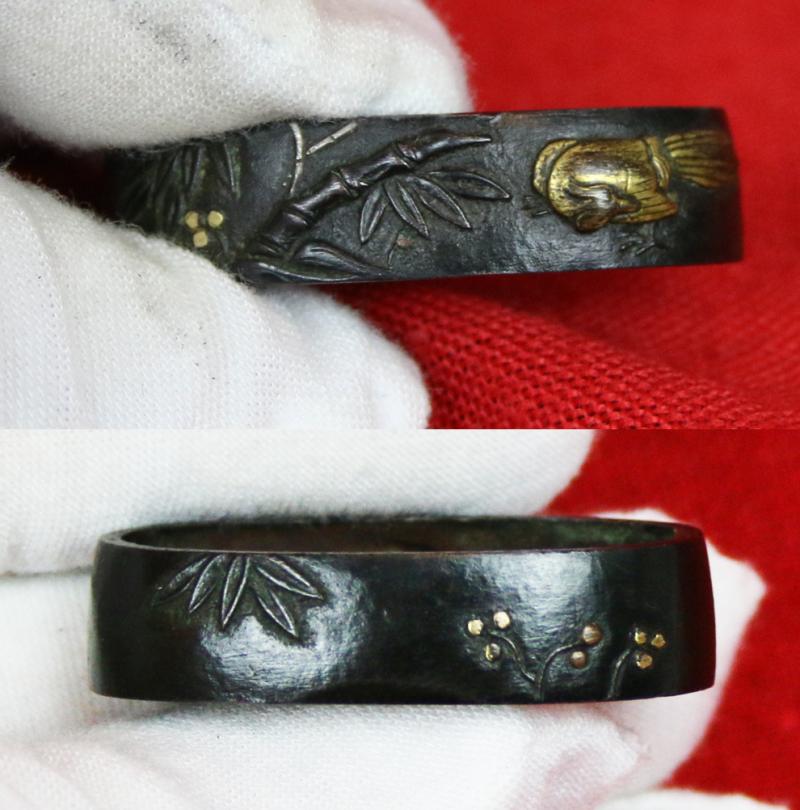
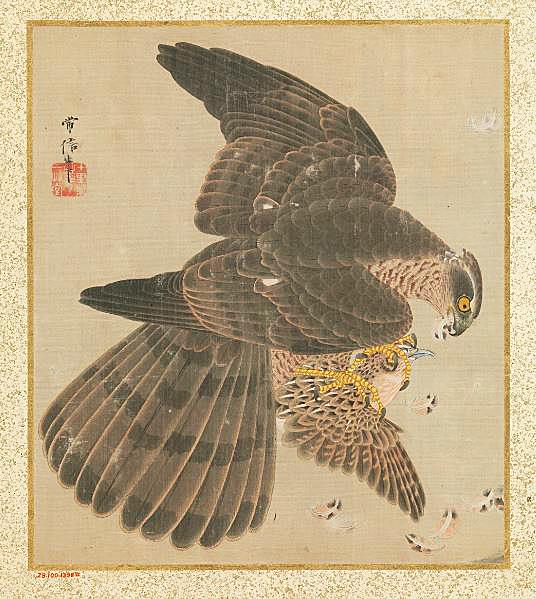
The blade has a captivating gunome midare hamon of incredible vibrancy, and overall its in superb condition, especially being so ancient, around 600 years old. Both the beautiful original Edo period fuchi and tsuba are decorated with the subject of takebori hawks hunting their prey, which is a crane in flight. The tsuba is tettsu with copper and gold takebori crane, hawk and reeds.
Jyakusyuu-jyu Fuyushige(若 jyaku , 州 syuu , 住 jyuu , 冬 fuyu , 重 shige , 作 saku was made by a swordsmith who was recorded and lived around 1430-1440 AD.
A Koto-era sword signed Jyakusyuu-jyu Fuyushige (若州住冬重) originates from Wakasa Province (present-day Fukui Prefecture) and translates to "Fuyushige, resident of Jyakusyuu (Wakasa)". Fuyushige was a swordsmith active during the Muromachi Koto period which spans the Muromachi period and earlier, known for high-quality steel forged during times of intense conflict.
The sword is shown here in its various parts, yet to be mounted with it’s tsuka and saya, once they are fully restored conserved and the remounting complete.
It was formerly part of the collection of sensei Roald Knutsen, likely the worlds foremost expert and author on samurai polarms and their use in combat, with various pieces acquired with or from Henry Russell Robinson's private collection. (7 May 1920, Hackney, London - 15 January 1978) He became Keeper of Armour at The Tower Of London The Japanese armour exhibition in 1965, which featured samurai artefacts arranged to demonstrate evolving defensive technologies and cultural contexts, drawing thousands of visitors to the Tower.
He was a British military armourer and historian.He served in the RAF during the Second World War making models interpreting aerial photographs. This was when he met Sir James Mann, Master of the Armouries at the Tower of London. Robinson joined the staff of the Tower Armouries in 1946 as a Temporary Assistant, before rising to Assistant Keeper and finally, in 1970, Keeper of Armour.
Robinson was a founder member and president of the Arms and Armour Society. In 1965, he was elected a Fellow of the Society of Antiquaries of London. In 1977, he was awarded an honorary MA by the University of Newcastle upon Tyne.
Between 1967 and 1969, he (a practical armourer) worked with Charles Daniels to interpret and reconstruct the Roman armour nowadays known as 'lorica segmentata'. He produced a series of reconstructions of the two sub-types of armour from the Roman site at Corbridge and one from Newstead in time for them to be exhibited at the 1969 Congress of Roman Frontier Studies held in Cardiff.
His work on the armour featured in one of his best-known books, The Armour of Imperial Rome. Published in 1975 by Lionel Leventhal at the Arms and Armour Press, it included line illustrations by his friend, Peter Connolly. Robinson's system of categorizing Roman helmets has been widely adopted in the UK and USA but never really found favour in Europe.
Robinson was not only known for Roman armour, since he worked on an exhibition of Japanese armour at the Tower Armouries and subsequently wrote two books on the subject. He was also an authority on Native American artefacts and was responsible for the production of the replica of the revised reconstruction of the Sutton Hoo helmet and wrote a guide to the Stibbert Museum.
Sensei Knutsen believed this blade was formerly in its combat past, several hundred years ago, a naganata or short bladed nagamaki polearm blade, remounted to become a sword in the Edo period.
Several hundreds years past this was a common practice to create more convenient sized weaponry from single edged polearms than became nagamaki naoshi.
Today, un-shortened historical nagamaki are incredibly rare collector's items, but nagamaki-naoshi blades survive as enduring testaments to the evolution of the samurai and the adaptability of their weaponry .
The weapon became synonymous with the bodyguards of elite warlords, most notably Uesugi Kenshin, who employed a dedicated vanguard of nagamaki-wielding retainers. And one such Nagamaki belonged to Sensei Knutsen and we were delighted to acquire it with this sword,
A re-shaped nagamaki is known as a Nagamaki Naoshi (which simply translates to "Nagamaki reshaped").
Because nagamaki were forged purely for lethal combat—not as ceremonial offerings—they were crafted with exceptional steel and durability. This gave birth to a famous Japanese proverb among swordsmiths and warriors: "No sword made by modifying a nagamaki is dull in cutting“
This blade still possesses its naganata/nagamaki saya without kurikata (as a spare)
Nagao Kagetora (長尾 景虎; February 18, 1530 – April 19, 15781), later known as Uesugi Kenshin (上杉 謙信), was a Japanese daimyō (magnate). He was born in Nagao clan,2 and after adoption into the Uesugi clan, ruled Echigo Province in the Sengoku period of Japan.3 He was one of the most powerful daimyō of the Sengoku period. Known as the "Dragon of Echigo", while chiefly remembered for his prowess on the battlefield as a military genius and war hero,
Code: 26217
Price
on
Request