
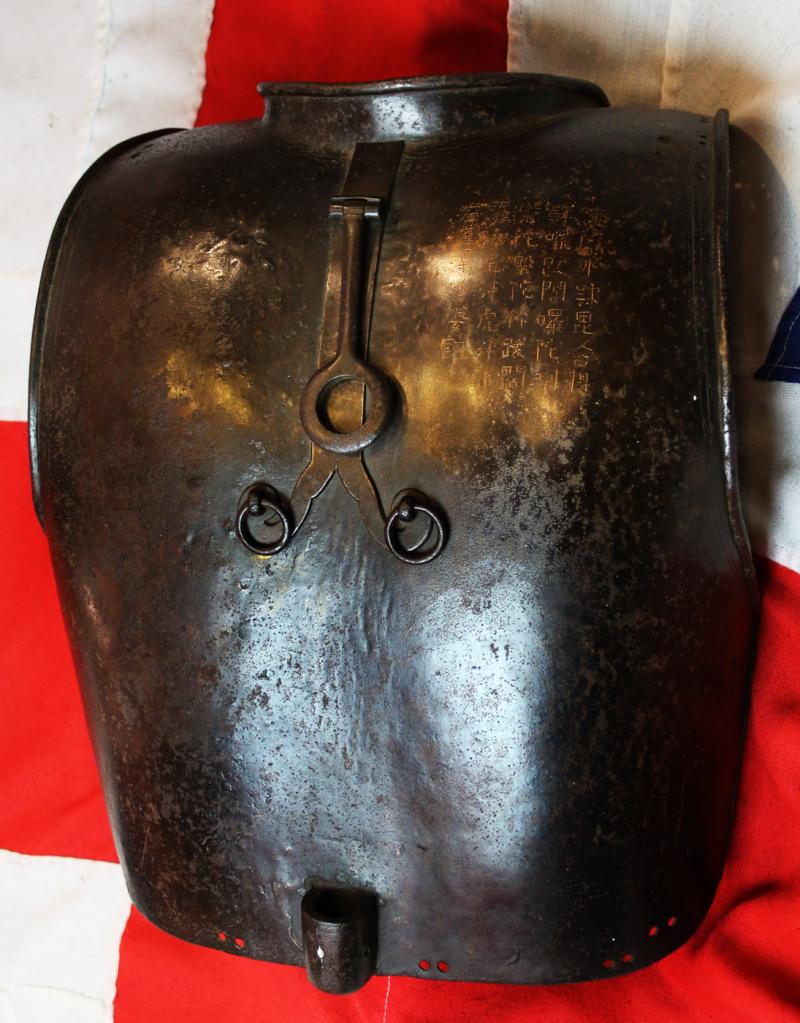
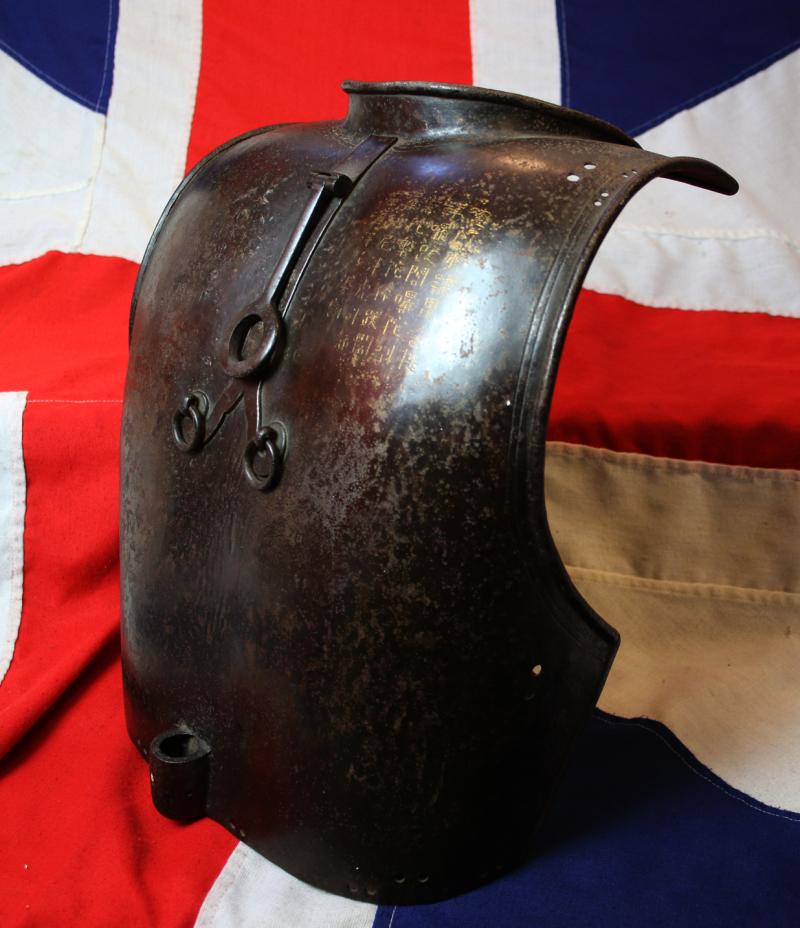
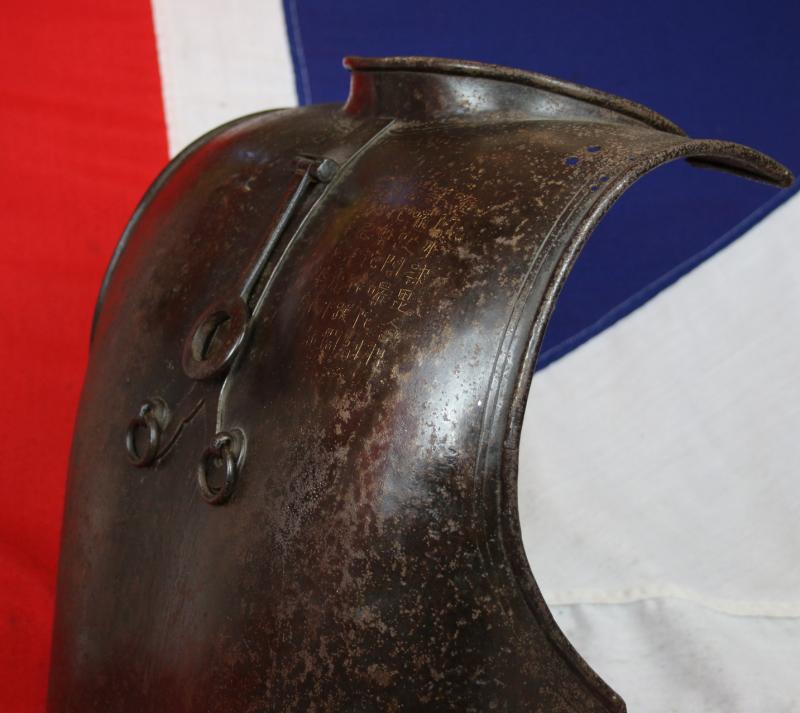
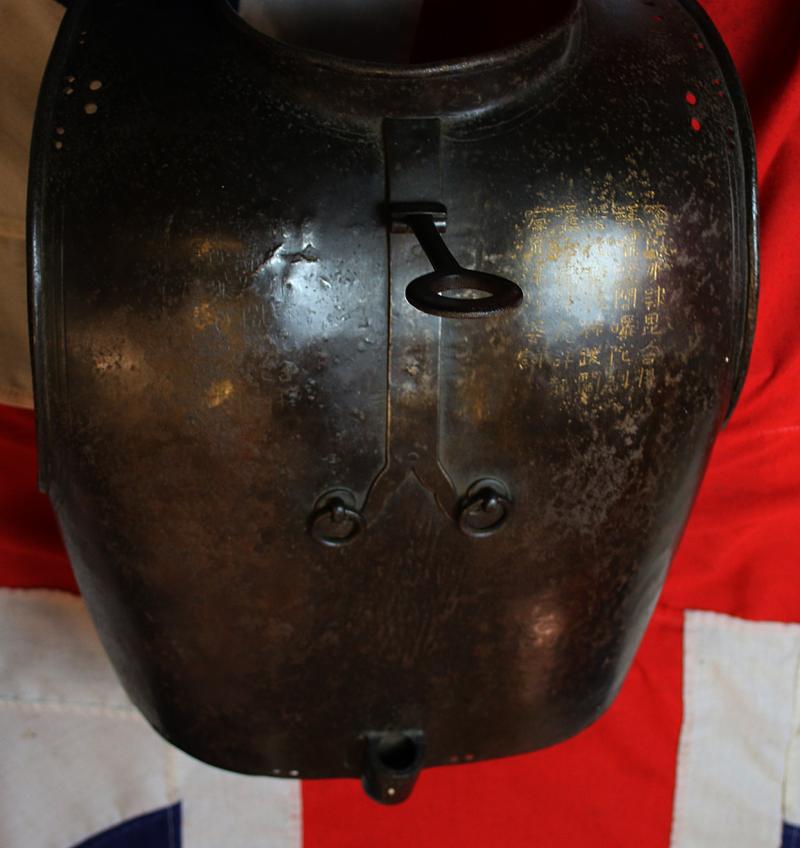
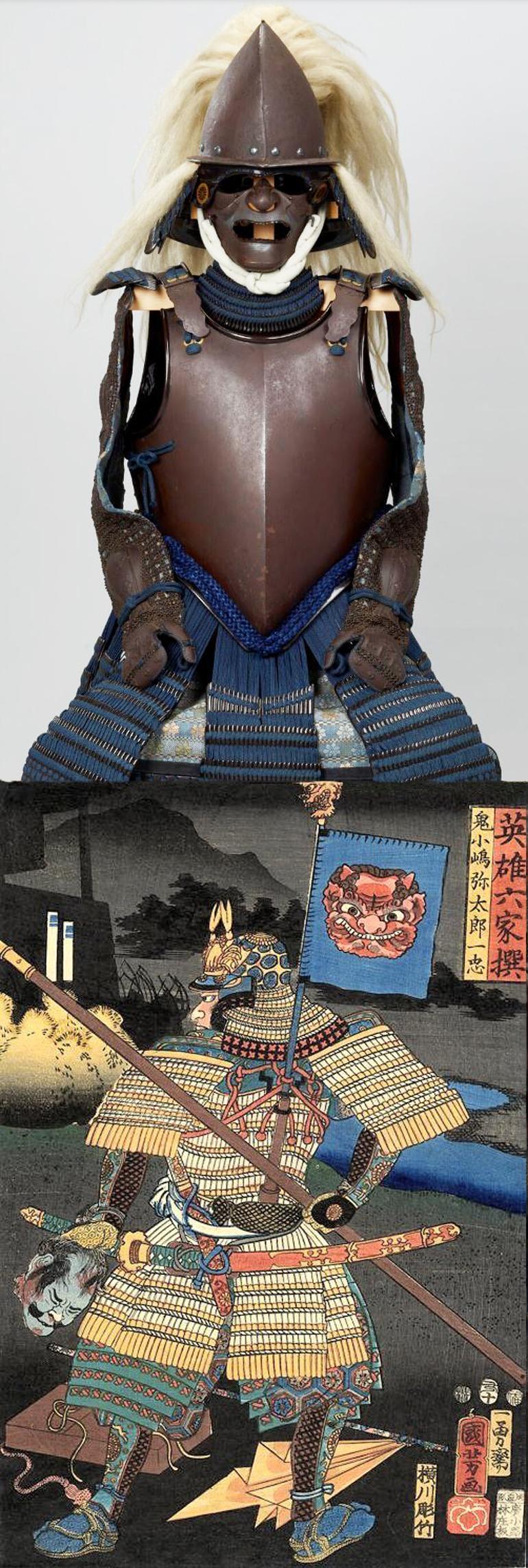
An Incredibly Rare Samurai Nanban-Do Gusoku {Southern Barbarian Steel} Armour 16th-17th Century Cuirass Dou {Body Armour} Made From The Cuirass of a 1530's Spanish or Portuguese 'Black Ship' Trader. The First Europeans To Arrive in Japan
Another really rare museum piece from the collection of likely the world's greatest authority, and author on Japanese polearms & their use in combat.
A superb, really rare and valuable, piece of early, original, samurai armour, created from the earliest armour worn by the first European visitors to Japan, that arrived in the 'Black Ships', as depicted in the fabulous historical novel {and films} 'Shogun' by James Clavell.
Such armour, was, and is, very rare indeed, it is incredibly sought after, and can be valued ten to twenty times the price that traditional, old, original samurai domestic armour.
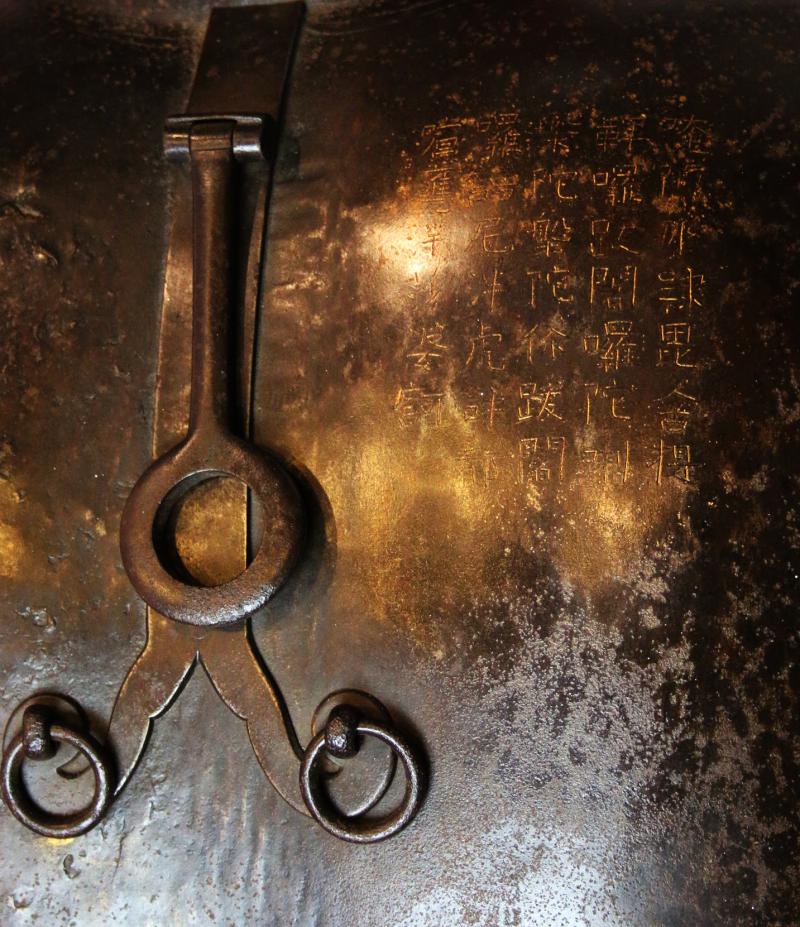
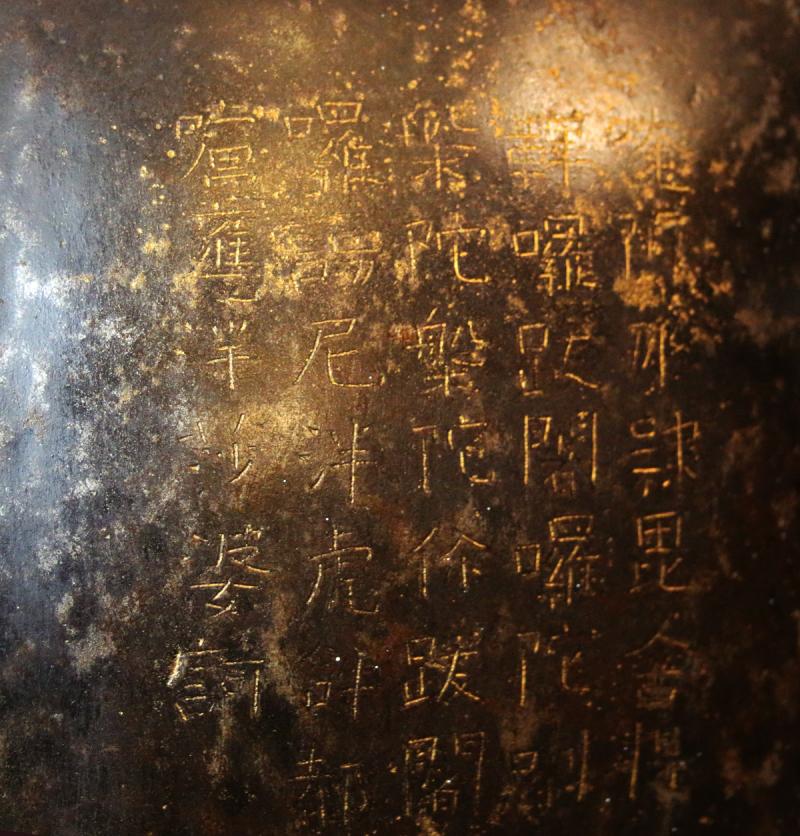
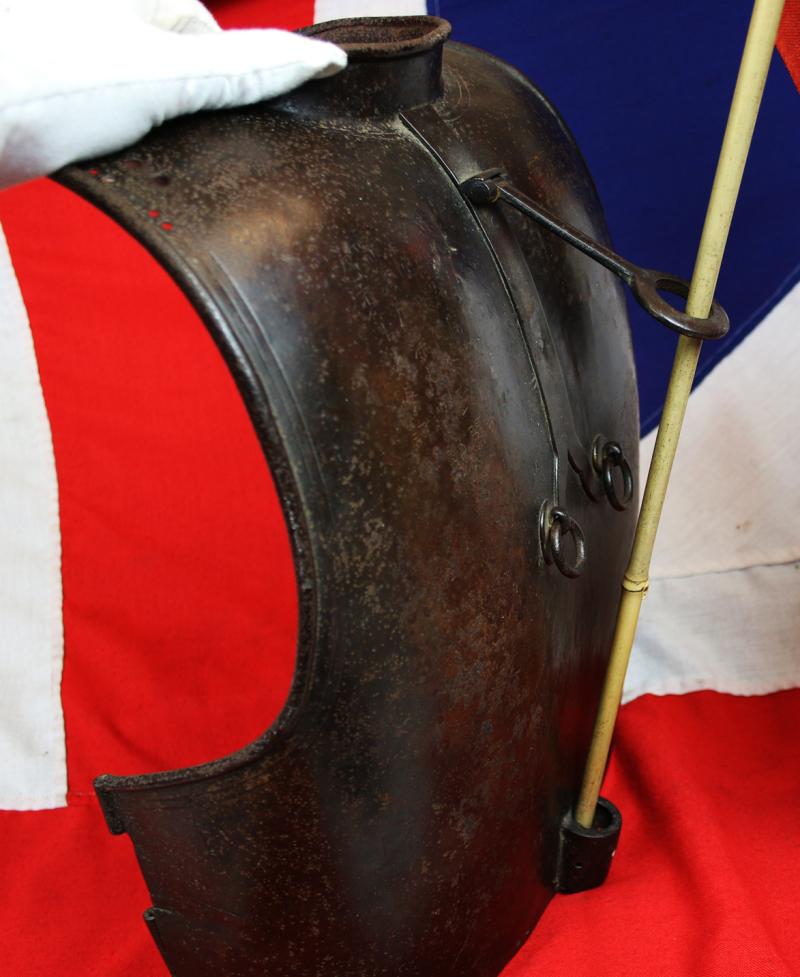
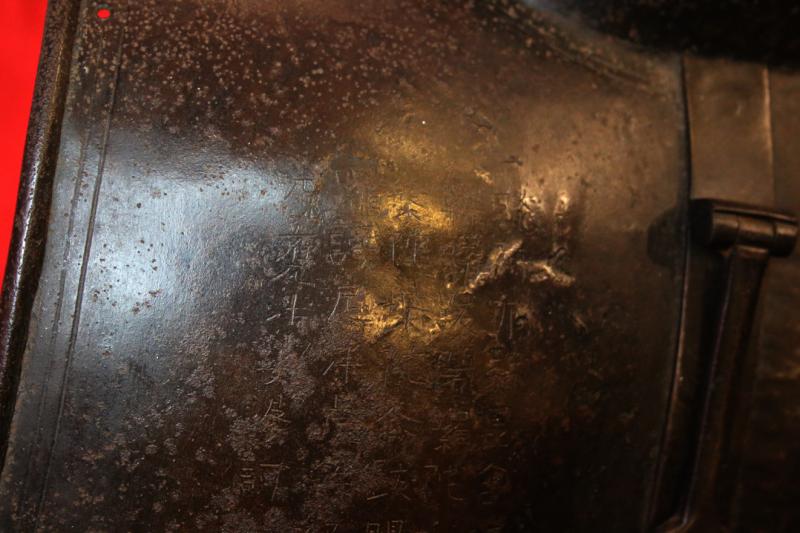
An armour cuirass or dou {in Japanese} that is fitted with a complete sashimono mounting system, and, an incredible two sections of early engraved script, of thirty five kanji, in seven rows, and one section on the front right is highlighted in gold lacquer colour.
We sent a scan to our dear friend in Japan and requested assistance in order to translate it, and, we received a very kind, and prompt, reply. He believes it’s an ancient form of kanji thus difficult to read {unless one has been taught specifically how to, one conjectures} but, it is some kind of divine text to ask assistance from the gods to embolden the samurai’s strength, alongside additional divine power requested from those same gods.
We have never seen its like before.
Sashimono Mounting System Components;
The banner was held in place by a specialized, two-part system attached to the back of the armour's main chest piece, the dō (dou):The ukezutsu (socket) is a tube, often square-shaped, that held the bottom of the banner pole. This was typically located at the lower rear of the cuirass.
Called a gattari (bracket) is a metal fixture situated at shoulder level on the back of the dō, often hinged, designed to secure the pole in an upright position, and fold back down when not in use holding the sashimono
European armour was brought into Japan through trade with Spain and Portugal in the 16th century. Later the Japanese would adapt them and imitate them and began producing them in Japan, which were collectively called Nanban Dogusoku (Nanban Armour). The yoroi armour we show in photo 9 in the gallery, was given to Sakakibara Yasumasa by Tokugawa Ieyasu right before the Battle of Sekigahara (1600) and has since been handed down to the Sakakibara family. That suit nanban armour would be priceless, but similar suits of nanban armour, of the same period, but without the history that the Sakakibara gosuko armour has, are valued up to 100K today or even more. with that photo is a Japanese print showing how the sashimono flag was mounted upon the samurai do cuirass armour.
Tokugawa Ieyasu also wore a nanban armour at the battle of sekigahara. Ieyasu's armour is composed of an Italian peascod cuirass {dou} from circa 1580, a gorget fitted over the cuirass as a "manchira" (derived from the Spanish term 'mantilla', i.e., "mantle" or "cloak"), and a helmet of the Spanish cabasset type
The story of the traders is beautifully conveyed in the novel Shogun James Clavell. William Adams was the principle character, based on the first English real life 17th century navigator adventurer who traveled to Japan, depicted in James Clavell's epic masterpiece "Shogun". Sadly for him, he was never again allowed to leave Japan and return to his family in England.
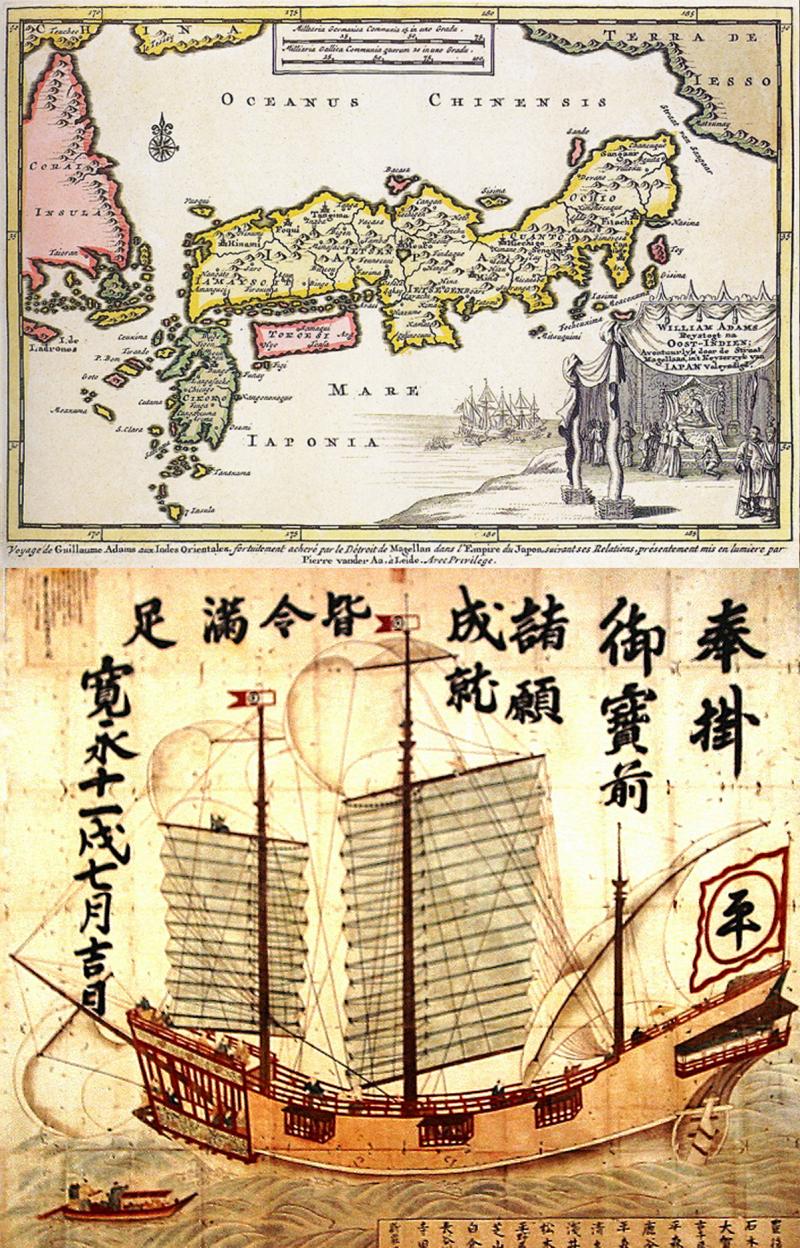
It is a wonderful and historical part of rare samurai plate armour. English navigator, William Adams, who became a close advisor to the Shogun, and known in Japan as Anjin. However, John Adams became such a highly regarded 'foreigner' within the shogun's court. A picture in the gallery is a print of the Tokugawa's Red Seal ships based on the navigators own ship, and a period print of Richard Adams being presented to the shogun, alongside a contemporary map of Japan as it was detailed on European maps in the early 1600's.
William Adams English navigator, also known in Japan as Miura Anjin, was born in 1564 in Gillingham England
(born 1564, Gillingham, Kent, England—died May 26, 1620, in Hirado, Japan), he was a navigator, merchant-adventurer, and the first Englishman to visit Japan.
At the age of 12 Adams was apprenticed to a shipbuilder in the merchant marine, and in 1588 he was master of a supply ship for the British navy during the invasion of the Spanish Armada. Soon after the British victory, he began serving as a pilot and ship’s master for a company of Barbary merchants. In June 1598 he shipped out as pilot major with five Dutch ships bound from Europe for the East Indies (present-day Indonesia) via the Strait of Magellan. The trouble-ridden fleet was scattered by storms, and in April 1600 Adams’s ship, the Liefde (“Charity”), its crew sick and dying, anchored off the island of Kyushu in southern Japan, the first northern European ship to reach that country.
Adams and the other survivors were summoned to Osaka, where Tokugawa Ieyasu—soon to become the shogun of Japan—interrogated mainly Adams about a variety of political, religious, and technological topics. Ieyasu was so impressed with Adams’s knowledge, especially of ships and shipbuilding, that he made the Englishman one of his confidants. Adams was given the rank of hatamoto (“bannerman”), a retainer to the shogun, and was awarded an estate at Miura, on the Miura Peninsula south of Edo (now Tokyo). Despite those honours, in the early years of his sojourn Adams repeatedly expressed his desire to return to England (where he had a wife and family, whom he eventually was able to continue to support) but was refused permission. He thus became permanently settled in Japan, married a Japanese woman, and came to be known by the name Anjin (“Pilot and Navigator later called Miura Anjin.
Adams oversaw the construction of Western-style ships, wrote letters on behalf of the shogun encouraging Dutch and English traders to come to Japan, and then officiated between the shogunate and the traders who began visiting the country. In 1613 he helped to establish an English factory (trading post) for the East India Company at Hirado, in Kyushu northwest of Nagasaki. Adams was allowed to undertake several overseas voyages between 1614 and 1619, traveling as far as Southeast Asia. His name is still revered in Japan with a district of his estate still bearing his name and his story is detailed in the magnificent epic book and film Shogun by James Clavell.
Code: 26216
6500.00 GBP