
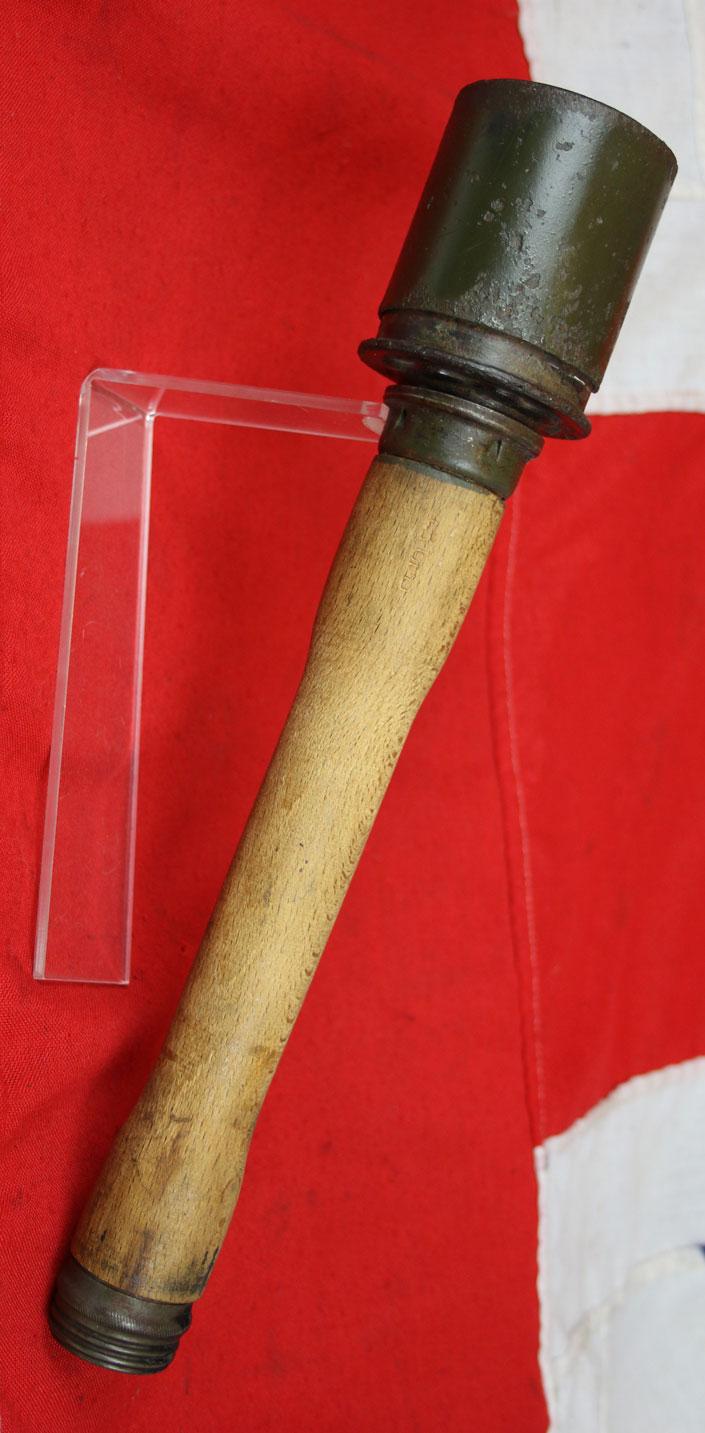
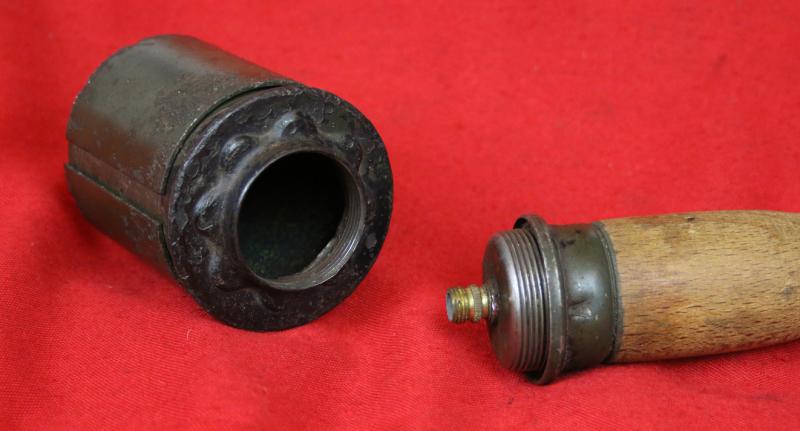
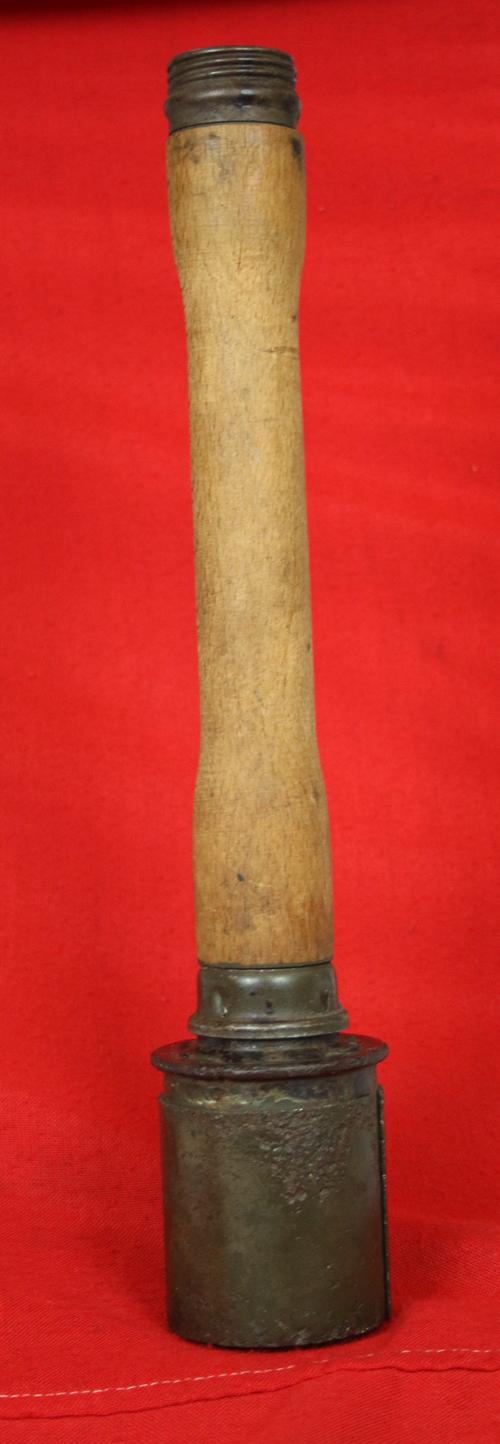
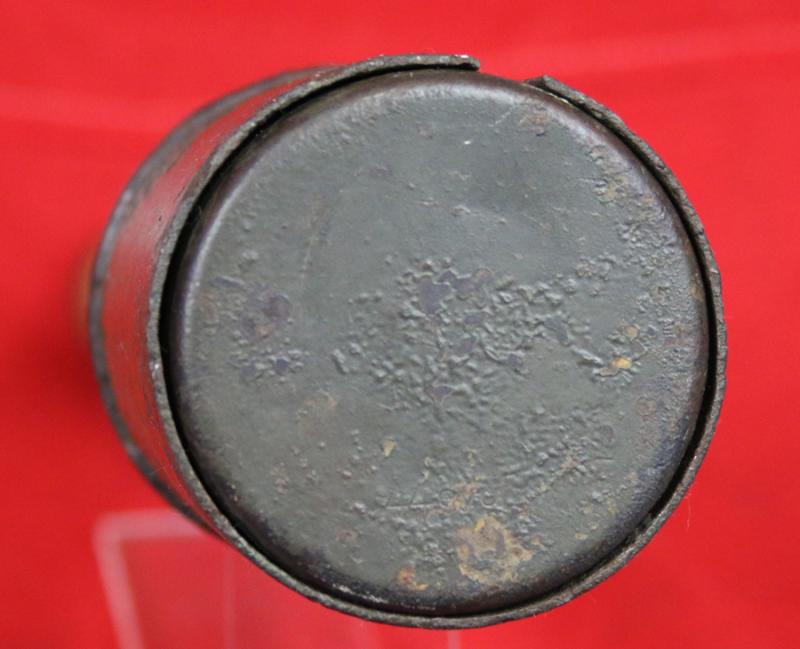
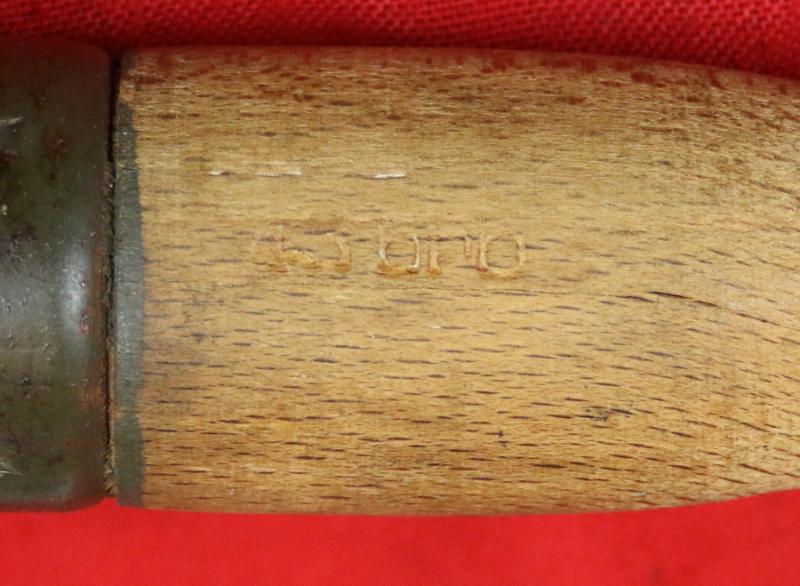
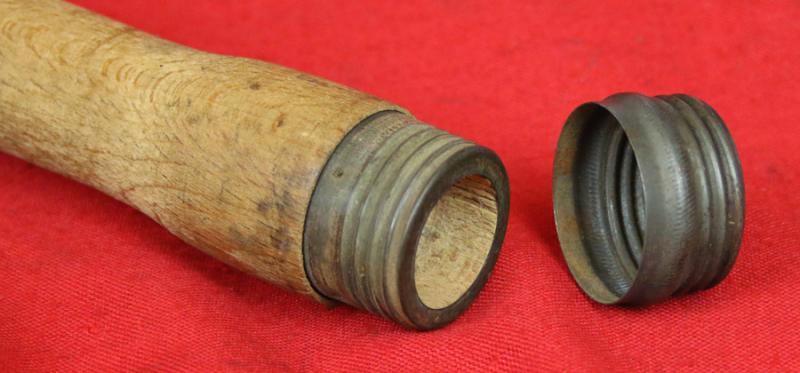
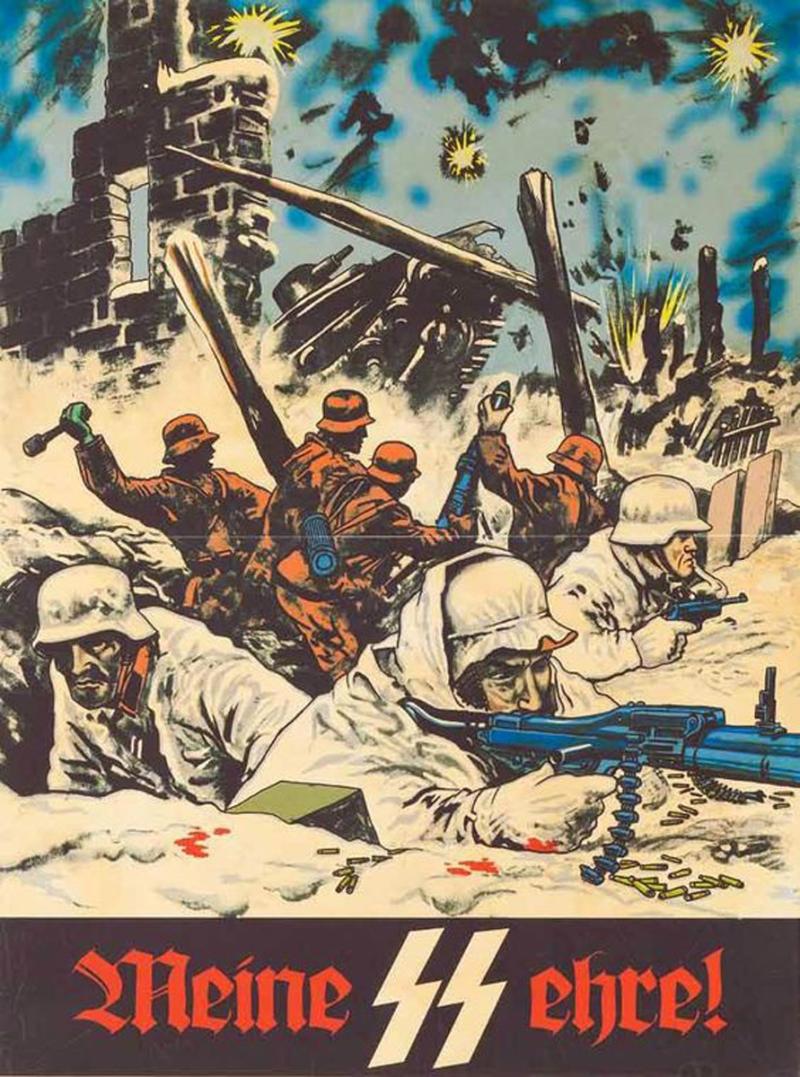

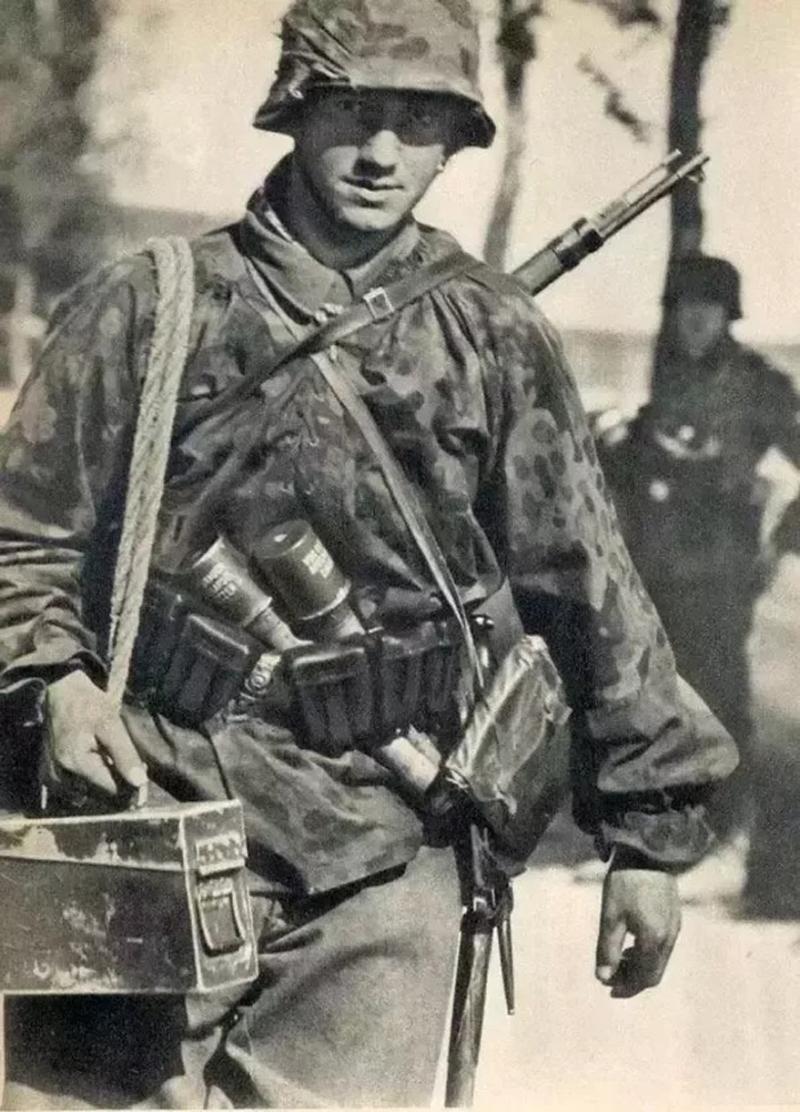
A Superb, WW2 Issue Stielhandgranate {German Stick Grenade} M24, WW2 Issue. In Excellent Condition For age. With Rare Fragmentation Ring, A Shrapnel 'Splitterring'. Issued To All Combat Ground forces Of The SS, Heer, Kriegsmarine, and Luftwaffe .
A great original souvenir of WW2 combat. you would have to go a long way to find a better example. With a loose pull-cord porcelain bead under the handle cap.
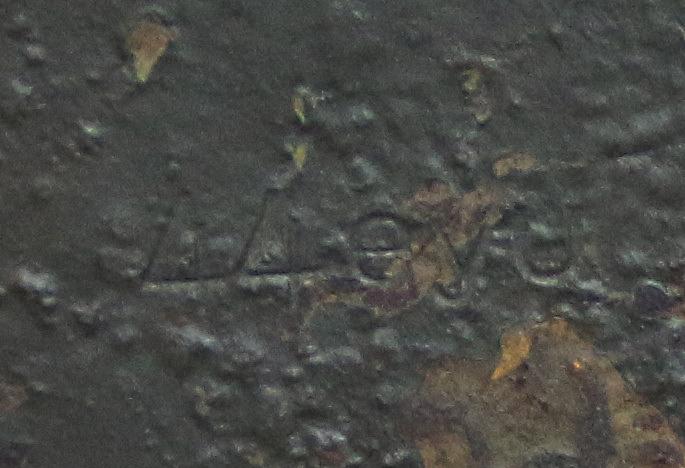
Overall in excellent condition, with maker code stamps to the top and wooden haft.
The Stielhandgranate 24 (M24) "potato masher" was primarily an offensive, concussion-based weapon designed to stun and kill through blast overpressure rather than shrapnel. Because its thin metal casing produced limited fragmentation, a specialized fragmentation sleeve—often referred to as a Splitterring (fragmentation ring) or shrapnel sleeve—was developed to increase its lethality.
The sleeve was designed to slide over the standard Stielhandgranate explosive head to create a "defensive" grenade that scattered high-velocity shrapnel over a wide area, according to a Reddit post and a forum discussion.
It consisted of a pre-scored or solid steel sleeve designed to break into multiple fragments upon detonation.
These sleeves were designed to convert the offensive stick grenade for defensive purposes, but they were often in short supply, limiting their deployment.
They were used to increase the destructive power of the grenade, which was particularly important for defensive combat scenarios where a wider, fragmentation-based lethality was desired.
Collector Item: Due to their specialized nature and the conditions of WWII, finding an authentic, original shrapnel sleeve with a stick grenade is rare.
While the standard M24 was a concussion grenade with an effective kill radius of only 10-12 meters (mostly in enclosed spaces), the addition of this sleeve significantly enhanced its effectiveness in open ground
The Stielhandgranate (German for "stick hand grenade") was a German hand grenade of unique design. It was the standard issue of the German Empire during World War I, and became the widespread issue of Nazi Germany's Wehrmacht during World War II.
The very distinctive appearance led to it being called a "stick grenade", or "potato masher" in British Army slang, and is today one of the most easily recognized infantry weapons of the 20th century
Germany entered World War I with a single grenade design: a heavy 750-gram (26 oz) ball-shaped fragmentation grenade (Kugelhandgranate) for use only by pioneers in attacking fortifications. It was too heavy for regular use on the battlefield by untrained troops and not suitable for mass production. This left Germany without a standard-issue grenade and improvised designs similar to those of the British were used until a proper grenade could be supplied.
The "stick grenade" first appeared in the midst of World War I; it was introduced in 1915 for use by the German Empire's armed forces. As time went on, the design further developed, adding and removing certain features. Aside from its unique and unusual appearance, the Stielhandgranate used a friction igniter system, a method very uncommon in other nations but widely used in German grenades.
During World War I, the original design of the Stielhandgranate, under the name M1915 (Model 1915), was in direct technological competition with the British standard-issue Mills bomb series. The first design model of the Mills bomb – the grenade No. 5 Mk. 1 – was introduced the same year as the German Model 1915, but due to delays in manufacturing it was not widely distributed into general service until 1916. (There was a small period of time where German troops had large supplies of new Model 1915 grenades, while their British opponents only had a very small number.)
As World War I progressed, the Model 1915 Stielhandgranate was further improved with various changes. These received new designations corresponding for the year of introduction, such as the Model 1916 and the Model 1917, and this one the M24
This item is empty, inert and safe, legal to own within the UK.
Not suitable for export.
Code: 26199
745.00 GBP