
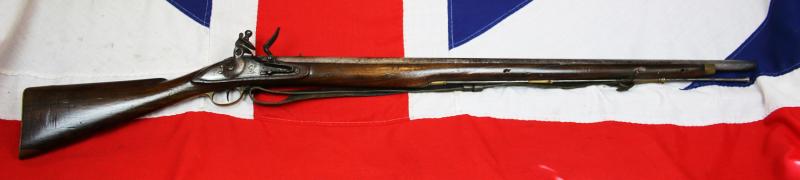
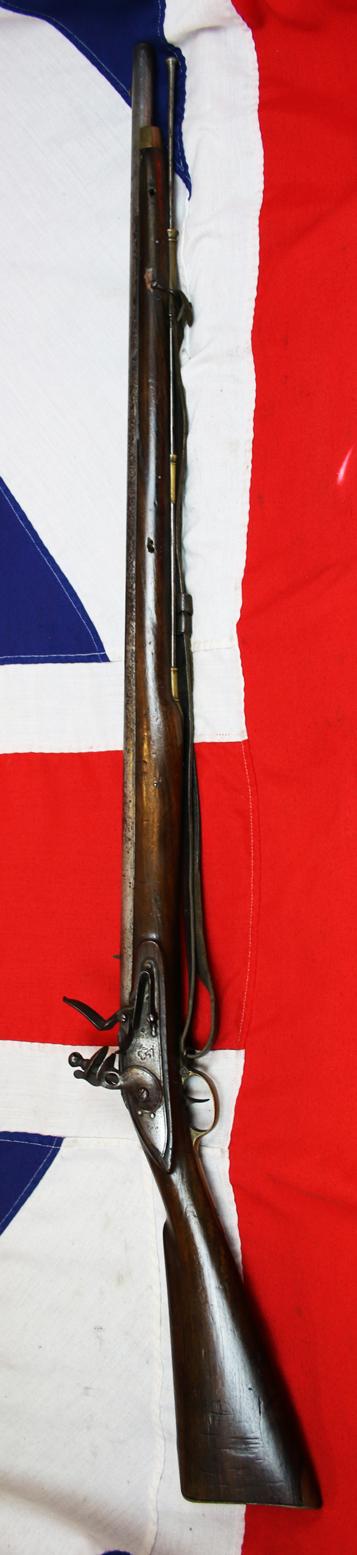
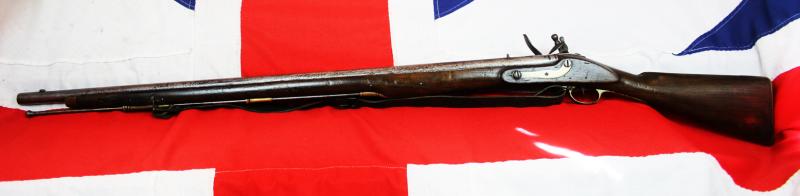
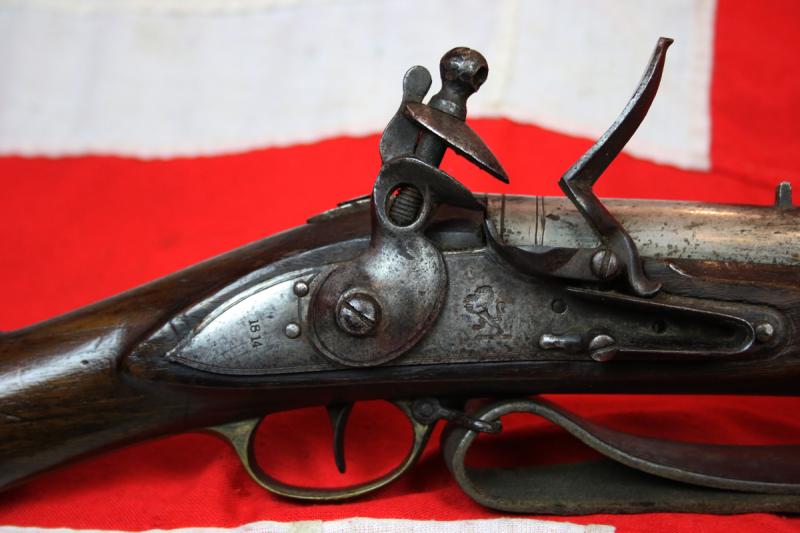
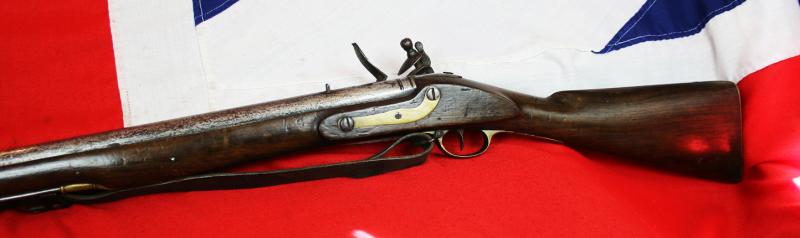
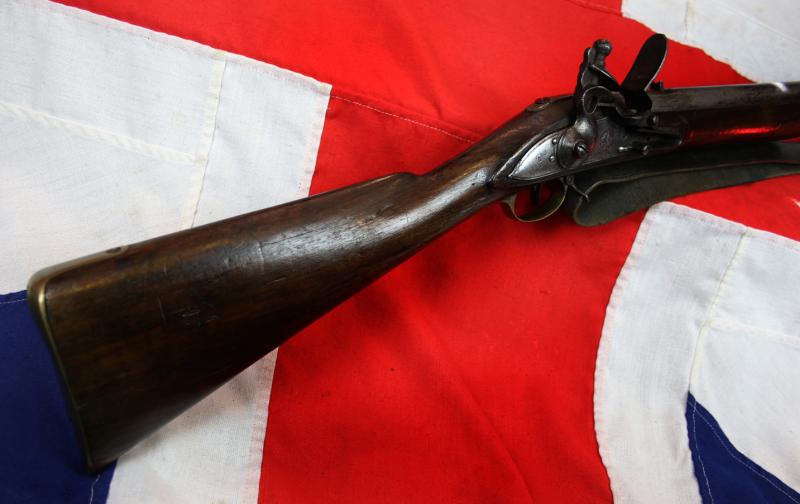
A Very Fine British ‘Brown Bess’ India Pattern Infantry Musket, Of The Napoleonic Wars Period. For Over One Hundred Years The British ‘Brown Bess’ Was The Most Famed and Feared Musket In The World. No Army In The World Failed To Respect Them
You would have to go a long way to find a better untouched example of a regulation ‘3rd Pattern’ ‘Brown Bess’ from the Napoleonic wars, and most importantly used from Quatre Bras and Waterloo
The stock has super patina, very sound, great condition, untouched and devoid of restoration and a great and fabulous feel of quality and heft.
A perfect example of an historic original Napoleonic ‘sleeper’ A musket, that once retired from British Army combat service, was placed in sound and dry storage, and has remained untouched for nigh on 200 years.
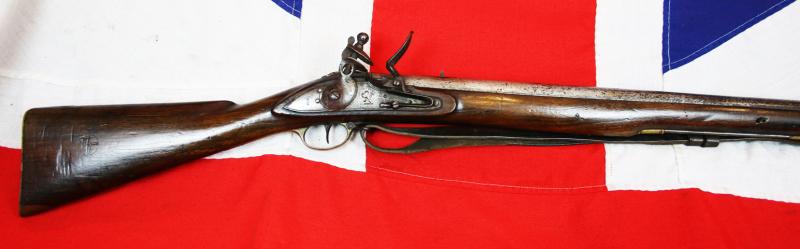
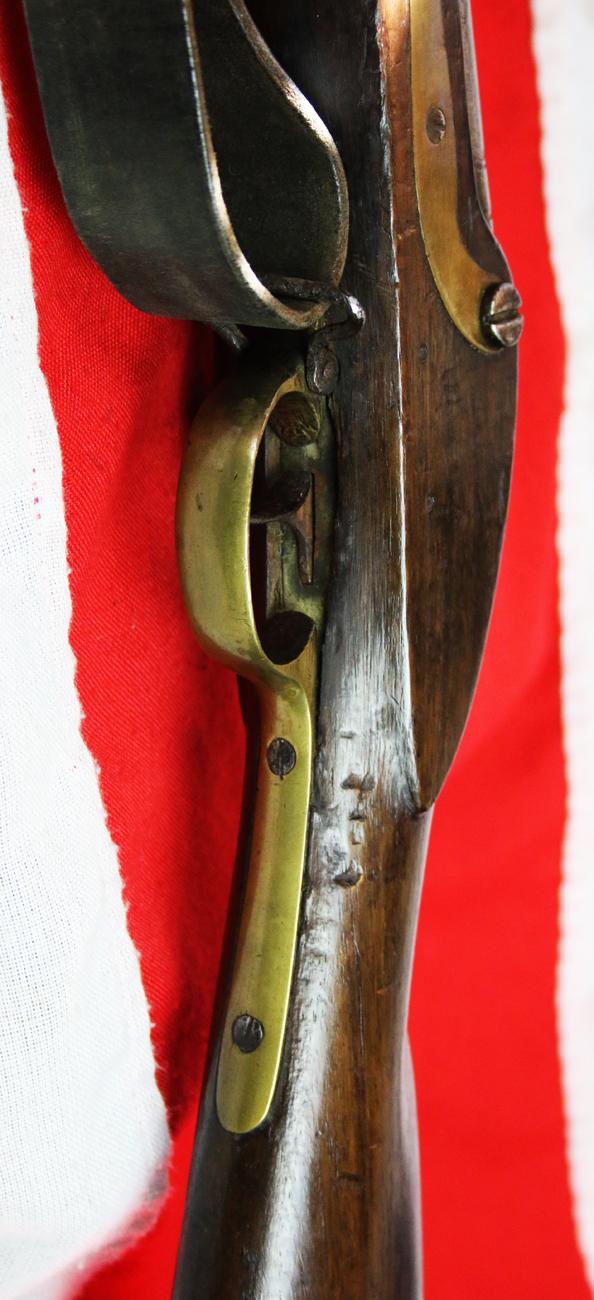
All the fittings are very good, a superb regulation length barrel, fine lock, trigger guard, butt plate, etc, ramrod, sling swivels and brass mounts, new land pattern flush fitting side plate with central screw to avoid recoil damage to the side nails. With a fine leather strap, good action, good proof marks, good inspection stamps, good dating. Effectively, everything you would want to see in an infantryman’s musket, that was contracted, supplied to the British infantry, and used in the last great battles of Napoleon from 1814 when he was first defeated, and most importantly, in his last Hurrah, the 100 Days War, the final Napoleonic War, a desperate gamble to reclaim his title, his throne and empire, culminating at Quatre Bras and Waterloo, and what a historical beauty!
In fact he very nearly succeeded, if it wasn’t for the tactical skill of the iron Duke, and his indomitable army, of fearless English, Scottish, Irish and Welsh infantryman and the great Prussian volunteers of the KGL. With the able last minute assistance from Field Marshal Blucher (*who, interestingly, and allegedly, believed he was pregnant during Waterloo) and his Prussians, direct from their battle and defeat at Ligny.
One of the 142,970 British contract made 'India Pattern' muskets turned over by the East India Co. army to the British Board of Ordnance for the Napoleonic wars, due to the urgent need for arms to counter Napoleon's massive armament reserve.
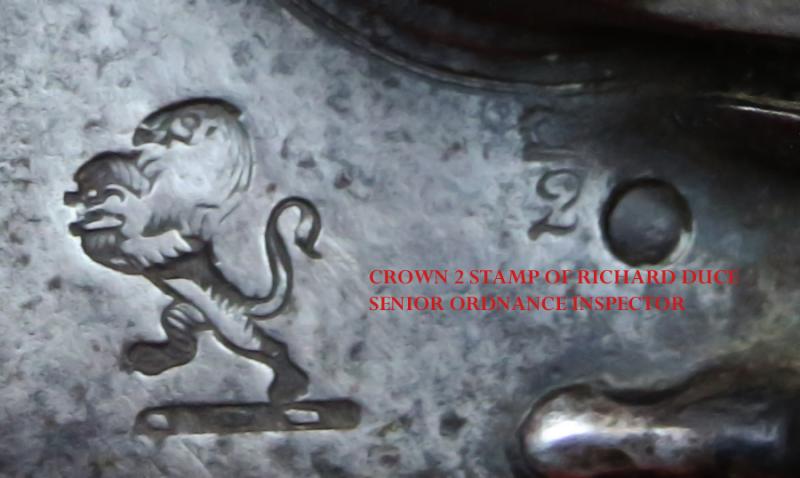
The lock is stamped by the primary, senior ordnance inspector, Richard Duce {his mark of Crown 2}. Who was also the controller of tempering & hardening of locks, after their arrival from the stores for fitting to the musket, and apparently he inspected all the EIC bess that were handed over to the British Ordnance for the Napoleonic Wars. An account that was confirmed to us by our friend and historic colleague, Howard Blackmore of the Tower of London armoury.
The musket was the standard weapon issued to the British soldier throughout the 18th and early-19th centuries. It would be the 'India', also known as the 'Third Pattern' Brown Bess musket that would play a central and pivotal role in the wars against Revolutionary and Napoleonic France.
By the end of the American Revolutionary War in 1783, the British Army was armed with the Pattern 1777 and Pattern 1779(S) Short Land Pattern musket. This was a musket made to the strict quality guidelines of the Board of Ordnance, and was characterised by its 42 in barrel. After the war the expectation was for a period of peace, a time when the need for Ordnance materials would be low, so the standing contracts for the Pattern 1777 and the Pattern 1779(S) musket were cancelled. Parliament was not prepared to fund equipment it deemed unnecessary, so financial retrenchment was the order of the day. No change there then
The world changed in 1793, a mere 10 years after the loss of the American colonies. Britain found itself once again at war, this time with Revolutionary France. An army now reduced in size to an authorized strength of only 44,432 men had to be expanded rapidly, along with the local militia and volunteer forces. The call for muskets was huge. Indeed, in 1793 the total stock of muskets in armouries around Britain, including the central arsenal at the Tower of London, was around a mere 60,000. The stocks held in French arsenals amounted to over a very sensible 700,000.
Something needed to be done. At first the Board of Ordnance tried to ramp up production of the Short Land Pattern muskets by engaging new contractors. Yet despite producing over 31,000 muskets in 1793 the numbers were still woefully inadequate for the expanding forces.
The Board of Ordnance had to fill the gap. They did this by ordering 10,000 muskets from the Birmingham gun trade and 10,000 from their usual emergency suppliers in Liege, Belgium. However this was still not enough, especially as the private contractors in both Birmingham and London were hard at work fulfilling orders for the private trade and for the East India Company, one of the biggest private purchasers of military arms. To begin to solve this lack of supply the Master General of the Ordnance, the Duke of Richmond, suggested to the government that they persuade the East India Company to sell their stocks of muskets to the government and also to agree not to place any further orders until the Ordnance's requirements were met.
The duke wrote to the Home Secretary, Henry Dundas, on the matter. As Chairman of the Board of Control of the East India Company Dundas had earlier been instrumental in securing parliamentary approval for the renewal of the East India Company's monopoly. The duke stated that he was: 'aware how unpleasant it must be to take such a step, and to deliver out to our troops these East India Company muskets, but ... the least important must give way to the most; and you will be best able to judge whether the East India Company can admit of a delay in respect of theses arms. And altho' they might not be quite so perfect as ours, they undoubtedly must be serviceable ones, and such as the new Raised Corps must put up with on the current Emergency.'
This suggestion was met with agreement, and the idea of introducing the East India Company's arms into British Army service was conceived. By the end of 1794 the East India Company had delivered 29,920 muskets into government stores, all that they could spare. Indeed transactions for East India Company muskets would continue throughout the duration of the Revolutionary and Napoleonic wars. By 1815, the East India Company had sold the Board of Ordnance at least 142,970 small arms.
The musket that the East India Company supplied was one originally designed by General Lawrence for East India Company service, altered and simplified by Lieutenant Colonel Edward Windus in 1771. The musket in Company service became known as the 'Windus' pattern. In 1795, the Board of Ordnance began to order 'India Pattern' muskets on its own account and by 1797 it officially adopted the musket as the Model 1793 and began to place substantial orders for it with the Birmingham gun trade.
The Model 1793 India Pattern musket was standardized by the Board of Ordnance in 1797, taking account of its comparable cheapness, simplicity of design and ease of manufacture. By the end of 1797, the Birmingham gun trade was able to deliver some 72,000 muskets to the government proof house at Bagot Street. The success of this model was self evident, along with its slightly modified successor the Model 1809 India Pattern. They produced at an average price of 18 shillings and 5 pence (roughly £3,000 in today's money).
This fabulous example was one of those desperately required Brown Besses.
The Brown Bess musket was the standard weapon of the British infantry for more than a century. Soldiers on both sides of the War of 1812 employed it in battle, staring down its barrel at opponents across distances of less than a hundred yards.
Flintlock musket
The Brown Bess musket was the standard weapon of the British for more than a century.
British foot soldiers marched into battle with this musket—nicknamed “Brown Bess”—for more than 100 years. British redcoats used the Brown Bess to fight the War of Independence in the colonies, and many of their opponents in the Americans’ Continental army used it as well. British soldiers fighting in the Napoleonic wars carried it into battle, and it was the principal firearm used by the infantrymen who fought the War of 1812.
The Brown Bess had several distinctive features. It was a large-calibre weapon: the bullet it fired was a lead ball up to three-quarters of an inch in diameter, three times the diameter of a modern .22-caliber rifle round. The inside of its barrel was smooth: unlike more accurate “rifled” muskets used by the famous rifle regiments, the Brown Bess had a smooth bore with no grooves to make its fire more accurate. Soldiers loaded the musket through the muzzle, which meant that each bullet had to be forced down a longer than three foot barrel before firing. Even trained soldiers could only launch two or three shots per minute.
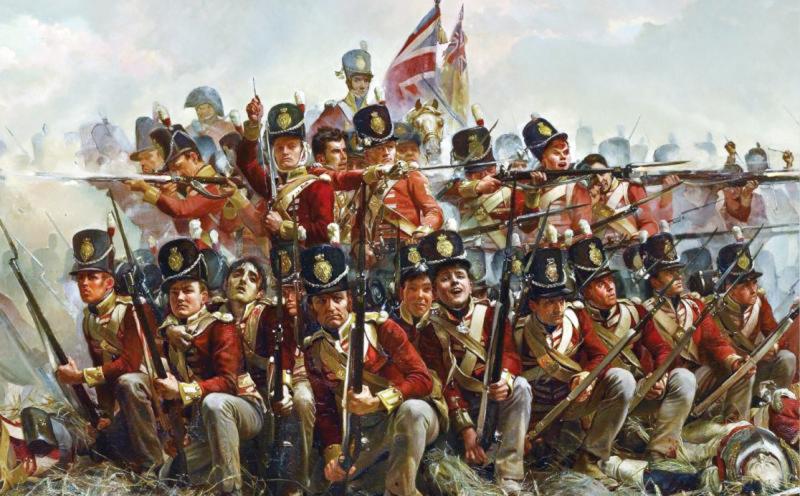
Because the weapon was slow to load and relatively inaccurate (experienced soldiers generally estimated its range between 50 and 100 yards), armies developed tactics that helped compensate for its shortcomings. The limitations of smoothbore muskets like the Brown Bess forced units employ “linear tactics,” in which a hundreds of soldiers stood in neat lines, shoulder-to-shoulder and out in the open. While such tactics appear decidedly unstealthy to twenty-first century eyes, they proved essential on the battlefields of all the conflicts which Britain was involved.
There, stealth was a low priority. Packing the men into blocs allowed officers to coordinate their troops’ fire into synchronized volleys. Firing a hundred guns in the same direction at once helped ensure that at least some, often most of the inaccurate musket balls found their targets. And grouping the men into neat lines out in the open helped commanders ensure that few of their troops gave in to the natural instinct to flee.
Of course, packing troops into blocks and fighting in the open required tremendous discipline from the individual soldiers. Infantrymen had to stand exposed to enemy fire as they loaded and fired their own muskets. And in some situations, soldiers learned the grisly dangers of fighting in lines—as at the Battle of New Orleans in the 1812 war, where American artillery attacked the exposed British formations with devastating effect.
The last photo in the gallery shows a photograph of one section of the collection in the museum of Waterloo, taken in around 1900, showing all the weapons of Waterloo en situ, including all the protagonists {British, French, Prussian and Belgian muskets, swords, pistols, armour uniforms, etc}. The museum was founded and owned by a veteran of the 7th Hussars that fought at Waterloo
*While Blucher’s "pregnancy" was a metaphor, it was widely joked about by contemporary figures as a sign of his mental exhaustion and stress following the war.
Code: 26181
3450.00 GBP