
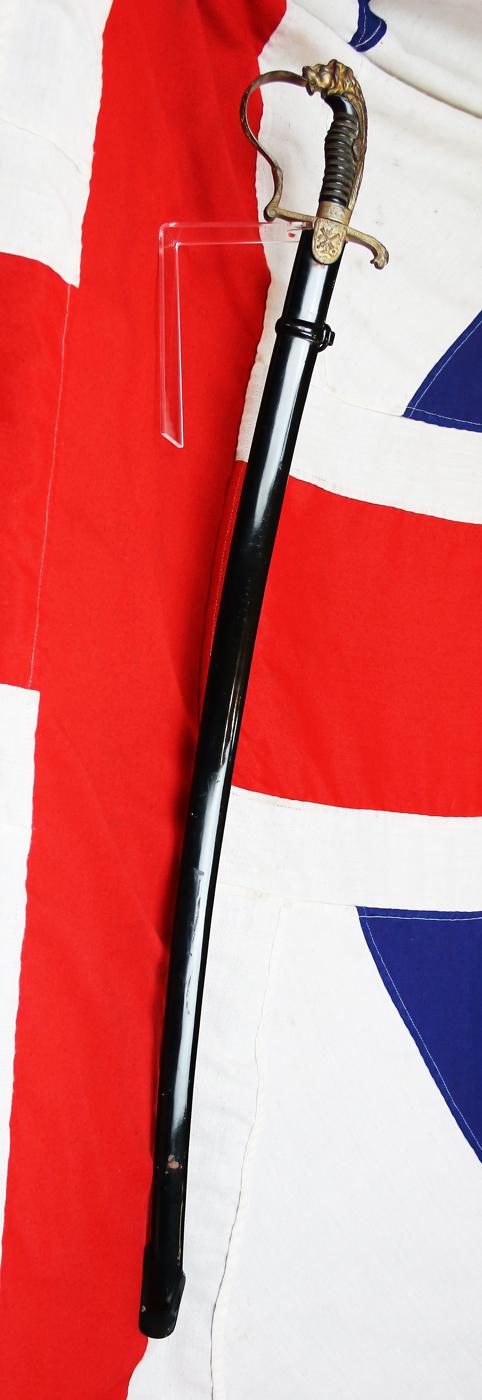
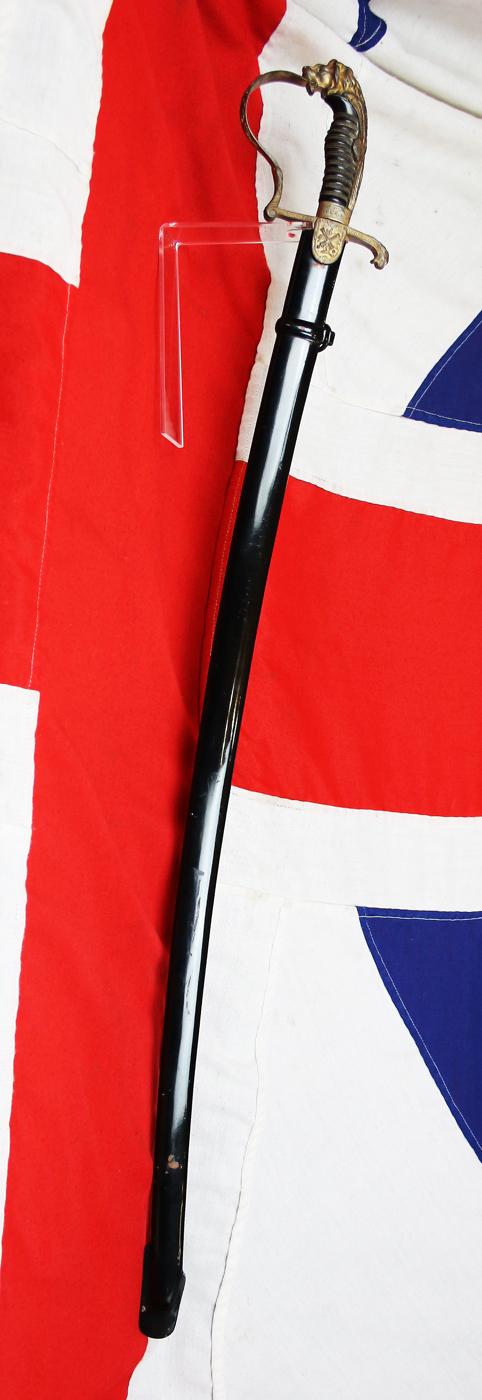
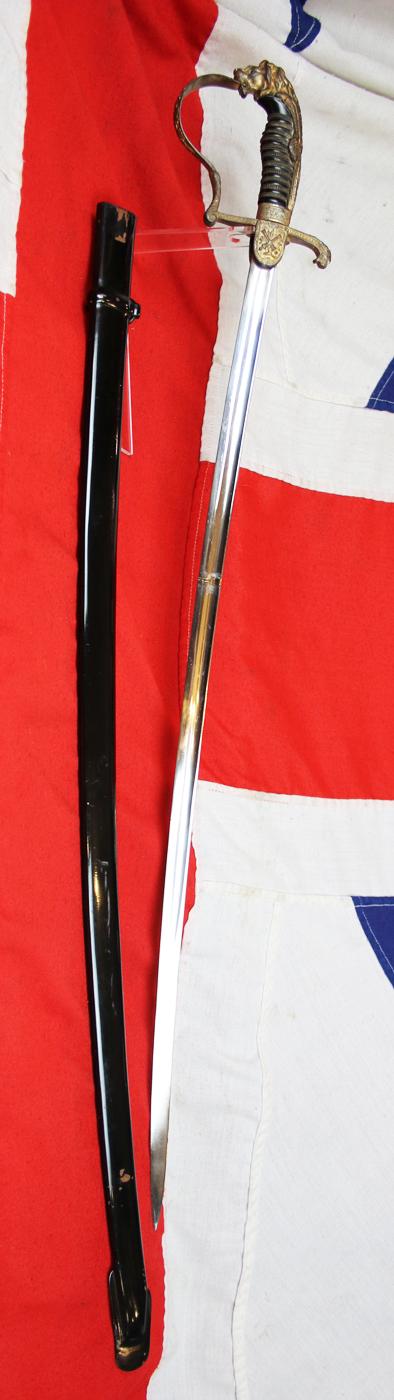
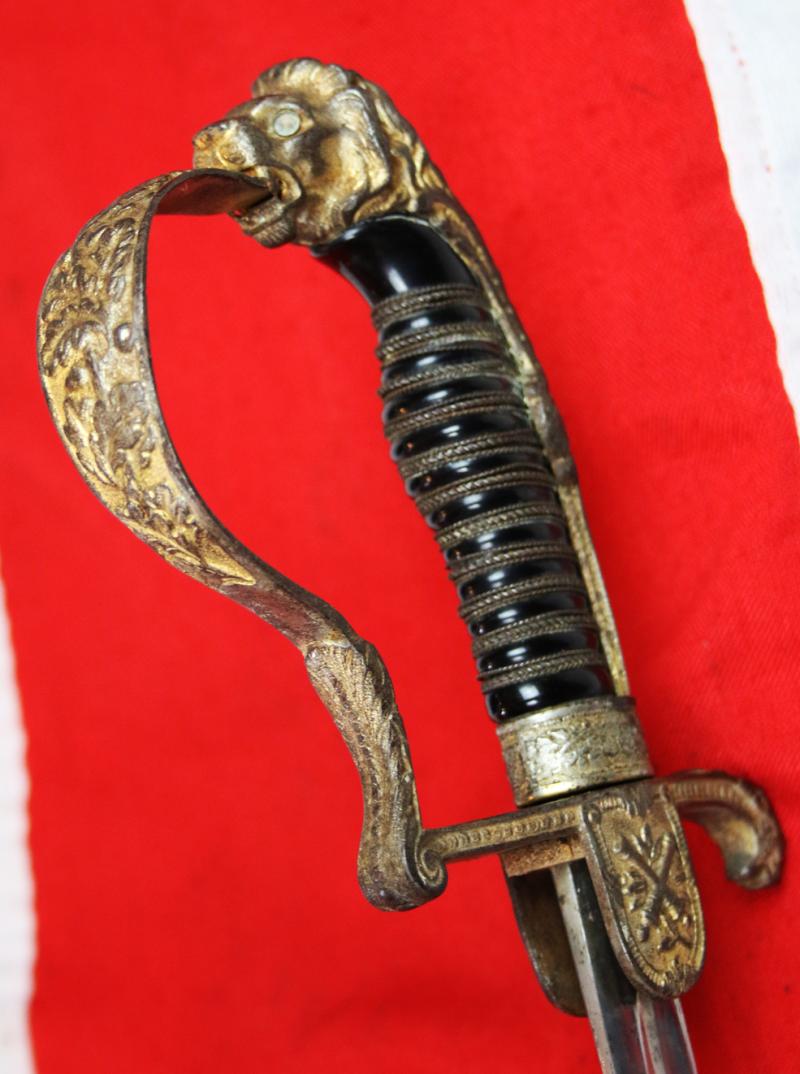
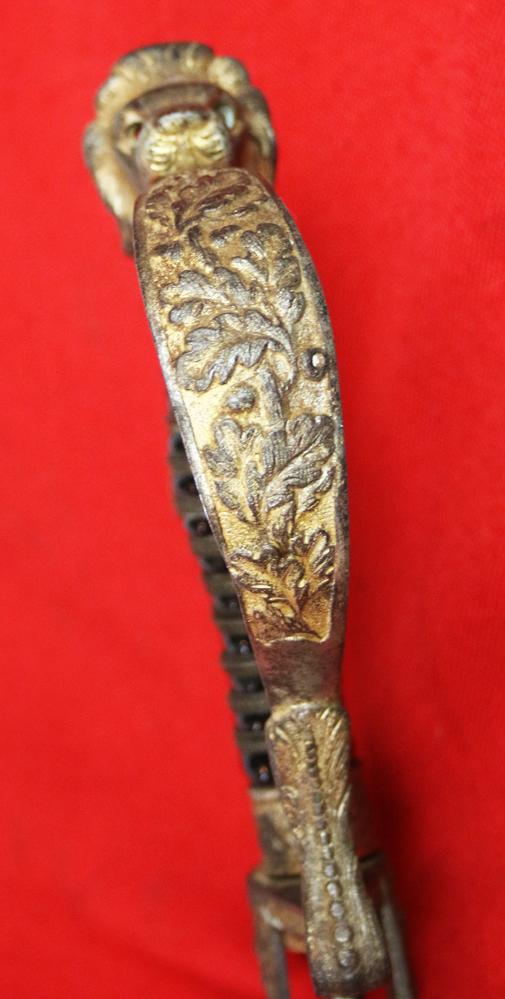
A Good Imperial German Artillery Officer's Sabre With Deluxe Lion Head Pommel Hilt, Lioness Quillon End and Embossed Oak Leaf & Acorn Pattern Design Throughout With Crossed Cannon Quillon.
Designed for use in WW1 but used into WW2 by senior officers that served in both wars, and were thus reluctant to use the later 'Nazified' sword patterns of WW2. Old school German officers {especially Naval Officers} were far more reluctant to display an affiliation to their Third Reich masters, than the new breed of younger officers.
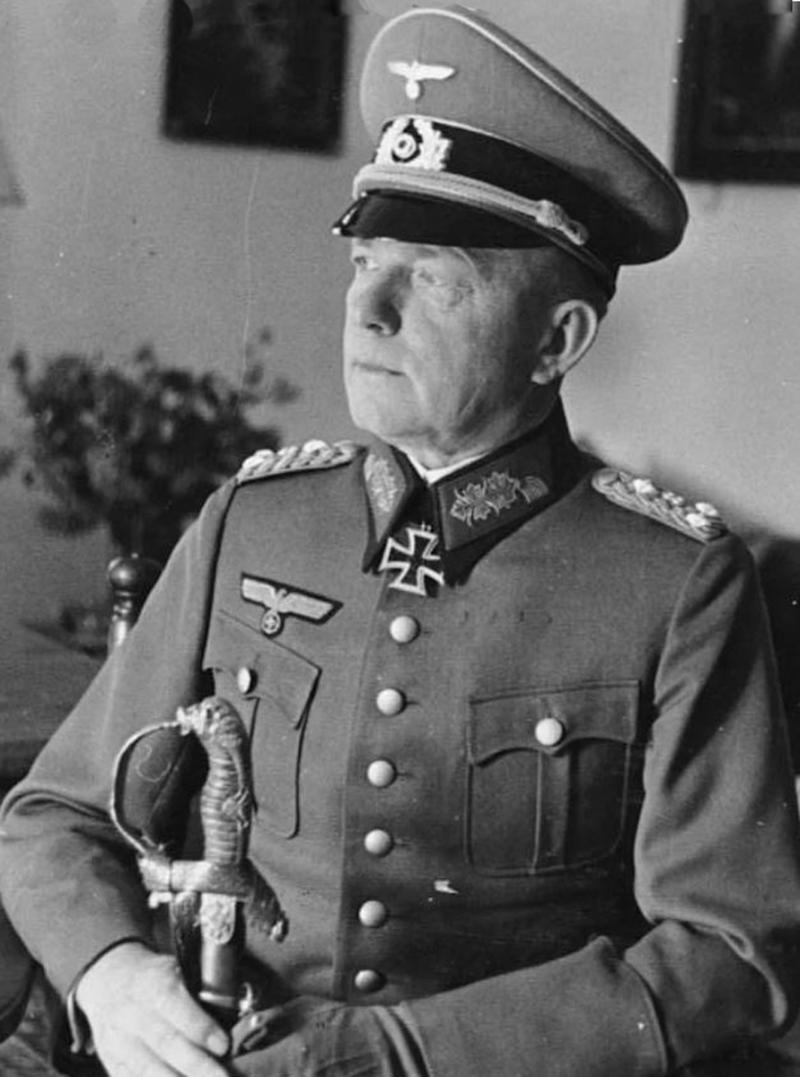
In the gallery we show a 1940 photograph of German general (later field marshal) Ewald von Kleist (1881-1954). Kleist notably commanded a panzer division in Operation Barbarossa in the Second World War (1939-45). In the photo he is holding his exact same Imperial German WW1 sword version.
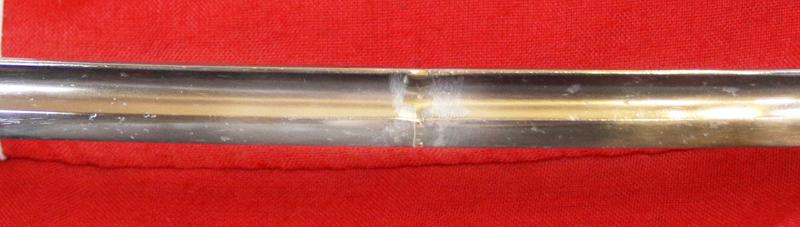
The blade in its working life has had a blade repair in the mid section.
The German artillery was categorized either as field artillery (Feldartillerie) – which also included the horse artillery (Reitende Artillerie) – or as foot artillery (Fußartillerie), which manned the army’s heavy artillery, howitzers and mortars. The horse artillery was intended for employment with cavalry divisions and the field artillery with infantry divisions. In 1913, the field artillery’s peacetime establishment consisted of 3,523 officers, 325 medical officers, 315 veterinary officers, 529 paymasters and assistant paymasters, 101 bandmasters, 214 artificers, 14,181 NCOs and 72,180 other ranks, with 57,327 horses. These personnel manned 3,732 guns and light field howitzers, with a further 54 guns designated for training use. All field artillery training and development was the responsibility of an inspector of field artillery.
The second category of artillery was the foot artillery, and in 1913 its peacetime establishment included 1,332 officers, 82 medical officers, 35 veterinary officers, 129 paymasters and assistant paymasters, 25 bandmasters, 50 artificers, 5,322 NCOs and 28,002 other ranks, with 3,391 horses. Training and development for all of the Prussian foot artillery regiments was the responsibility of an inspector of foot artillery, his inspectorate being organized as three sub-inspectorates. However, in peacetime the Bavarian ministry of war retained a measure of responsibility for the efficiency and preparation of the Bavarian artillery regiments for war.
One glass eye lacking.
Code: 26179
645.00 GBP