
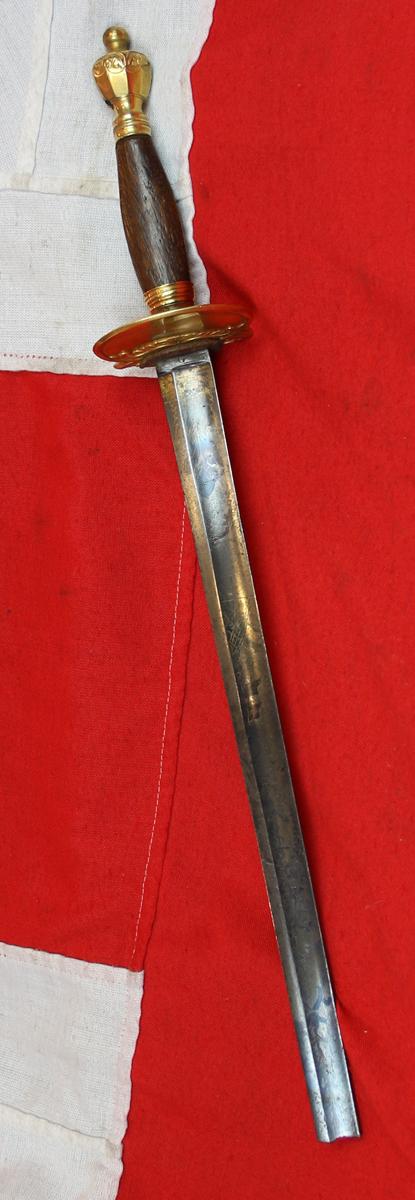
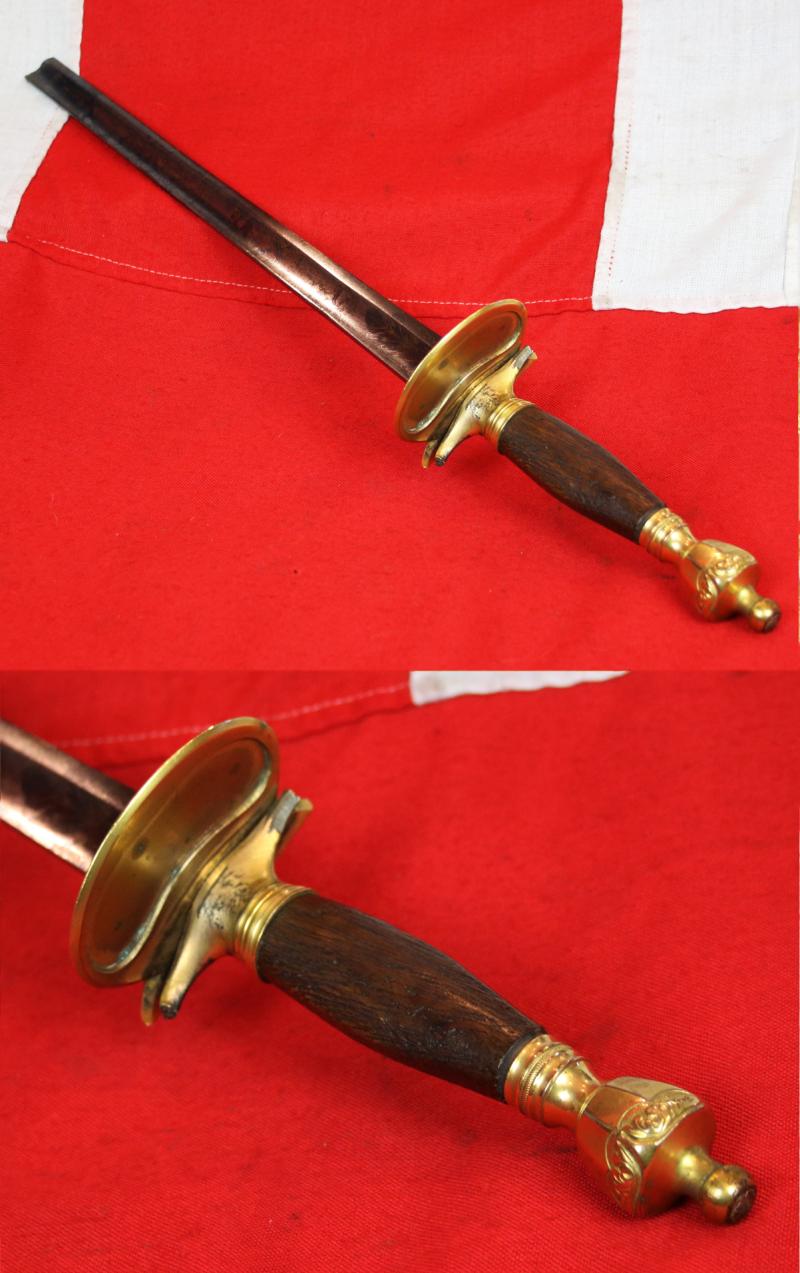
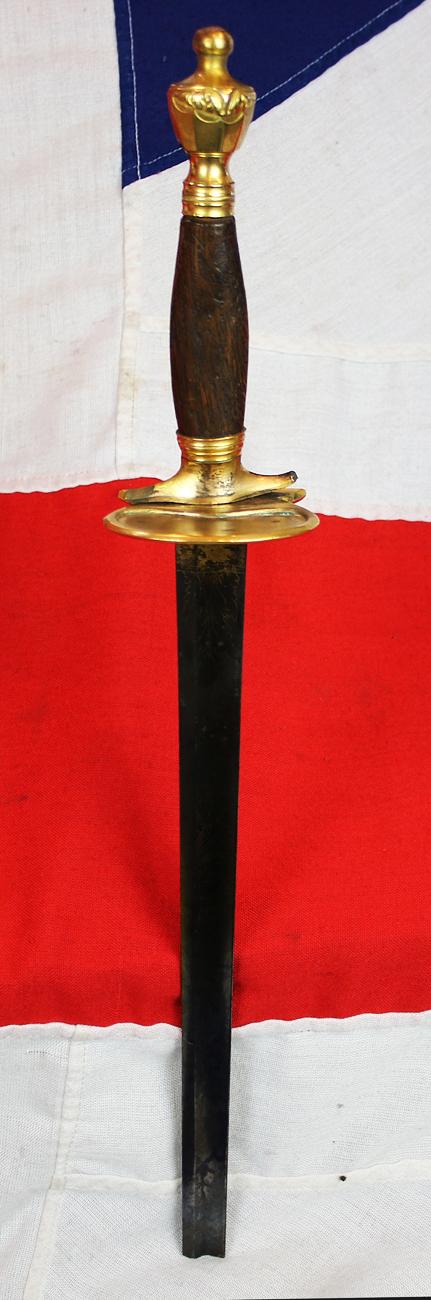
An Incredibly Rare, Trafalgar and Napoleonic Wars Period, Historic Sword of Huge Collectable Interest. A Battle Damaged Royal Marines Officer’s Sword 1796 Pattern. A Sword Type Unknown To Us For Over 100 Years Of Our Extensive Experiance
As one of the worlds leading sword dealers, of over 100 years combined experience, we have handled probably more swords than any other, still thriving, military antiques company in the world today.
However, we cannot recall ever handling, examining or even seeing a specific 1796 pattern British infantry officers, sword of a Royal Marines officer's design before. Not even in the Royal Collection or the National Maritime Museum.
We have seen bespoke swords made earlier, before British sword patterns were regularised. Swords from non-regularised period, made in the 1760s to 1790s, that were swords thus clearly intended for infantry officers that fought at sea in the Marines {before it gained the honour and title, Royal Marines}. And, we have seen many later swords, such as several of the 1827 naval pattern, specifically made for Royal Marines officers, or, far more, of the infantry pattern swords, of the later designs, specifically bladed for Royal Marines service, but, never a single 1796 pattern infantry officers sword, a Royal Marines version, and used at the time, of Nelson‘s Navy, at Trafalgar etc.
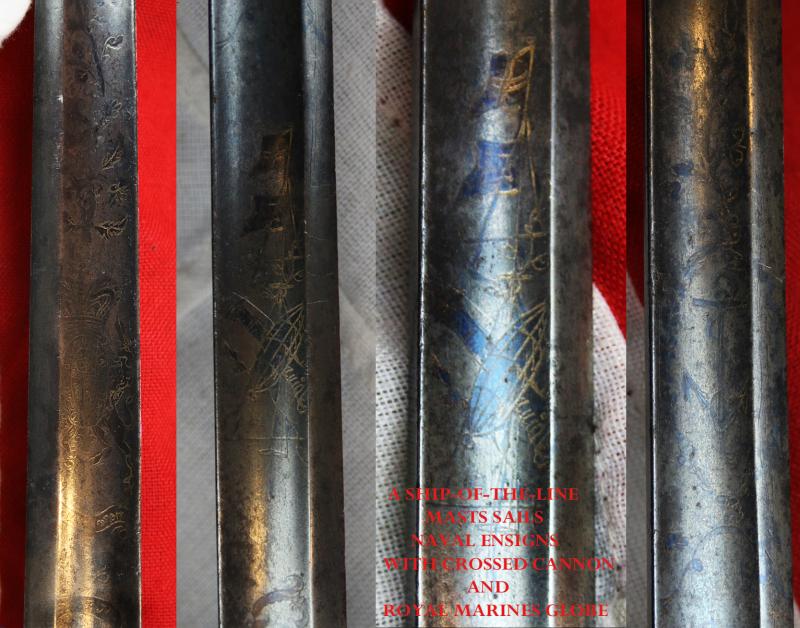
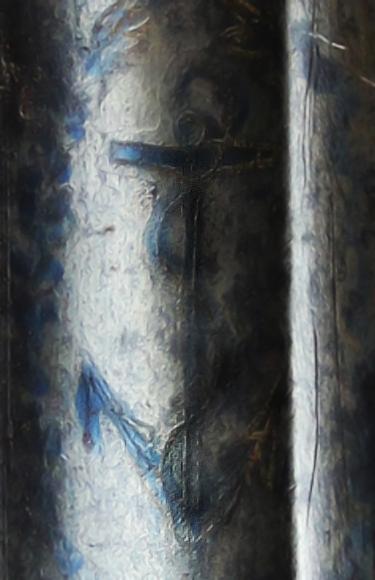
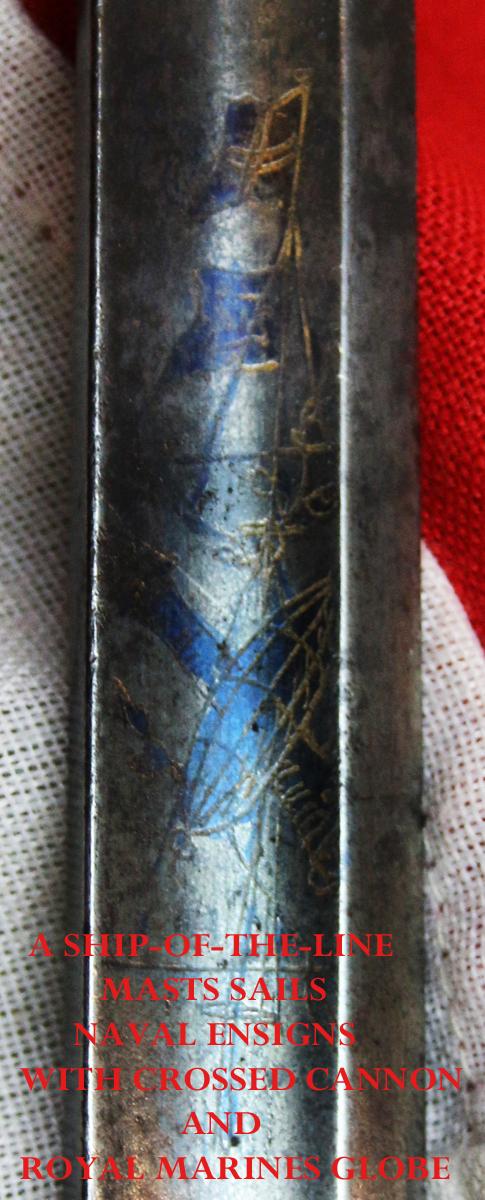
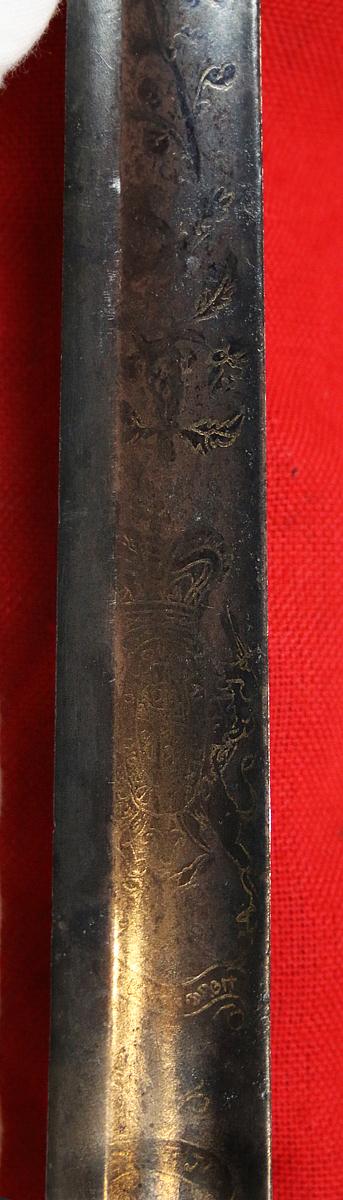
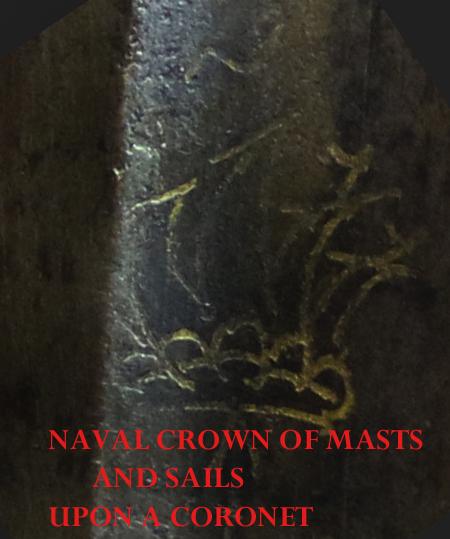
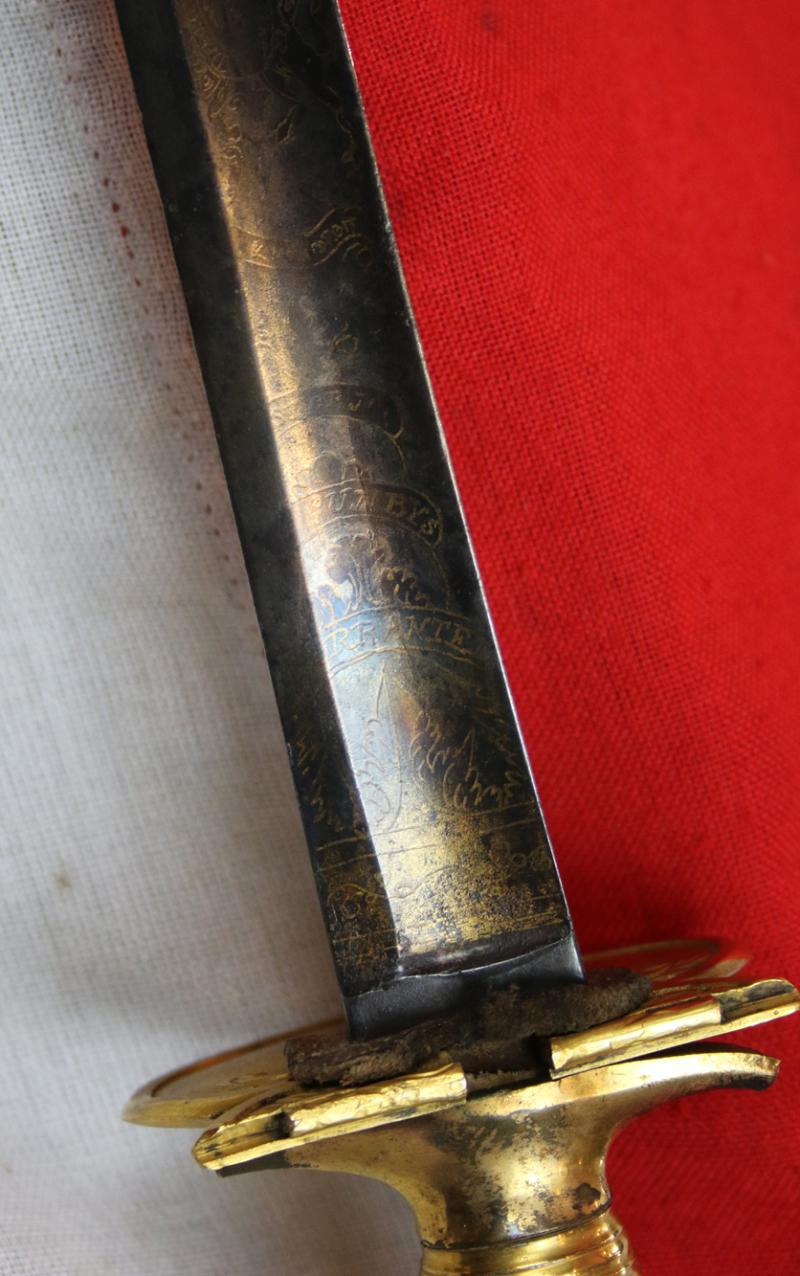
What remains of this sword is still in superb condition, the remaining main portion of its hilt still has its near mint fire gilt, and its snapped blade bears no significant surface corruption at all, it even has clear traces of its original blue and gilt decor, and its engraving clearly reveals its George IIIrd Royal Marines credentials, including the Kings Royal Crest of King George IIIrd, alongside the naval anchor, and the engraved design, of a ship-of-the-line, and the all important, crossed, cannon and Royal Marines globe { the globe has been elongated to match the length of the cannon when crossed }. Also a naval crown with its masts and sails design over a coronet. Plus, its fine maker's name, within a scroll, of Henry Osborn. Henry Osborn was a major cutler who helped design the original 1796 pattern infantry sword. He went into partnership with gunsmith John Gunby in 1805, and was based in Birmingham, and also with a shop at 82 Pall Mall, London.
Clearly, it was damaged in combat, such as at Trafalgar, but, importantly, it was not then discarded, or, even lost into the depths at sea {where it would have corrupted into nothingness} and then later recovered, but, it was saved, preserved, and obviously superbly cared for, just as is post combat damage, from then until now, but by whom, we know not.
From the time of the battle of Trafalgar, then for the following 180 odd years, the Royal Navy of Great Britain was the finest Navy in the world, until it was eviscerated by today’s political minnows. Such shortsightedness, hopefully, the country will not live to regret.
From the time of the admirals, Nelson, Cochrane and Earl St. Vincent, this is a wonderful sword that has obviously suffered catastrophic combat damage, likely from the impact from such as shrapnel from cannon fire. It has remained completely untouched, 'as is', and Hors de Combat, since its return to Great Britain, possibly, to be returned to its owners family, in memory of his remarkable combat service
This sword, especially in its present condition, effectively encompasses the very essence of the of the entire beginnings of the worlds greatest naval service in all maritime history. From Trafalgar to the Falklands War, the indomitable power, spirit, skill and resourcefulness of the officers and men that fought at sea, on land, and later, in the skies above. It was, quite simply, second to none.
The Royal Marines were titled "Royal" in 1802 by King George III. This honour was bestowed to recognize their meritorious service, particularly after distinguished actions in battles on land and sea during the Revolutionary Wars. The title was instigated by Admiral the Earl St Vincent, making them a permanent, elite force.
Royal Marines at the Battle Of Trafalgar;
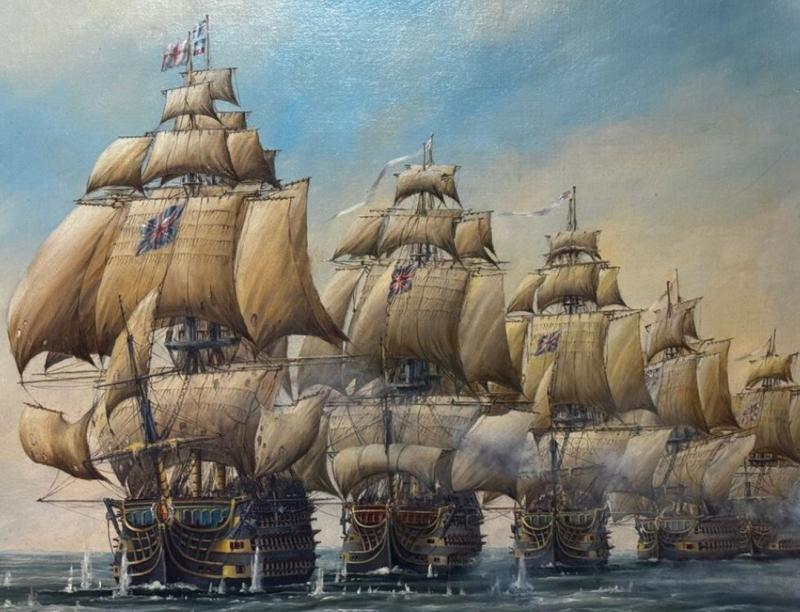
Ninety-three officers and 2610 other ranks of the Royal Marines were at their traditional stations on the upper decks of the British ships, Nelsons Flagship HMS Victory carried 165 Marines, led by Captain Charles Adair, and it was a Marine Sergeant who carried Nelson below after being shot.
By the end of the battle the Marines had 17 officers and 332 men killed or wounded, of these 4 officers and 117 men were killed or died of wound. (Total killed Navy and Marines was around 458)
It is potentially possible this sword may have been used by one of these RM officer's. If it was Capt Adair RM it might explain it being saved for posterity due to him perishing in combat in the battle.
Charles Adair RM Capt. {Killed in Action}
James Peake RM 1st Lt.
Lewis B Reeves RM 2nd Lt
Lewis Boatley RM 2nd Lt
Effectively, this is such an historical piece, despite its combat damage, and of such rarity, that it is priceless. However, we have placed a nominal price upon it, so it can hopefully be enjoyed, in, maybe a museum collection, or, by a collector, and generations to come.
Code: 26172