
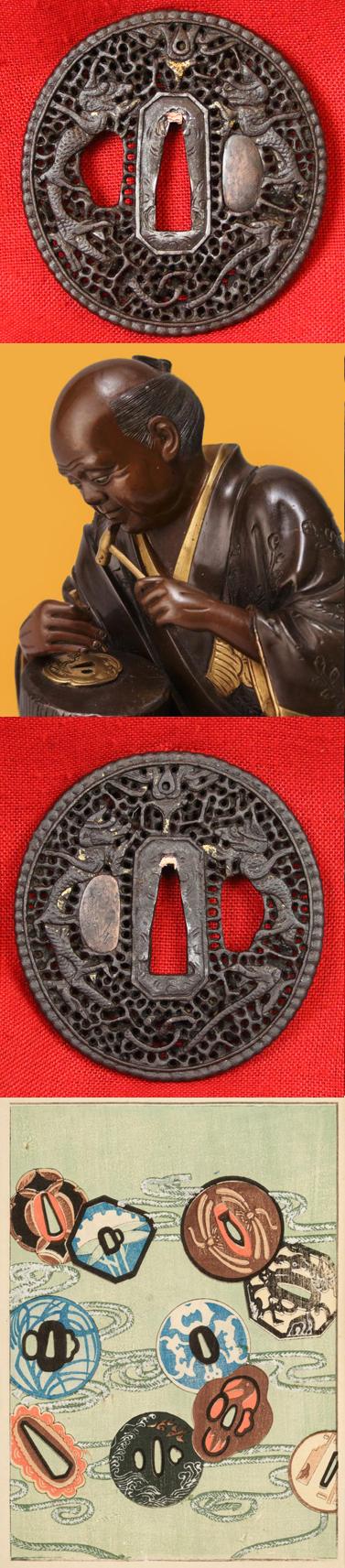
Openwork Iron Nanban Tsuba With A Pair of Dragons and Golden Nunome-Zogan Decor. A Most Fine Japanese 17th Century Sword Guard
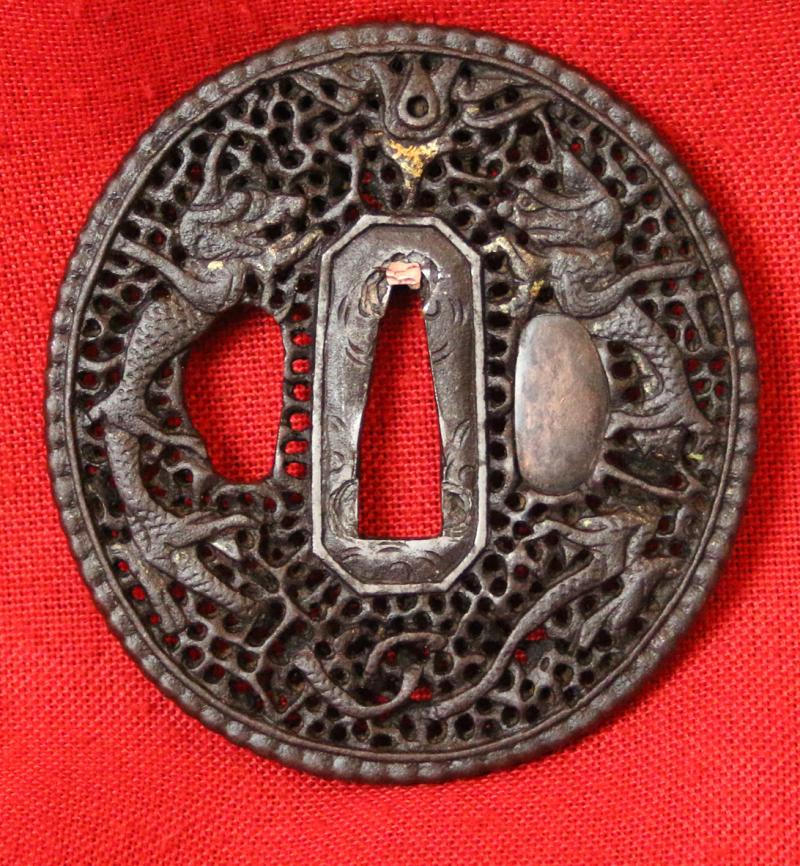
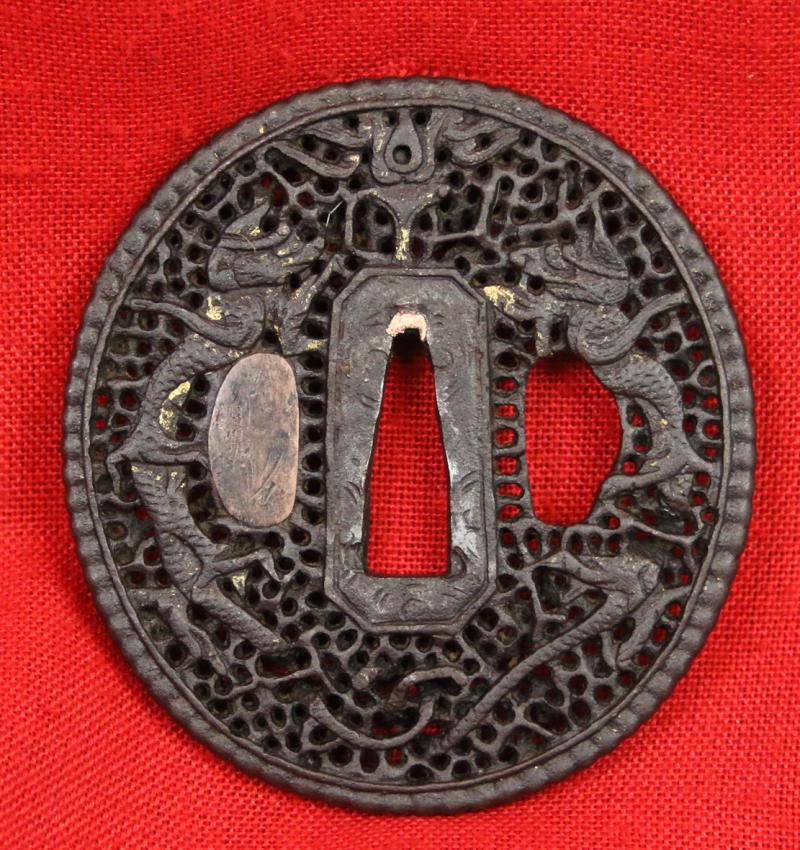
Japanese sword hilt (tsuba) in cut iron and damascened with gold (nunome-zogan). The metal is finely carved with dragons chasing the sacred pearl in the Nanban style. The pearl is pierced and contains a small mobile ball which today comes out of its housing (see photos). Japanese work from the 17th century Edo period.
Nanban tsuba (Southern Barbarian sword guards) are 16th to 19th-century Japanese sword fittings characterized by foreign, non-traditional designs, primarily featuring intricate iron openwork (sukashi), beaded rims, and Chinese or European motifs. Originating from trade with foreign ships, these often-lavish guards were produced in China or by the Dutch East India Company and adapted for Japanese swords.
"Nanban" means "Southern Barbarian," a term used during the Edo period to describe foreigners—specifically Portuguese, Spanish, and Dutch traders—who arrived by sea.
While the name implies Western influence, most designs actually show strong Chinese influence.
They are usually made of iron, featuring complex openwork (carved in relief or pierced), undercutting, and often feature "small balls" trapped in small compartments that can move. Common motifs include dragons chasing flaming pearls, foreign letters (like "VOC" for the Dutch East India Company), and arabesque designs.
Initial pieces were likely imported from China or Southeast Asia through Nagasaki from the late 16th century onwards.
Japanese craftsmen began copying these styles. They often added specific features for Japanese swords, such as the hitsu-ana (holes for the utility knife/hairpin) and modifying the nakago-ana (tang hole).
The Yagami School: Based in Nagasaki, this school specialized in this style during the 18th century, famous for intricate ironwork featuring Chinese-style dragons and, notably, "1000 monkey" designs.
Although foreign-influenced, they were popular among samurai as fashionable, often heavily gilded or inlaid with gold/silver. They were sometimes used to subtly showcase hidden religious preferences (e.g., small crosses) during the prohibition of Christianity
Nanban-style carvers in Yamashiro (modern-day Kyoto) refers to 18th-century Japanese metalworkers, specifically tsuba (sword guard) makers, who adopted foreign design elements—primarily Chinese, but also Portuguese and Dutch influences—into their craft.
These artisans are known for producing Nanban Tsuba (Southern Barbarian sword guards), which often feature intricate, openwork (sukashi) designs, such as dragons, vines, and lion-like figures, usually on an iron ground.
They utilized gold or silver nunome-zōgan (inlay) to highlight designs, frequently carving on a cross-hatched background to create a textured, luxurious, or exotic look.
While Nanban-style items were often associated with Nagasaki, Kyoto-based makers (Yamashiro) were known for producing higher-quality, more sophisticated, and detailed versions, often with better-finished carvings.
Connection to Heianjo School: Some of these designs are categorized alongside Heianjo-style Tsuba, which were established in Yamashiro and known for combining iron with brass inlays.
These carvers operated during the Edo period (1603–1868), with peak production of these refined, domestically made Nanban pieces occurring around the 18th century.
Size 72x5mm Good condition.
Code: 26169
495.00 GBP