
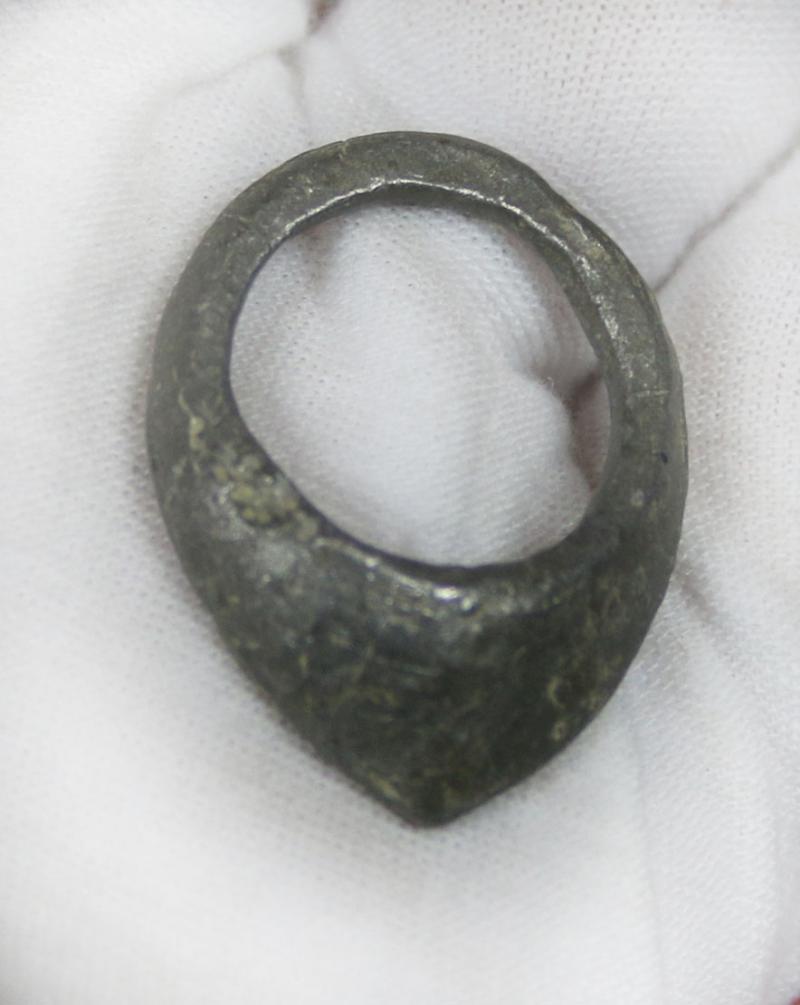
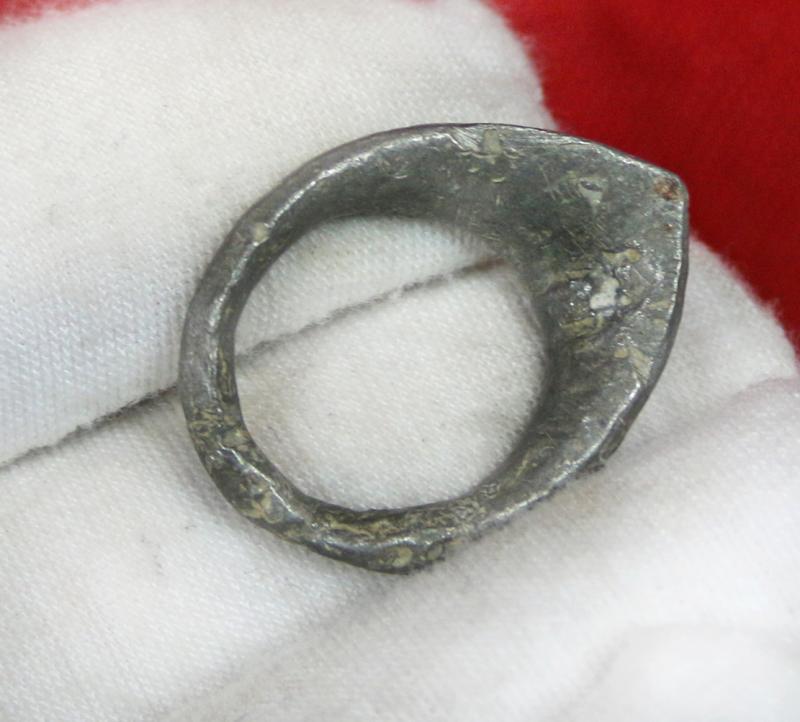

Superb & Rare Original, Solid Silver, Medieval Longbow Archer’s Thumb Ring, Mid 14th Century. Of the Battle of Crecy. From Our Latest Antiquities Collection Aquisition Recovered From Crecy, Azincourt and Other Famous Battle Sites in The 1820’s
For those bowmen that used them in the 13th to 14th-century, archer's thumb rings were essential tools of war. This example, being of solid silver would have been used by a high ranked yeoman archer, maybe a leader of a large section of archers, within the ranks of the the kings army. It would also be worn as a symbol of his status and rank, and thus worn when not in combat as well
This archers thumb ring was made circa 1340, over 680 years ago, and this is a superb, beautiful and historical original artifact. Stunning age patination of the silver In superb aged condition.
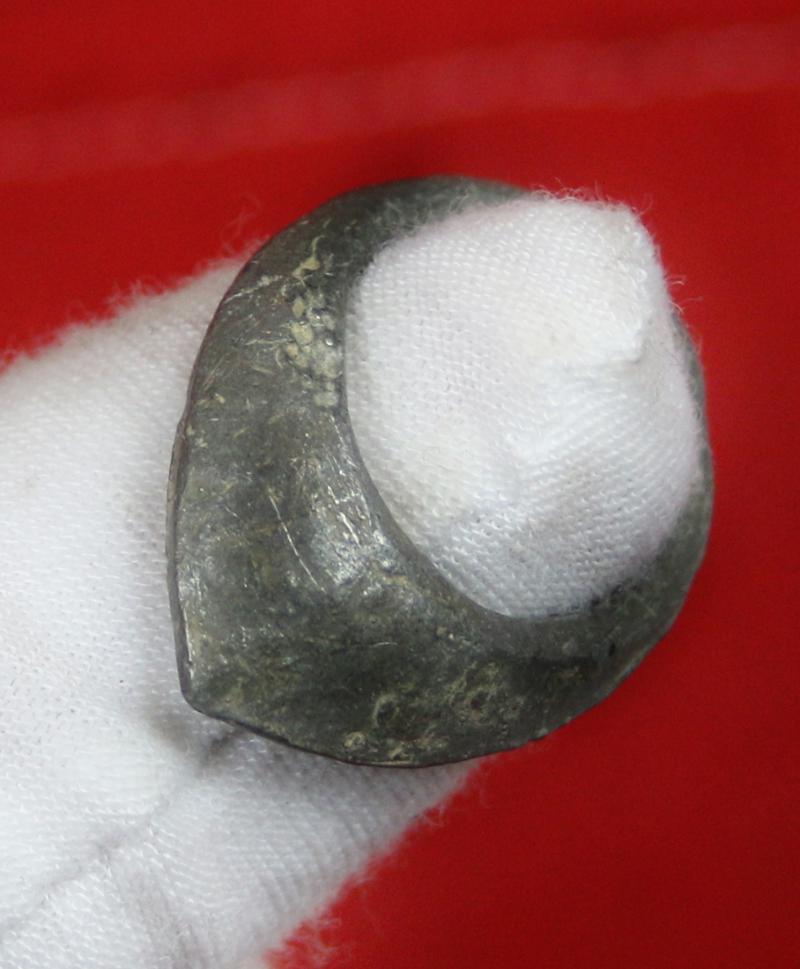
A thumb ring is a piece of equipment designed to protect the archer’s thumb during archery. It is a ring of that can be made of leather, stone, horn, wood, bone, antler, ivory, metal {silver or bronze}, even ceramics, which fits over the end of the thumb, coming to rest at the outer edge of the outer joint.
Typically a flat area extends from the ring to protect the pad of the thumb from the bowstring; this may be supplemented by a leather extension. An absolute iconic original piece of British history. In superb battlefield recovered patinated condition, and very nice indeed. Beautiful Items such as this were oft acquired in the 18th and early 19th century by British noblemen and women touring battle sites in Northern France and Italy, in fact most of Europe and the Middle East, on their so-called ‘Grand Tour’. They were often placed on display upon their return home, within the family’s 'cabinet of curiosities', within their country house. Some significant British stately homes had entire galleries displaying the treasures and artefacts gathered and purchased on such tours, and some tours lasted many years, and the accumulated souvenirs numbered in their hundreds or even thousands. A popular pastime in the 18th and 19th century, comprised of English ladies and gentlemen traveling for many months, or even years, throughout classical Europe, and the Middle East, acquiring knowledge and education on the arts, and thus returning with antiquities and antiques as souvenirs for their private collections, and these travels have been thus called ‘Grand Tours’. We recently acquired some beautiful pieces acquired from the descendant family of the 10th Duke of Hamilton in the 1820's such as the archer's ring from just north of the Mave River at Crecy.
Although traditional English archers often used three fingers (Mediterranean draw) or finger tabs, but some were obviously trained in the Ottoman style of archery.
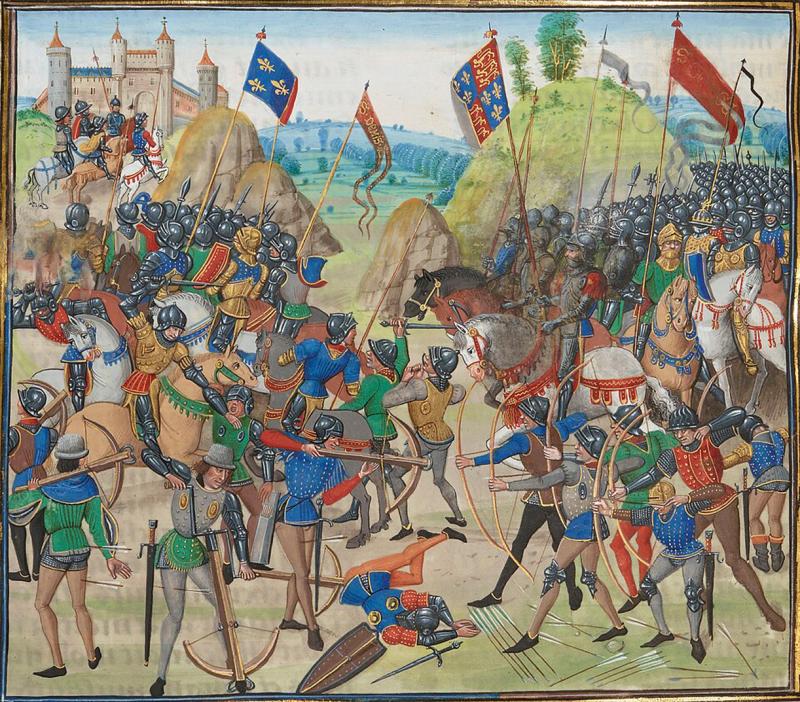
The Battle of Crécy took place on 26 August 1346 in northern France between a French army commanded by King Philip VI and an English army led by King Edward III. The French attacked the English while they were traversing northern France during the Hundred Years' War, resulting in an English victory and heavy loss of life among the French.
The English army had landed in the Cotentin Peninsula on 12 July. It had burnt a path of destruction through some of the richest lands in France to within 2 miles (3 km) of Paris, sacking many towns on the way. The English then marched north, hoping to link up with an allied Flemish army which had invaded from Flanders. Hearing that the Flemish had turned back, and having temporarily outdistanced the pursuing French, Edward had his army prepare a defensive position on a hillside near Crécy-en-Ponthieu. Late on 26 August the French army, which greatly outnumbered the English, attacked.
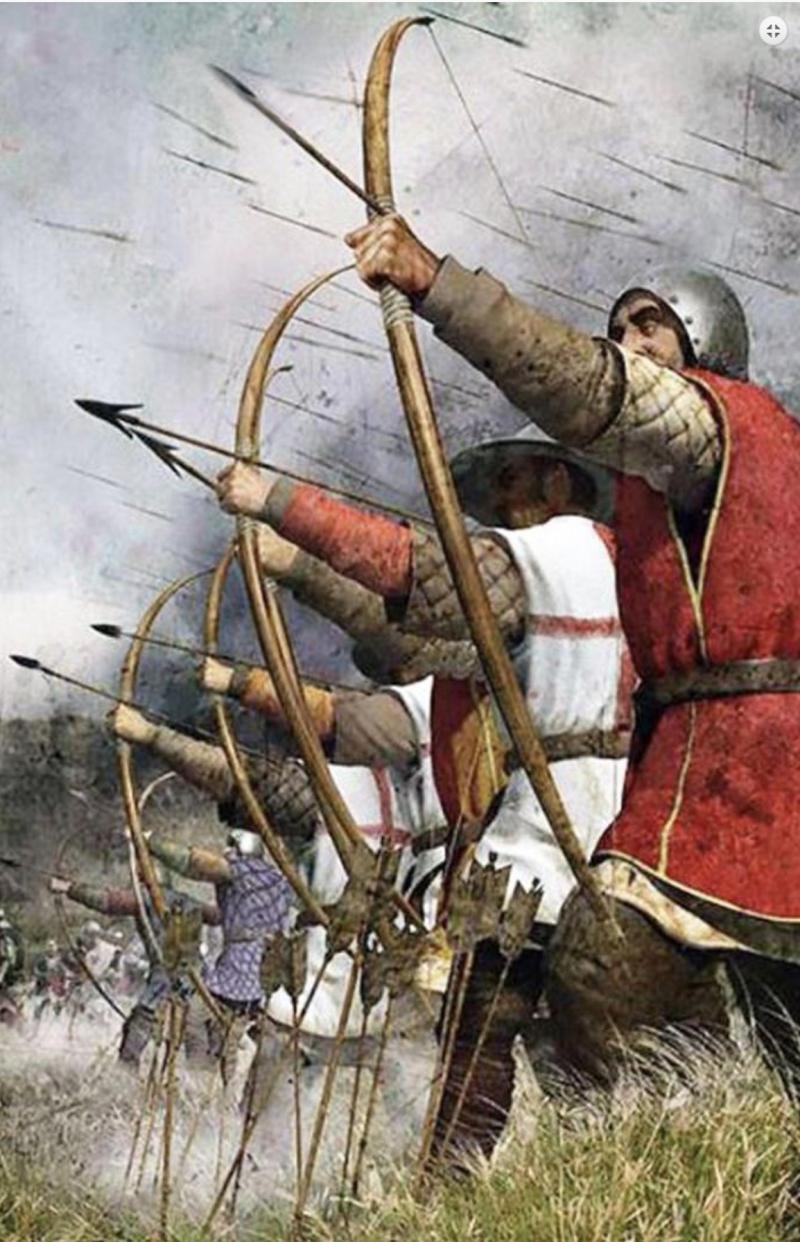
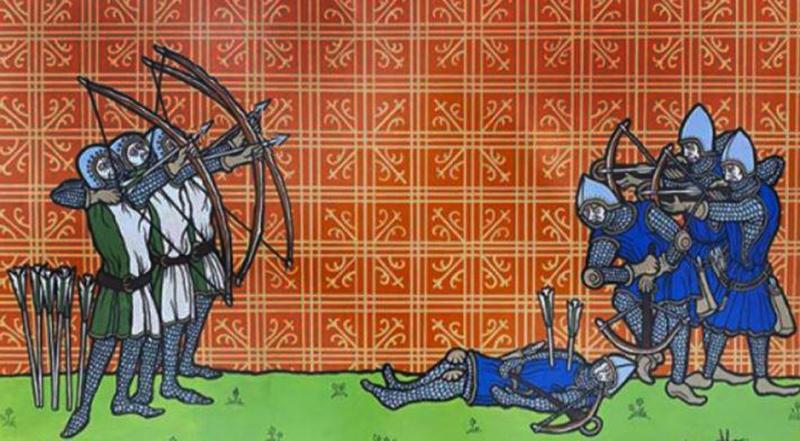
During a brief archery duel a large force of French mercenary crossbowmen was routed by Welsh and English longbowmen. The French then launched a series of cavalry charges by their mounted knights. These were disordered by their impromptu nature, by having to force their way through the fleeing crossbowmen, by the muddy ground, by having to charge uphill, and by the pits dug by the English. The attacks were further broken up by the effective fire from the English archers, which caused heavy casualties. By the time the French charges reached the English men-at-arms, who had dismounted for the battle, they had lost much of their impetus. The ensuing hand-to-hand combat was described as "murderous, without pity, cruel, and very horrible." The French charges continued late into the night, all with the same result: fierce fighting followed by a French retreat.
The English then laid siege to the port of Calais. The battle crippled the French army's ability to relieve the siege; the town fell to the English the following year and remained under English rule for more than two centuries, until 1558. Crécy established the effectiveness of the longbow as a dominant weapon on the Western European battlefield.
The 2009 Encyclopædia Britannica uses the figures of about 6,000 for the English and 20,000 to 30,000 for the French. Part of an original medieval collection we have just acquired, of Viking and early British relics of warfare some from ancient battle sites recovered up to 220 years ago.
When drawing a bow using a thumb draw, the thumb is hooked around the bowstring just beneath the arrow and its grip reinforced with the first (sometimes second) finger. The bowstring rests against the inner pad of the archer's thumb and the thumb ring protects the skin. The bowstring rests against the flat of the ring when the bow is drawn. Today, thumb rings are used by archers practicing styles from most of Asia and some regions of northern Africa. Ishi, the "last wild American Indian", used a thumb draw, but no skin protection.
Thumb rings have been in use in Asia since the Neolithic period. The first examples were likely made of leather,.
As early western armies mainly used peasants as archers, and bowmen fought on foot. some may have needed little training as they already were using bows to hunt, and were indeed required to be trained on archery, usually with a Mediterranean draw. Of course, armies fought foreigners, and probably learnt their opponent's methods/strategies, as well as travelers who brought back hunting/fighting technique, but it may have been marginal amongst archers as the thumb ring draw was difficult to learn.
The regular English and Welsh bowmen fought on foot, but while they fought the major battles on foot, there were mounted archers, those bowmen in the chevauchées against the French. Effective use of the longbow required regular practice and it wasn't easy to just pick up and use one (which is why inferior firearms replaced the bows - the firearms were easier to master). In this period, hunting was the domain of the uppermost classes. The land, and the animals in it, was the property of the king. Poaching could get you hanged.
In the chevauchées it would be unlikely longbows would be used while mounted. Unlikely dismounting to shoot, so using a smaller hunting bow is far more likely. Nobles hunted with shorter handbows commonly, but the bow and the technique were distinct from longbow. Both the length of the longbow, and the posture used for the longbow would make mounted archery quite difficult.
From our latest original antiquities collection arrival, that contain many pieces acquired from famous historical battle sites while on a ‘Grand Tour’ in the 1820’s, such as this superb piece, at Agincourt, and other pieces from such as Crecy and Poitiers, and Paris.
Code: 26128
645.00 GBP