
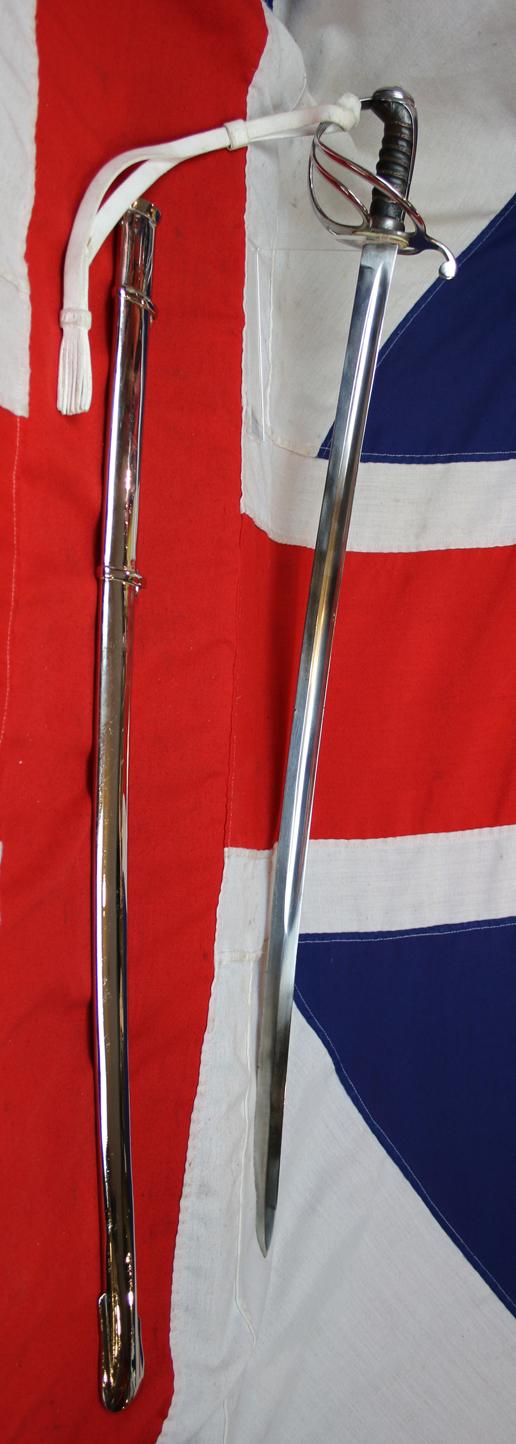
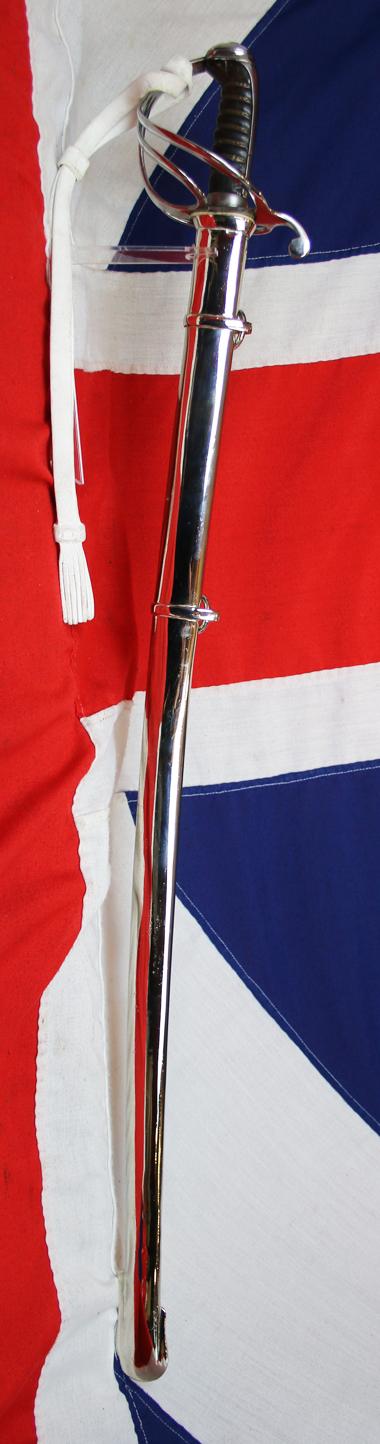
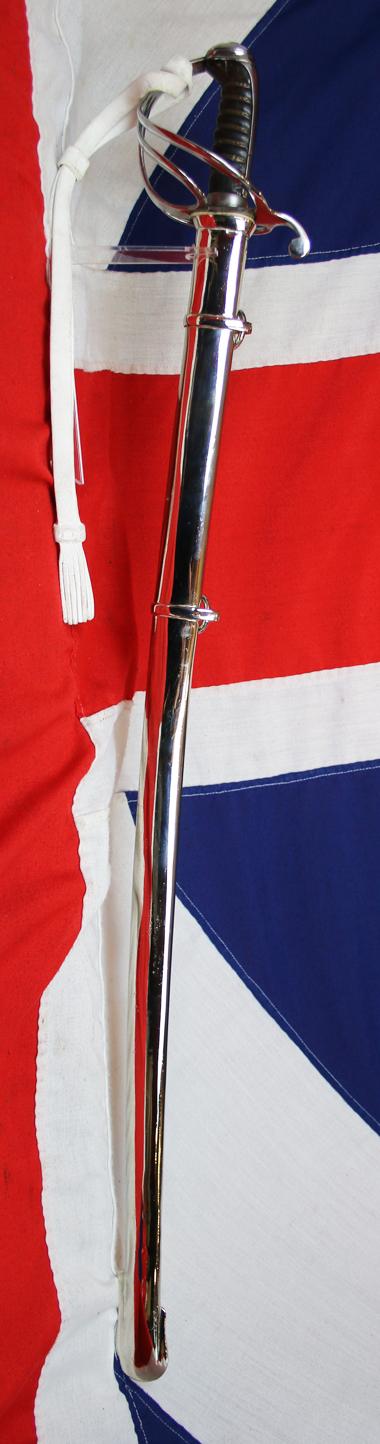
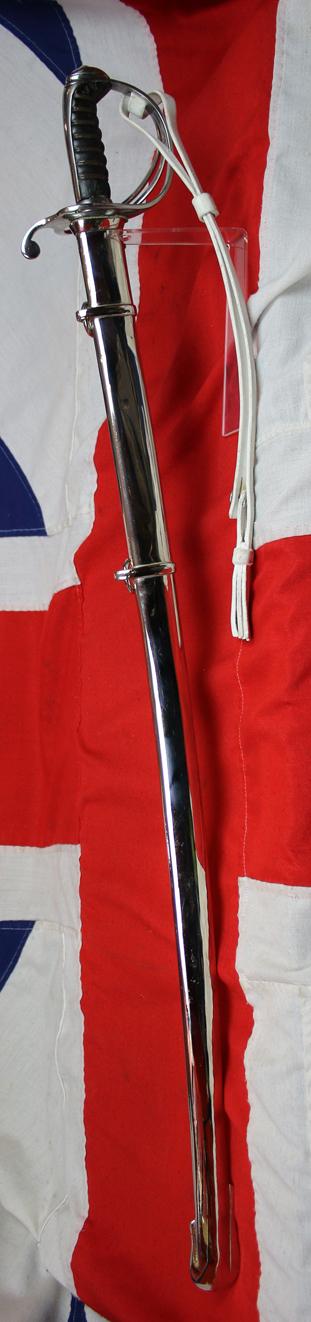
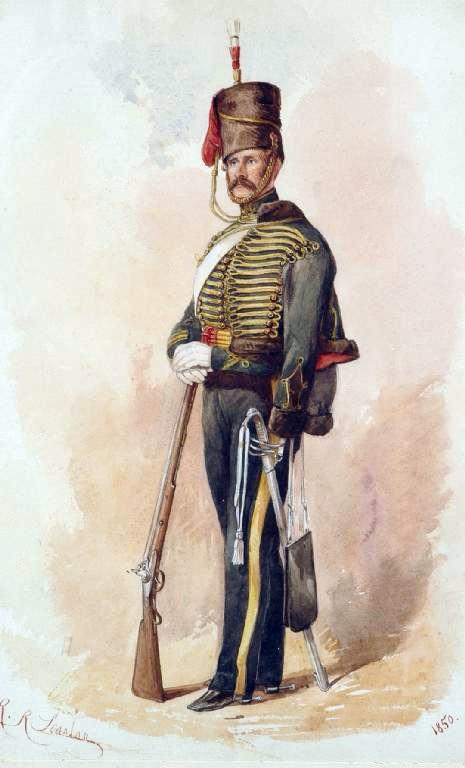
A Simply Superb Looking Original, Victorian, 8th King's Royal Irish Hussars 'Charge of the Light Brigade', 1821 Pattern, Hussar Trooper's Sword In Simply Amazing Fully Restored and Conserved Condition. With White Buff Hide Knot
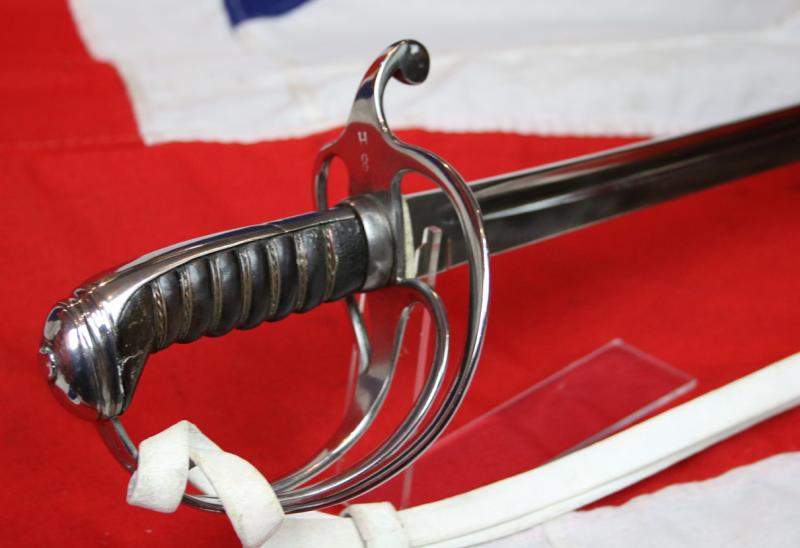
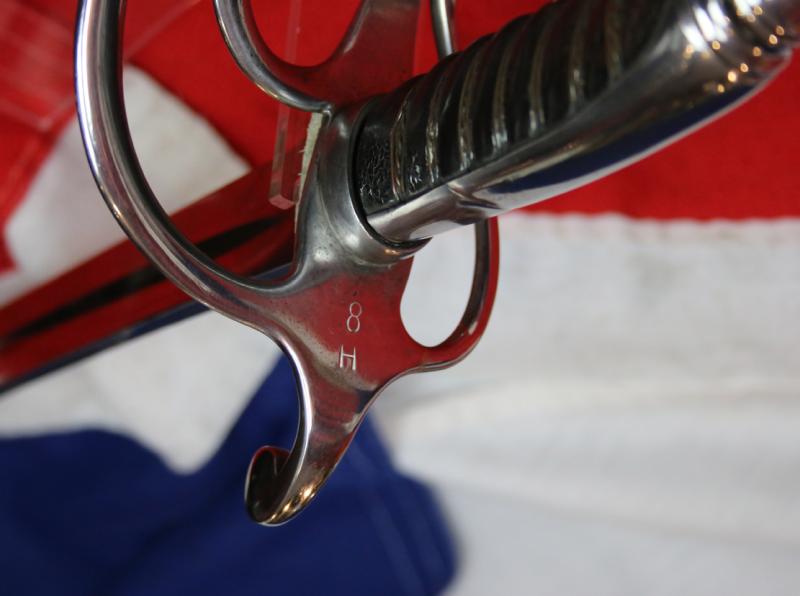
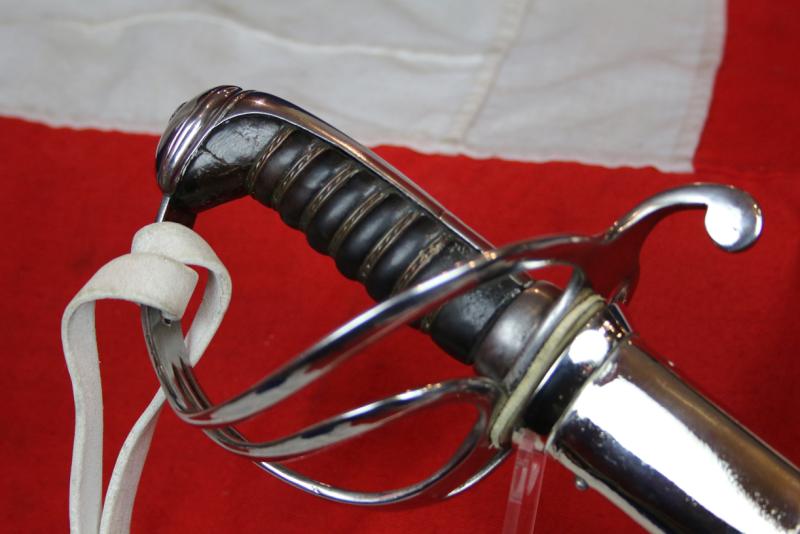
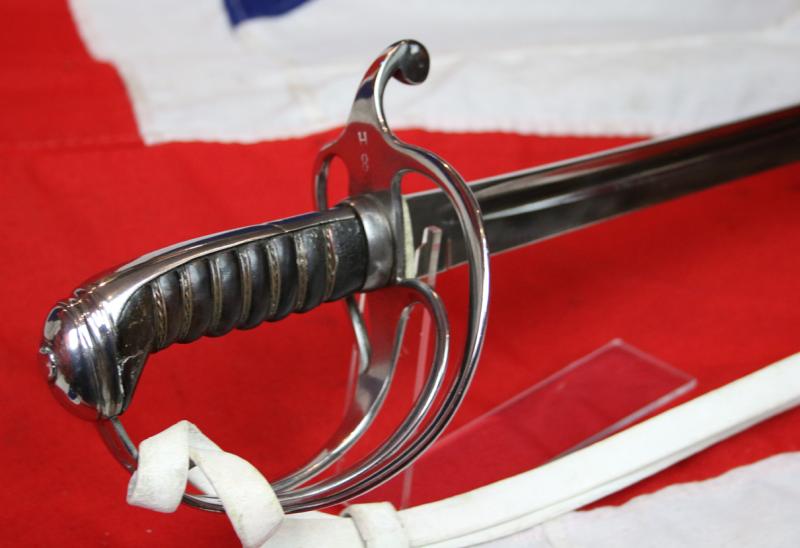
Polished bright steel hilt with original triple wire bound leather grip, regimentally marked, for the 8th Hussars upon the quillon, excellent and bright polished rolled steel dent free scabbard, showing areas of previous light polished out surface pitting.
Blade is superb with a few sword to sword, close combat edge cuts
Around 180 years old and still as fine as it was when issued.
During the Crimean War, the regiment formed part of the Light Brigade. The regiment set sail from Plymouth in early March 1854. Five ships were needed to transport them to the Black Sea. The Echunga, Mary Anne and the Shooting Star left first, followed by the Medora and the Wilson Kennedy on 1 May.4 The next battle was near the River Alma in September 1854 and the 8th Hussars were awarded the battle honour for a convincing defeat of the enemy. On 28 September, following a report that Russian troops were out in front of Balaklava town, the troop of the 8th, which made up Lord Raglan's escort under Captain Chetwode, was thrown out in skirmishing order. The Horse Artillery then came up and opened fire, causing the Russians to abandon all their wagons and flee from the scene. Some 70 wagons and carts were captured, some only containing small arms ammunition, which was destroyed. The rest of the wagons contained black bread. The troops were allowed to pillage the wagons that did not contain anything of value to the Commissariat. As a result, within a few minutes, the ground was strewn with various pieces of clothing – Hussar uniforms, fur cloaks, and wigs. The carriages were said to belong to the suite of Prince Menshikov. After this engagement until 25 October, the regiment furnished patrols and outpost duties, being billeted close to vineyards and barns containing water, corn, hay and fuel.5
The charge of the Light Brigade, October 1854; The 8th Hussars were in the third line of cavalry (on the right of the picture)
In October, Balaklava and the Charge of the Light Brigade took place. It was started when 25,000 Russians tried to capture Balaklava, the British Army's only port, defended by the 93rd Highlanders, some Turks, and the Cavalry Division. Lieutenant Colonel Sherwell led the King's Royal Irish Hussars, forbidding two soldiers to carry their swords in the charge because they had "Disgraced the regiment by smoking in the presence of the enemy". The charge through the crossfire into the mouths of the Russian guns is vividly described by Lieutenant the Hon S Calthorpe, an 8th Hussar ADC.
The pace of our Cavalry increased every moment, until they went thundering along the valley, making the ground tremble beneath them. On they went headlong to death, disregarding aught but the object of their attack. At length they arrived at the guns, their numbers sadly thinned, but the few that remained made fearful havoc amongst the enemy's artillery.3
The Charge of the Light Brigade by Richard Caton Woodville
As part of the second wave of the brigade's attack, the 8th were in line with the 4th Light Dragoons and, advancing in support at a steady pace, came under fire. Wounded men and horses from the leading squadrons kept dashing out, making the lines unsteady. With the pace increasing, the 4th were not checked by their officers and the lines separated. In spite of the fall of men and horses, the regiment passed the remains of the battery in the valley.6 The 8th pushed through the line of Russian gunners to the remnants of the first line in retreat, unaware that a Russian brigade of light cavalry was at hand. A regiment of Russian lancers was advancing from behind, as the 8th Hussars went through the infantry crossfire and lost half their men. The remnants of the brigade formed up, totalling about 70 men. They decided to attack the Russian lancers, eventually overthrowing them. The ground was now opened up for the brigade to retire, the 8th now pursued their course to their original position, followed by all the other horsemen of the other regiments and, as their horses became blown or wounded, they tailed. The Russians were now recovering in confidence and they pursued the dismounted men. The officers of the 8th called off the men, freeing up the ground for artillery fire, which gave many the chance to escape. Overall, two officers and 19 other ranks were killed and two officers and 18 other ranks were wounded. One officer and seven other ranks were taken prisoner-of-war.
Indian Rebellion of 1857
The 8th spent a year in England after the Crimea, but were called to India to help suppress the Indian rebellion of 1857 and were ready for war in February 1858. The most celebrated action of the war came three months later at Gwalior when a squadron of the 8th, under Captain Heneage fought a large Indian force under Rani Lakshmibai trying to leave the area. The 8th Hussars charged into the enemy, killing swathes of Indian soldiers, taking two guns and continuing the charge right through the Phul Bagh encampment. Rani Lakshmibai, the Queen of Jhansi state, dressed as a cavalry leader, was badly wounded. She did not want the British to capture her body, so she told a hermit to burn her body. General Sir Hugh Rose awarded the squadron four Victoria Crosses under Clause 13 of the Victoria Cross warrant.9 This meant that one officer, one NCO, and two for the corporals and troopers, all to be elected by their comrades. Captain C W Heneage, Sergeant J Ward, Farrier G Hollis and Private J Pearson were chosen to be recipients. The citation was published in the London Gazette of 28 January 1859, The remaining year of the Mutiny consisted of the pursuit of the rebel forces. On 5 September 1858, a squadron of "D" Troop, 8th Hussars, caught the mutineers at Beejapore, inflicting heavy losses. Of the 850 enemy troops, no less than 450 bodies were counted dead on the field. On 8 September 1858, at Beejapore, when both the officers attached to the troop were disabled, Troop Sergeant-Major James Champion, although severely wounded himself at the start of the action, continued to do his duty and wounded several of the enemy. For this action, he too was awarded the Victoria Cross. From then on, until 21 May 1859, when the Headquarters Troop reached Nusserabad, all troops had been in search of the rebels. In its time in India, the 8th had gone through two hot-weather campaigns, H.Q. Troop had shifted camp 300 times and marched over 3000 miles with some of the other Troops marching close to 4000 miles. Reaching Meerut in February 1861, there was an epidemic of cholera in which the regiment lost two officers and thirty-one men. The title of the regiment was simplified in 1861 to the 8th (The King's Royal Irish) Hussars.
This 1821 pattern trooper's sabre was gradually replaced by the 1853 pattern, that was issued in time to a few of the hussar and lancer regiments in the Crimea, but it took around another 10 years or so to be supplied to all the other cavalry regiments in the army, especially if they were in service at the time within the far flung reaches of the empire. We have also acquired an 1853 issue example, in the same fabulous order, from the same collection.
Code: 26099