
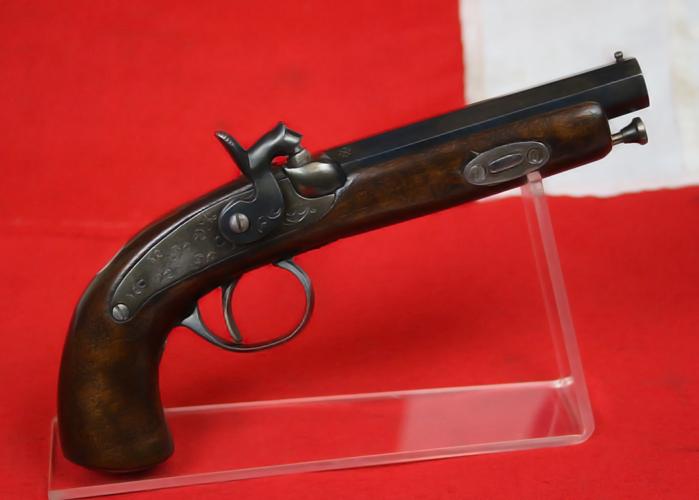
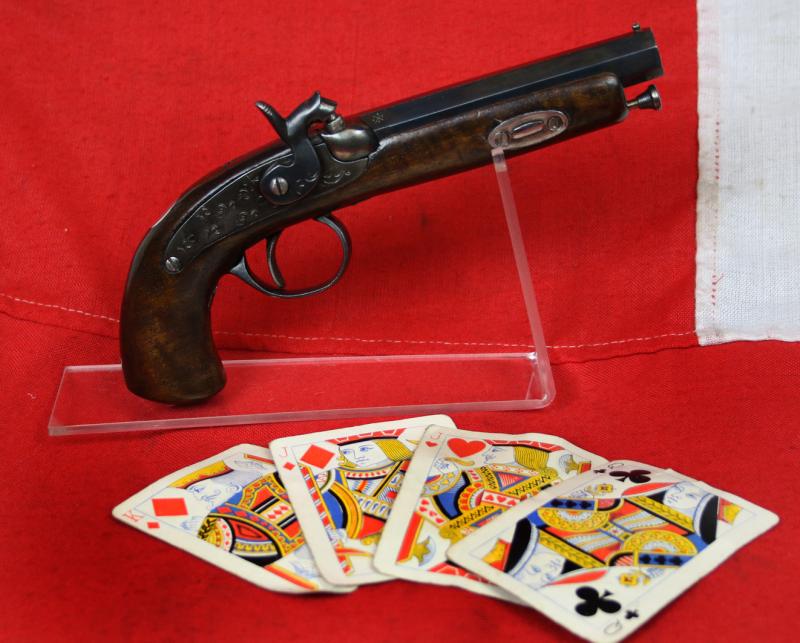
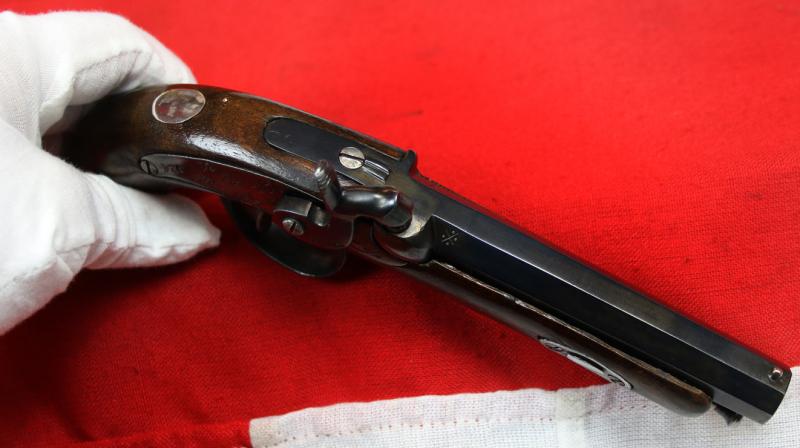
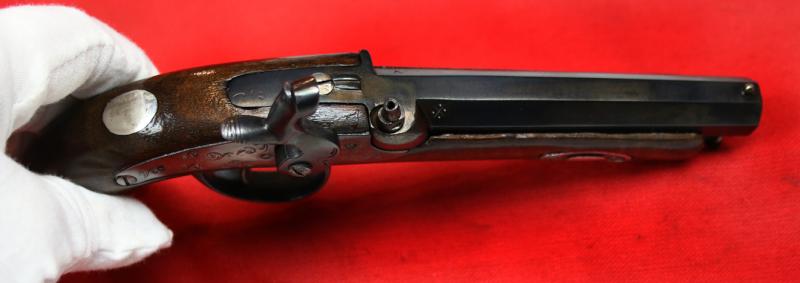
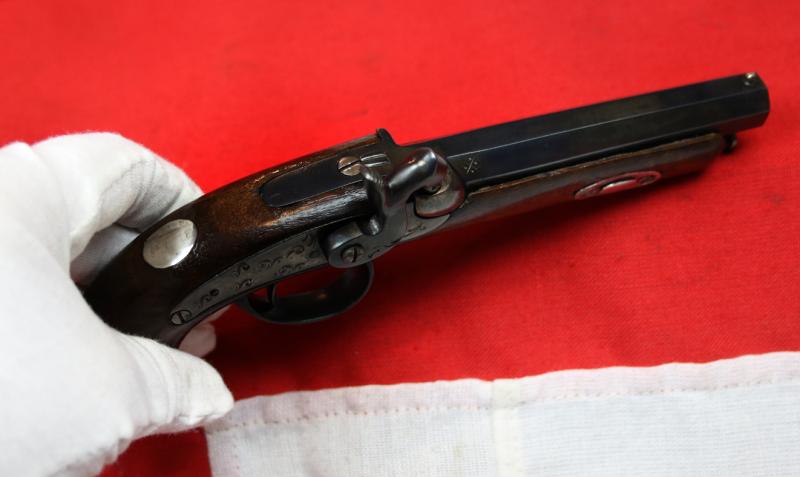
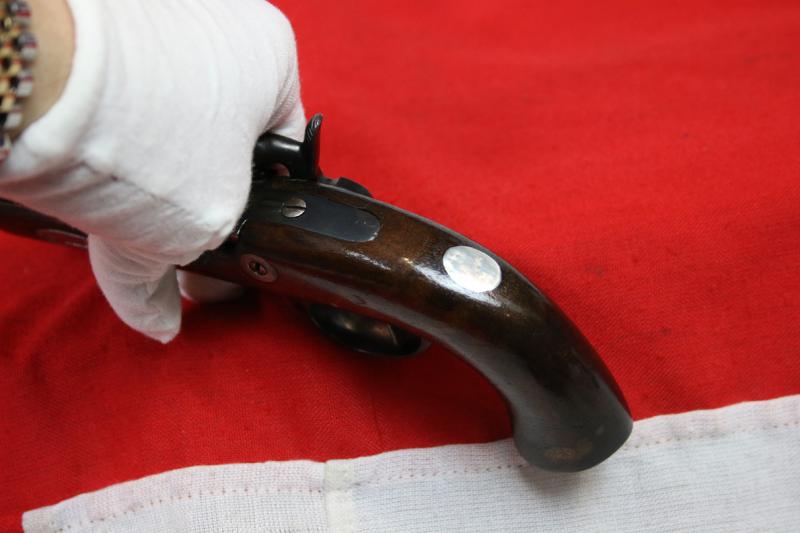
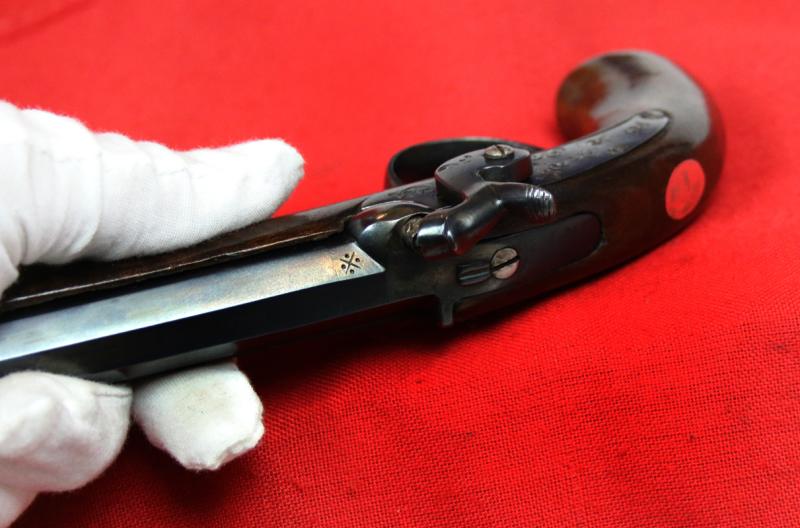
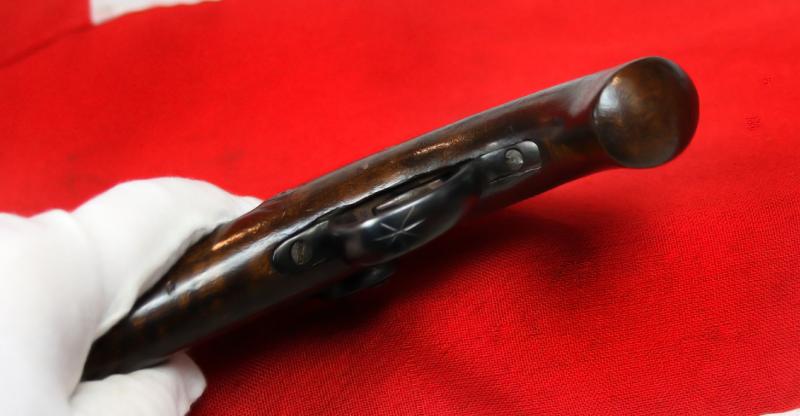
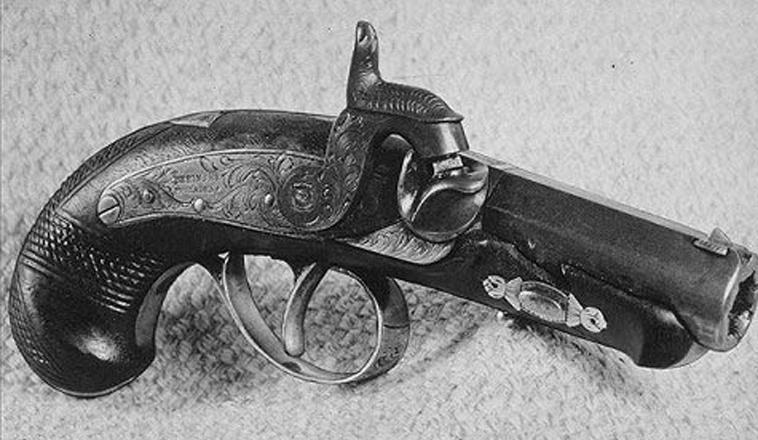
An Original, Antique, Small Continental 'Derringer' Back-Action Percussion Lock Pocket Pistol Circa 1840. Fancy Engraved Lock. Blued Steel Finish
This pistol is singularly attractive. It was acquired with a pair of cased, Belgian, percussion 'Barkers' boxlock pistols. This pistol required full servicing, and hand conservation by our artisans, and after three intensive days work it has been completed and looks dramatically improved and very charming indeed. The percussion action has now been hand cleaned and conserved to be as tight and crisp as it was 185 years ago.
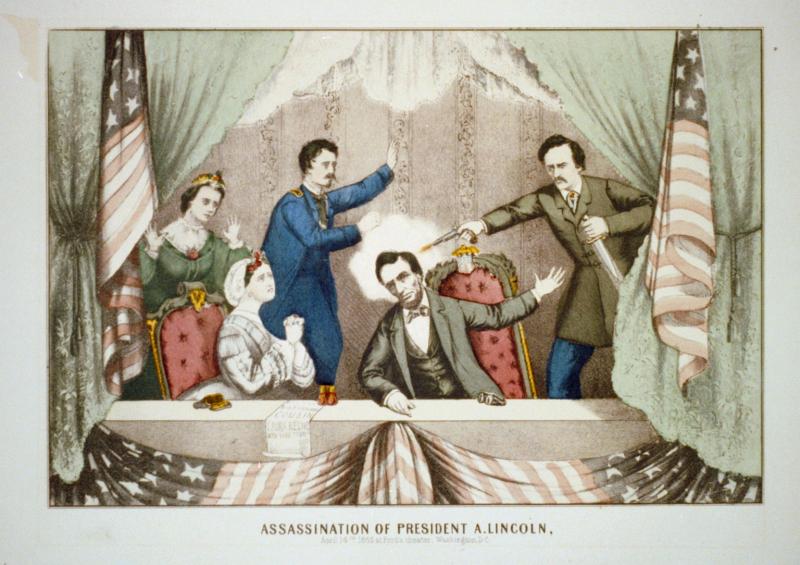
This 'Derringer type of pocket pistol was actually made before the Philadelphia, US, Henry Deringer pistol, by varied makers, but the Henry Deringer pistol was made famous, by being used in the notorious assassination of President Abraham Lincoln in 1865.
This is the very same style and form as the Lincoln Deringer pistol, and it is not known if the American, original Henry Deringer pistol example was a design made first, by his company, or other way round.
One of the scarcest and most collectable small pistol of American history, is the original US, Philadelphia manufactured, Henry Deringer's back action lock 'Deringer' pistol. The pistol that was used by Henry Wilkes Booth to assassinate probably the most famous American President to have ever lived, Abraham Lincoln. It was this Deringer gun after which all small pocket pistols have since been named. A pistol and name that shall live on in memory, for as long as American history is recorded.
.
In the century and a half since it happened, populist history has largely boiled down the assassination of Abraham Lincoln to the story of a single perpetrator: John Wilkes Booth. Four of the eight convicted for participating in the conspiracy to assassinate Lincoln in April of 1865 died on the gallows three months later.
But in his appearance at the Camden County Historical Society, Lincoln scholar Hugh Boyle made clear that the real story is a sprawling epic. It involves a gang of Confederate operatives and sympathizers that first plotted to kidnap the President and, when that failed, decided to murder not only him, but the Vice President and Secretary of State as well. Their goal was to decapitate and destabilize the federal government in hopes of forcing a settlement to the war that would avoid the South's total defeat. In the end, they managed to kill Lincoln and seriously injure Secretary of State William Seward.
By 1865, the South was a vast swath of utter destruction.
It was a time of massive upheaval, great danger and high emotion for the South, so the idea that someone might be thinking about attacking the President or other high government officials was not a crazy one in the atmosphere of the times."
The frustrations and angst of the Southern cause came to a boil in April of 1865. Its capital, Richmond, Va. -- now a burned out hulk of a city -- was captured and occupied by Ulysses S. Grant's forces on April 3. Six days later, Robert E. Lee's Army of Northern Virginia surrendered and was disarmed at Appomattox. Three days after that -- April 11 -- President Lincoln, standing in a second-story window of the White House, spoke to a huge crowd in a city gone wild in celebration of the Appomattox surrender. But among those listening in that crowd were John Wilkes Booth and 21-year-old Lewis Thornton Powell.
John Wilkes Booth, one of America's most famous actors of the time, and Lewis Thornton Powell were enraged by the President's White House speech on April 11. Three days later, Booth killed Lincoln in Ford's Theater while Powell tried to kill Secretary of State William Seward in his home. Booth was one of the country's most famous actors and an ardent supporter of the Confederacy. His young companion, Powell, was a Confederate army veteran and a second cousin of Confederate general John B. Gordon
The gang leader -- 27-year-old John Wilkes Booth -- was tracked down and shot to death by Union soldiers in Virginia. Eight others were convicted of being conspirators with Booth. Four were sentenced to death and hung, including the first woman ever executed by the U.S. government. The other four were sent to a remote prison island off the coast of Florida.
John Wilkes Booth killed President Lincoln with a shot in the back of the head near his left ear. The Henry Deringer pistol was the weapon he used. Manufactured by Henry Derringer. The weapon was found on the floor of the State Box in Ford's Theatre after the assassination, but it located today in the basement of Ford's Theatre.
10.8cm / 4 1/4 inches barrel length, 8 inches / 20cm long overall
Priced once the conservation cost has been calculated
Code: 26091
650.00 GBP