
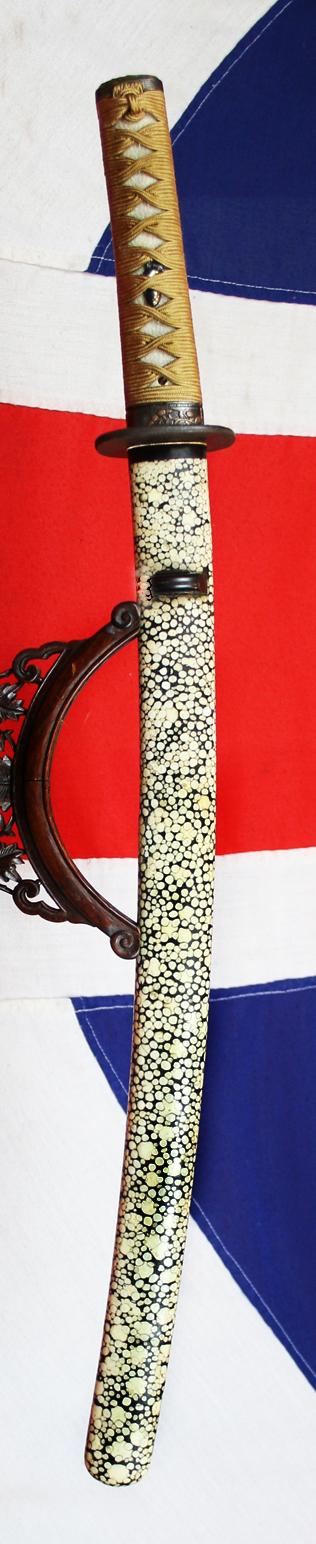
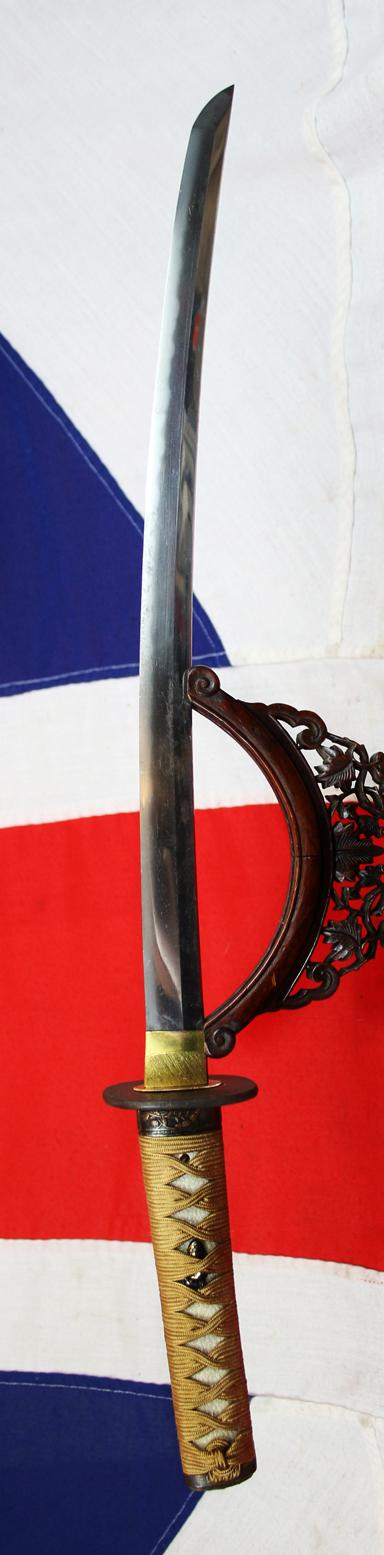
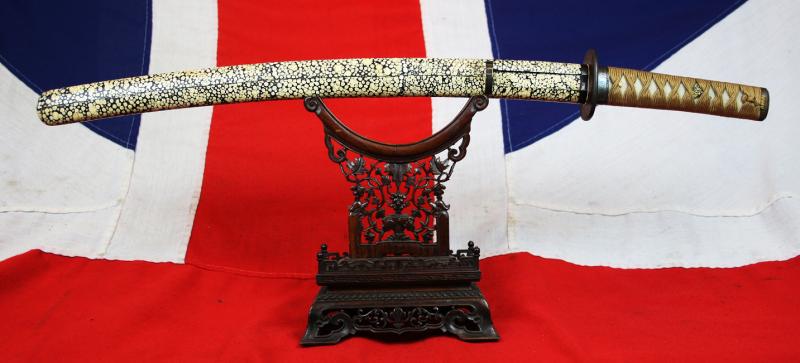
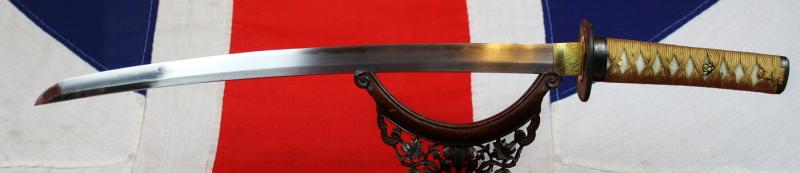
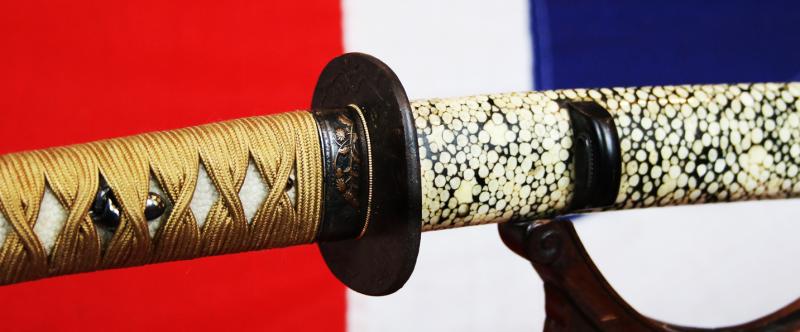
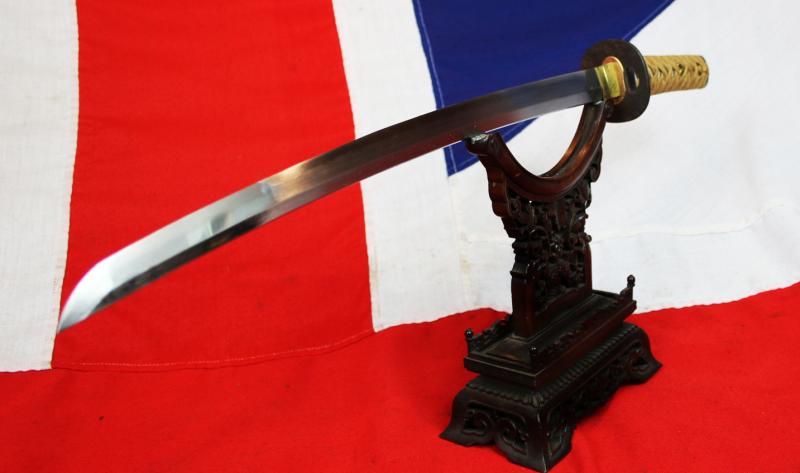

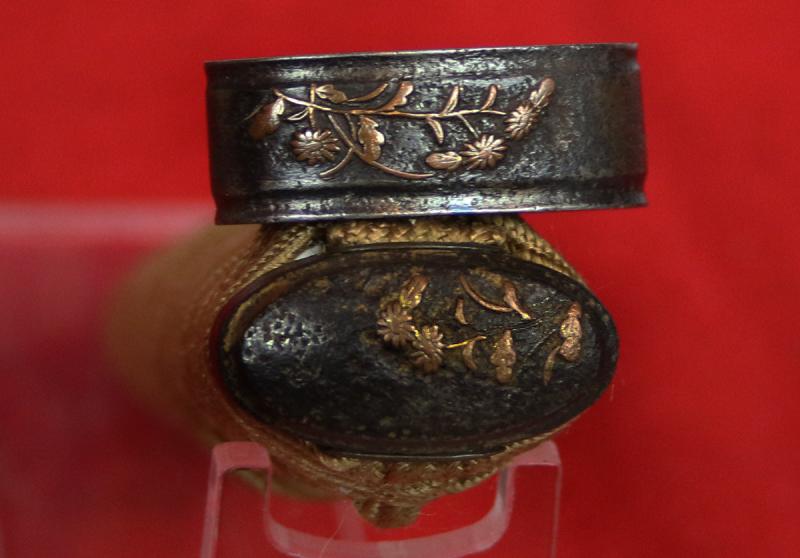
A Simply Beautiful Shinto Era, Edo Period Samurai Wakazashi Sword, Circa 1700, With A Very Fine Midare Hamon Blade, With A Fabulously Beautiful, Hand Polished, Samegawa Saya { Giant Rayskin Covered Scabbard}. And a Wonderful Hilt Bound In Golden Silk
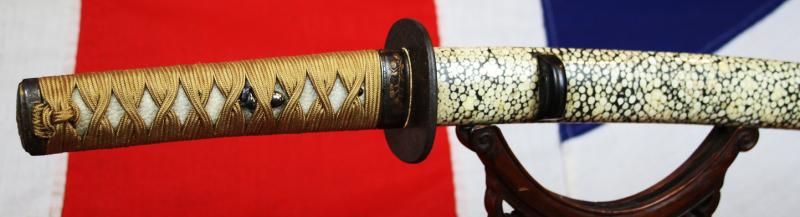
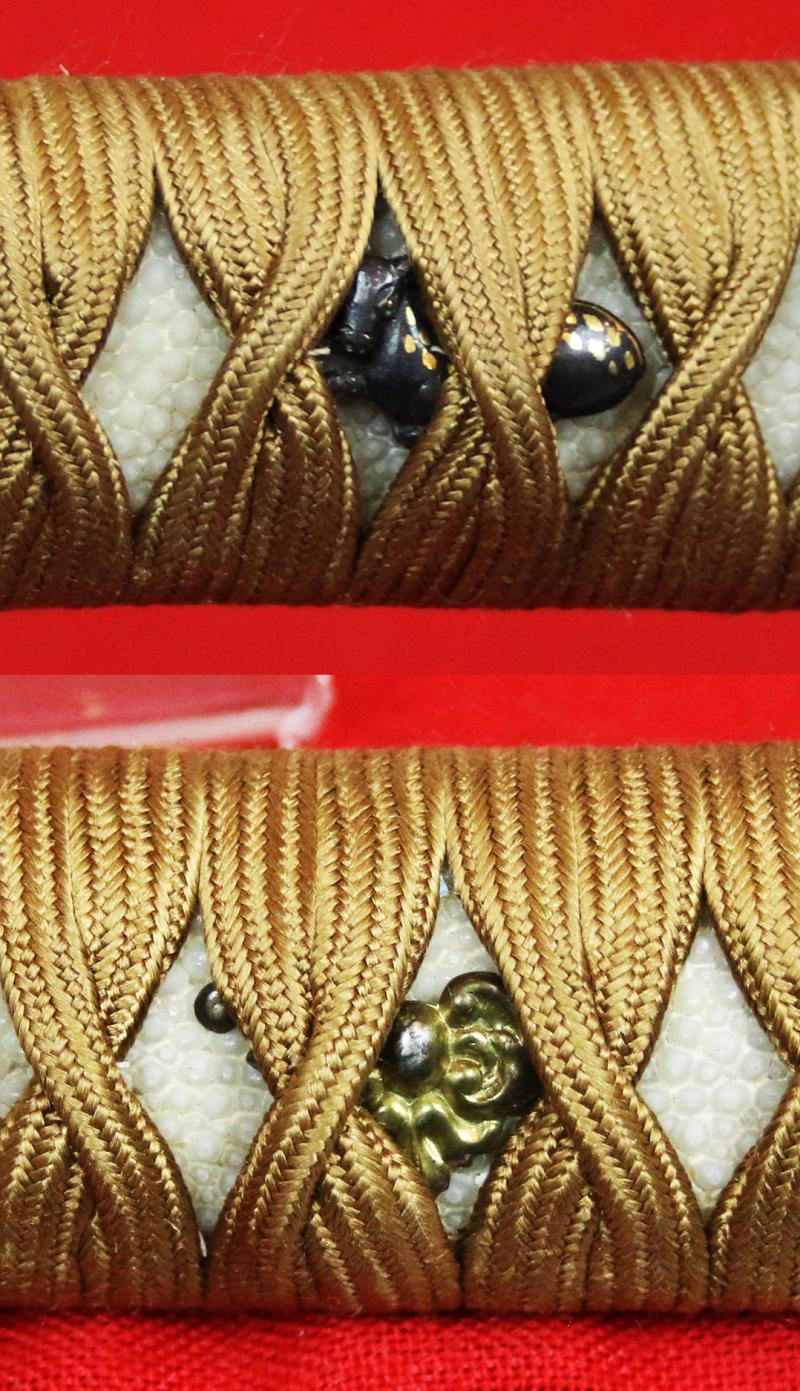
The tsuka-ito binding, is wrapped over gold and shakudo menuki {hilt ornaments}. One menuki is shakudo with pure gilt speckled overlay of fur dappling, of a resting fawn. The other is a takebori gold flower head. Both menuki are fitted traditionally over unpolished giant rayskin under the binding. The fuchi kashira {hilt collar and pommel} are Hizen school, of copper inlaid long necked chrysanthemum flower stems over a course iron surface. The habaki is a deluxe grade hand made, 'two piece habaki' overlaid in light gold.
The Hand Polished Giant Rayskin {Samegawa} Saya {Scabbard} is a unique feature of some of the finest antique Japanese swords. The saya was hand made and bespoke fitted to the blade, and it was then covered in the preserved skin of the giant ray, which was extremely hard and course, made up of thousands of nodules. This surface was then hand polished to create a very hard, highly polished, flat, but uneven surface, that was then over lacquered, within the separate gaps between each nodule, with purest black urushi lacquer, and then polished once more, to create a perfectly flat hardened surface of extraordinary beauty. This remarkable hand finished work, unmatched throughout the world, could take over a year of supreme expert artisan skill, in order to create.
It has been over one thousand years ago that the art of making swords appeared in Japan. The swordsmiths of the time may not have known it but they were creating a legendary sword. The Samurai sword has seen combat in many battlefields. From the early days of the Samurai warrior to the fierce battles in the South Pacific during WWII.
Each hand-made traditional Samurai sword was unique because it was forged using the finest skills known to man. A tremendous amount of work was dedicated to creating these pieces. They were an instrument of war as much as a beautiful artifact to adorn any decor.
The Samurai sword, from all eras, in all its forms, has grown to be one of the most highly desired and iconic military antiques of all time.
There are many reasons why people enjoy collecting swords. Some people are drawn to the beauty and craftsmanship of swords, while others appreciate their historical and cultural significance. Swords can also be a symbol of power and strength, and some collectors find enjoyment in the challenge of acquiring rare or valuable swords.
One of the greatest joys of sword collecting is the opportunity to learn about the history and culture of different civilisations. Swords have been used by warriors for millennia, and each culture has developed its own unique sword designs and traditions. By studying swords, collectors can gain a deeper understanding of the people who made and used them.
Another joy of sword collecting is the sheer variety of swords that are available. There are swords in our gallery from all over the world and from every period of history. Collectors can choose to specialize in a particular type of sword, such as Japanese katanas or medieval longswords, or they can collect a variety of swords from different cultures and time periods. No matter what your reasons for collecting swords, it is a hobby that can provide many years of enjoyment. Swords are beautiful, fascinating, and historically significant objects.
Collecting antique swords, arms and armour is not merely an acquisition of objects; it’s an engagement with the historical and cultural significance that these pieces embody. As collectors, we become custodians of history, preserving these heritage symbols for future generations to study and appreciate.
We are now, likely the oldest, and still thriving, arms armour and militaria stores in the UK, Europe and probably the rest of the world too. We know of no other store of our kind that is still operating under the control its fourth successive generation of family traders
As once told to us by an esteemed regular visitor to us here in our gallery, Victor Harris, in order to study and discuss our extensive collection, and he used the same words that are repeated in his book below;
“In these textures lies an extraordinary and unique feature of the sword - the steel itself possesses an intrinsic beauty. The Japanese sword has been appreciated as an art object since its perfection some time during the tenth century AD. Fine swords have been more highly prized than lands or riches, those of superior quality being handed down from generation to generation. In fact, many well-documented swords, whose blades are signed by their makers, survive from nearly a thousand years ago. Recognizable features of the blades of hundreds of schools of sword-making have been punctiliously recorded, and the study of the sword is a guide to the flow of Japanese history.”
Victor Harris
Curator, Assistant Keeper and then Keeper (1998-2003) of the Department of Japanese Antiquities at the British Museum. He studied from 1968-71 under Sato Kenzan, Tokyo National Museum and Society for the Preservation of Japanese Swords
Code: 26074