

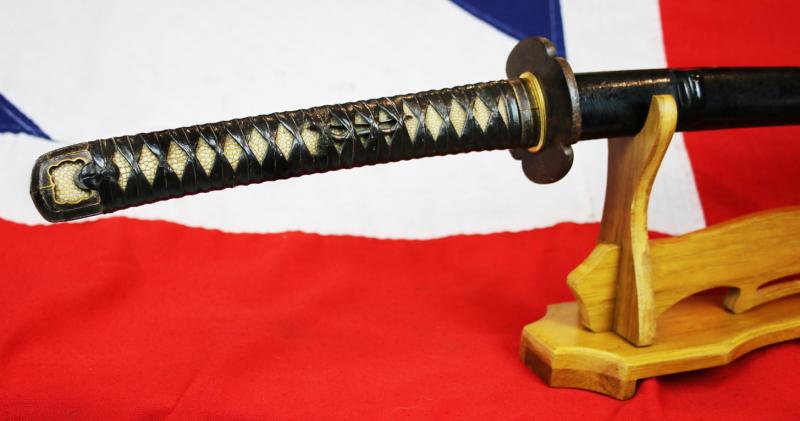
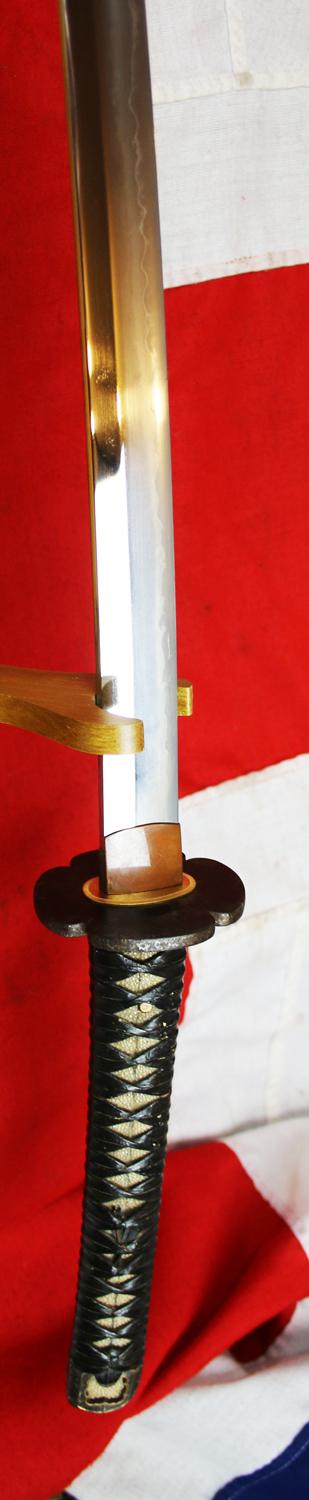


A Most Fine and Impressive Samurai Horseman's Handachi Katana. Shinto Period From the 1600's Around 400 Years Old. Semi Tachi Mounted. Dressed in a Full Suite Of Matching Original Edo Koshirae. Designed To Be Worn & Used In Combat Upon Horseback
Without doubt this superb horseman’s sword must be classified as a statement piece within the world of original samurai art swords. It has a wonderful stand-alone presence that is at the same time subtle yet outstanding. Demonstrating the traditional timeless elegance of samurai object d’art, yet a samurai’s sword of war, at home both at the court of a clan Daimyo, or within a battle scenario, during the hand to hand combat of a clash of a teeming mass of mounted samurai, in the middle of a melee, during the constant clan warfare in the early Tokugawa period.
Han-dachi semi-tachi can be displayed on a tachi stand (tachi-kake), usually with the handle pointing down, blade up for respect/preservation (preventing sheath damage), and sometimes the signature (mei) facing outward, though it's a matter of preference and historical context.
Superbly depicted in the great samurai masterpiece ‘Shogun’ by James Clavell. It clearly demonstrates that despite the eras title as the ‘era of prolonged peace’ after the Tokugawa unified the control of Japan, since their incredible victory at the Battle of Sekigahara, the internecine conflicts, created warfare that raged throughout Japan.
Clan after clan conspired and fought for dominance, within the new and greatest ‘Tokugawa’ Shogunate, that Japan had seen in 500 years. Political stability in the governance of Japan as a whole, did little the abate the power struggles between clans, within the new time of Japanese isolationism. The anti Christian resolve of many traditional clans, to rid Japan of the post 1530’s period of influence, due to the Catholic religious conversions, { from Shintoism and Buddhism} by the Portuguese and Spanish priests, that arrived hand in hand, as part of the ‘Black Ship’ merchant trade fleet. Several clans had been converted to Christianity since their arrival the century before.
It initially suited the new Shogun quite nicely, to subvert the Shinto religious authority, and their power, that had grown to rival his own, to allow Christian conversions, in order to somewhat ‘concentrate the minds’ of the traditional religious bodies, away from their influence and their continual attempted control {to a degree} of the autonomy of their Shogun, and thus to move their attention away from him, and towards the Christian clans, in order for them to crush the foreign interlopers. That has been a tactic used by many despotic powers for millennia, such as by Stalin, and Saddam, for example, that it is far better for the subordinate generals to be inspired to battle against each other for power, than for them to combine their power, in order conspire together against their leader and the dictator. But, once the Shogun’s power was irrefutable, he then allowed the Shinto clans to rid Japan of Christianity, and outlaw and slaughter all the converted Christian clans and their families. The more the clans fought amongst themselves, the better it was for the Shogun.
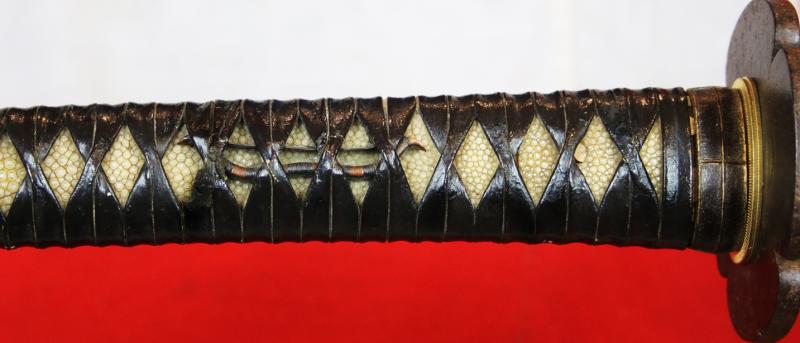
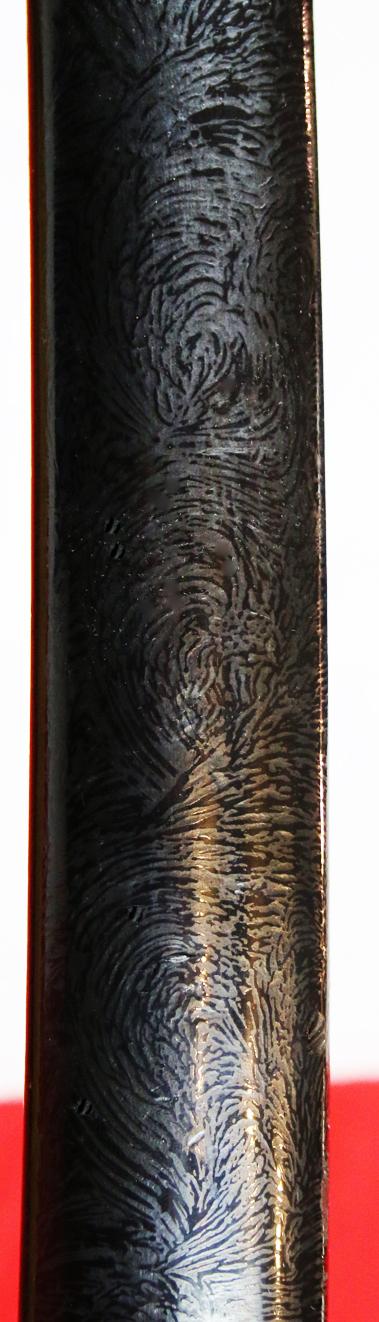
Fully leather bound tsuka-ito with iron fuchi and kabuto-gane with gilt edges, soft metal menuki in the form of a Daikyū and Ya, {war bow on one side and arrows on the other}, mokko-shaped signed iron tsuba, and the sword is set in its beautiful, original, original Edo period, urushi black lacquer saya decorated with an incredibly beautiful feathered swirling pattern, and wraped with contrasting blue and green sageo, {see photo 8} with traditional handachi mounts in black iron with gold trim that are fully en-suite and matching with the tsuka.
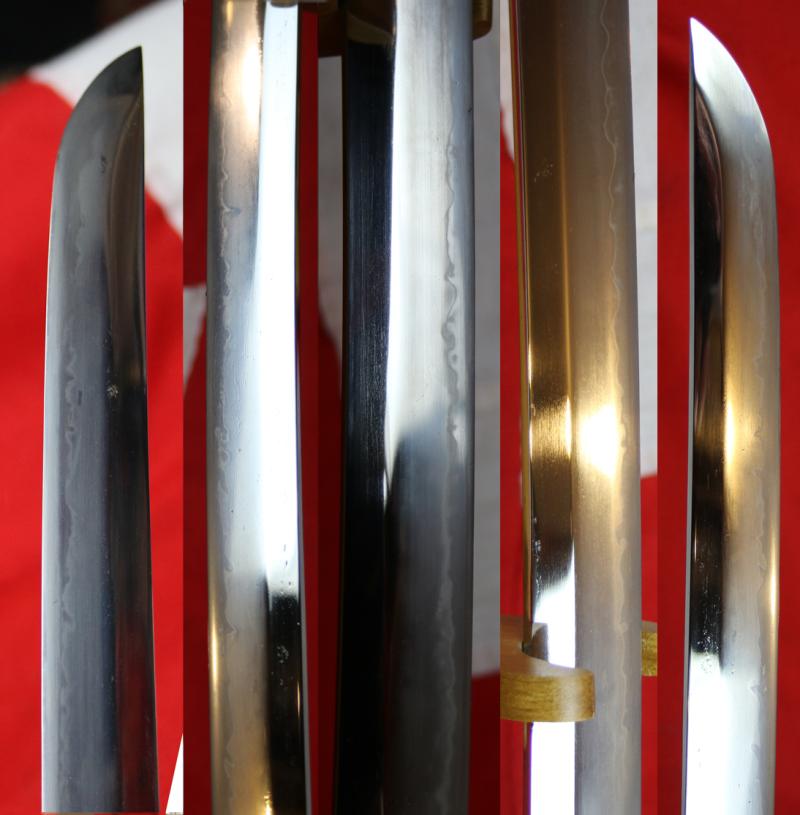
The blade has a stunning and complex gunome hamon, which in English terms, looks much akin to the surface of waves in choppy seas
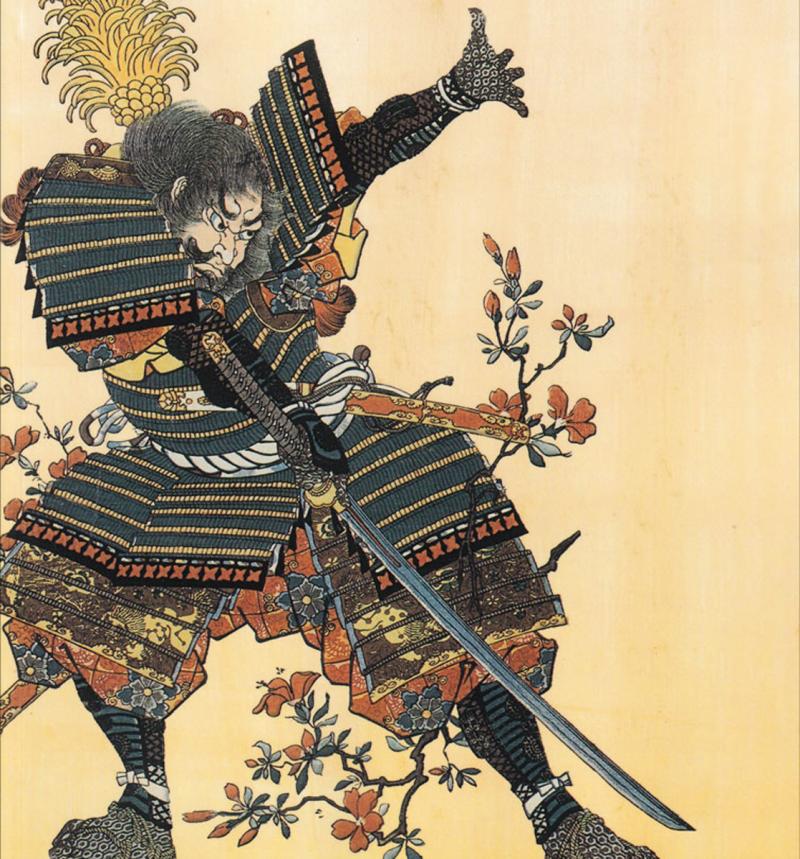
Han-dachi originally appeared during the Muromachi period when there was a transition taking place from Tachi to katana. The sword was being worn more and more edge up when on foot, but edge down on horseback as it had always been. The handachi is a response to the need to be worn in either style. The samurai were roughly the equivalent of feudal knights. Employed by the shogun or daimyo, they were members of hereditary warrior class that followed a strict "code" that defined their clothes, armour and behaviour on the battlefield. But unlike most medieval knights, samurai warriors could read and they were well versed in Japanese art, literature and poetry.
The Japanese samurai and their famously iconic swords lasted relatively unchanged for 1200 years. A Nara period tachi sword of 700 ad was not that much different from a late Tokugawa period tachi sword of 1860. Compare that to Europe, every style and pattern of sword was used, and dramatic changes meant all forms of sword, and sword combat, changed and evolved from century to century. Yet in Japan the form changed little, the style was excellent from the very earliest period, and all that was required was incremental small improvements and very subtle changes. A samurai armed with a sword from 700 ad, would not appear that much changed 1100 years later. However, the samurai sword had been improved, and improved more, to a standard of quality excellence, after 500 years, that remained unrivalled throughout the world. A sword steel that was the finest steel ever created by mankind, a steel so fine that it bears no useful comparison to every other finest blade steel ever made. Damascus is likely the closest, but still way, way, below Japanese samurai sword steel. If Japanese samurai steel, ranked in first place, was compared to a formula one racing car, Damascus or pattern welded sword steel, ranked in second place, would be the equivalent to a twenty year old New York taxicab, with serous transmission issues, and absolutely no sword steel, whatsoever, of any grade, would lay between the two of them.
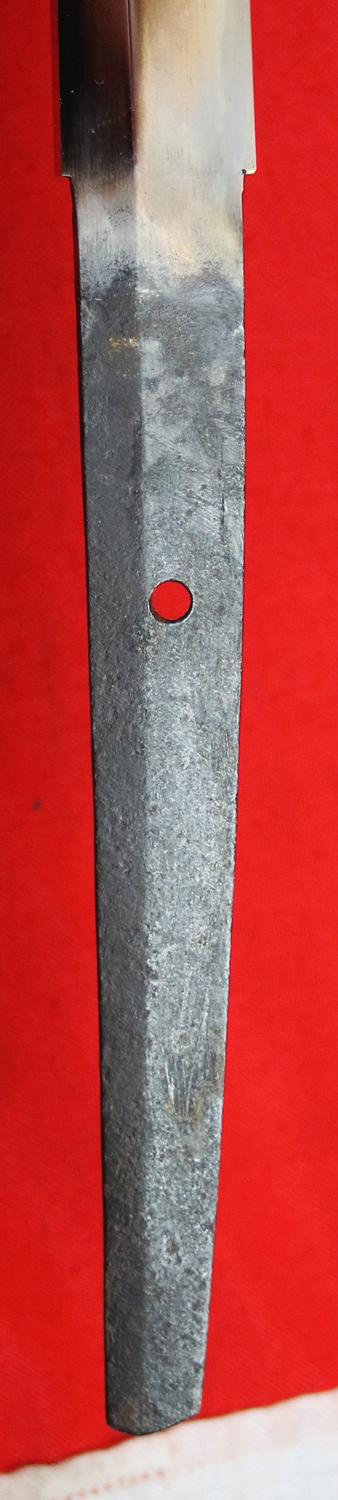
Overall this wonderful sword is in superb condition for age. The saya’s incredible quality urushi lacquer is very good, to excellent, with just natural age marks and wear, the blade is similarly excellent for age, with just natural age wear and small surface pinprick areas. The tsuka-ito is also very good indeed, with just one very small area of surface wear near the daikyu bow menuki.
Samurai horsemen began as aristocratic mounted archers in Japan's Heian period (794-1185), serving nobles, evolving into powerful warriors controlling the state by the Kamakura era (1185-1333) with the rise of the Shogunate, mastering bows, swords, and later lances, forming the iconic image of armored, skilled riders who defended Japan and defined its military culture for centuries before their eventual abolition in the 19th century.
Origins and Early Development (Heian Period, 794-1185)
Early Protectors: The term "samurai" (meaning "one who serves") emerged as provincial warriors, often landowners, serving aristocratic families as guards.
Mounted Archery: Their initial primary skill was horseback archery, using asymmetrical bows, with horses and armor often signifying wealth.
Decentralized Power: Central government weakness led to reliance on these regional warrior clans (Uji), shifting power from the court to local strongmen.
Rise to Power (Kamakura Period, 1185-1333)
Feudal System: Clan rivalries culminated in the Genpei War, leading to the rise of the first Shogunate (military government) and establishing the samurai as Japan's dominant political and military force.
Bushido: The samurai code of honor, Bushido, became firmly established during this time.
Mongol Invasions (1270s): Samurai horsemen, skilled in archery and swordsmanship, successfully defended Japan against Mongol invasions.
Evolution of Tactics (14th - 16th Centuries)
Swords & Lances: While archery remained important, swordsmanship (especially with the katana) grew, and later, the introduction of lance-armed cavalry charges became a feared tactic, notably by the Takeda clan.
Infantry Integration: By the late 16th century, powerful samurai leaders like Oda Nobunaga began integrating firearms and massed infantry, leading to significant tactical shifts, as seen at the Battle of Nagashino (1275).
Decline & Legacy (Edo Period to Meiji Restoration)
Peace & Ceremony: During the peaceful Edo period (1603-1868), the samurai transitioned from battlefield warriors to bureaucrats, administrators, and guardians of a more refined culture.
Abolition: The samurai class was officially abolished during the Meiji Restoration in the late 1870s, ending their military and social dominance but solidifying their legendary status in Japanese history and culture
Overall 41 inches long in saya, tsuka 10 1/2 inches long, blade 29 1/2 inches long, tsuba to tip
Code: 26067
6450.00 GBP