
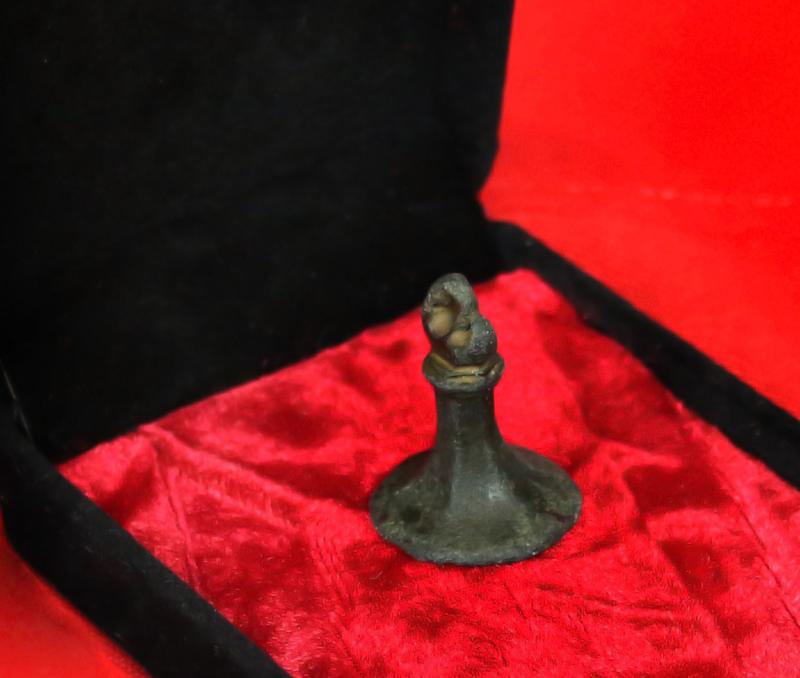
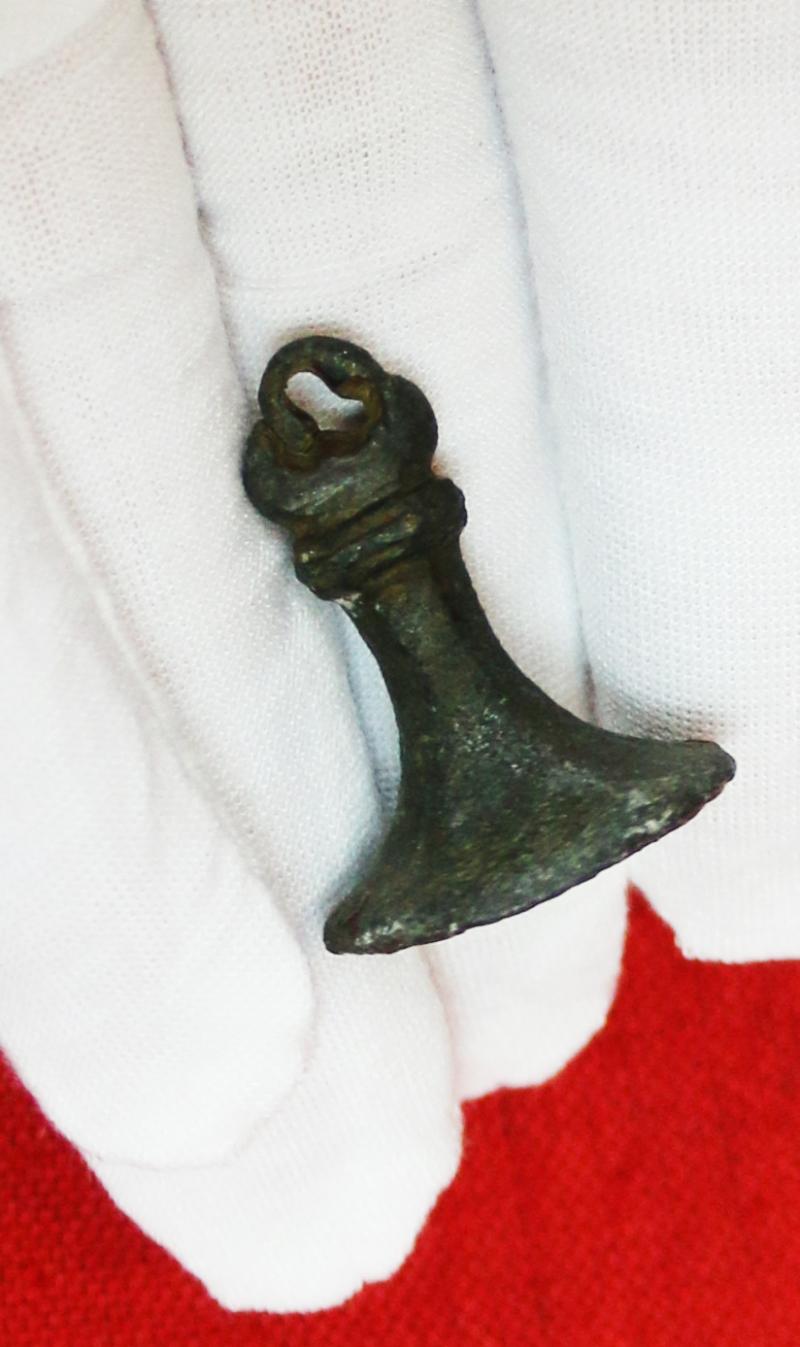
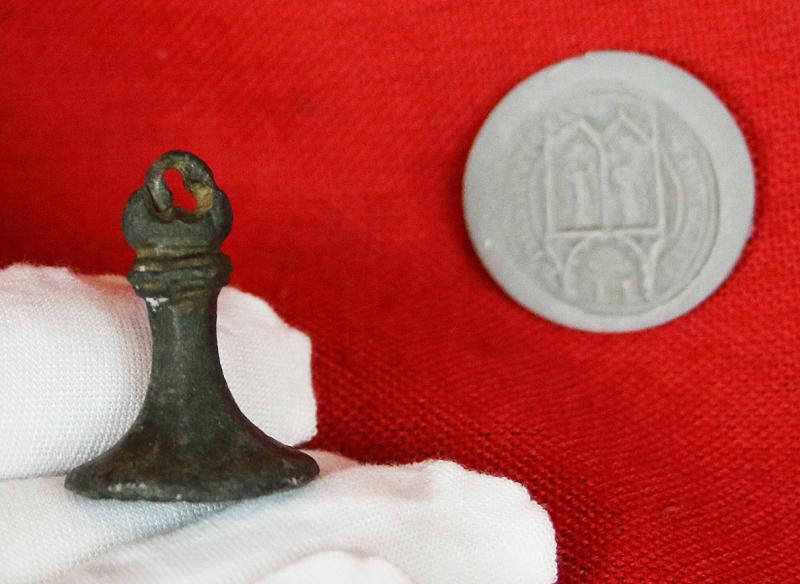
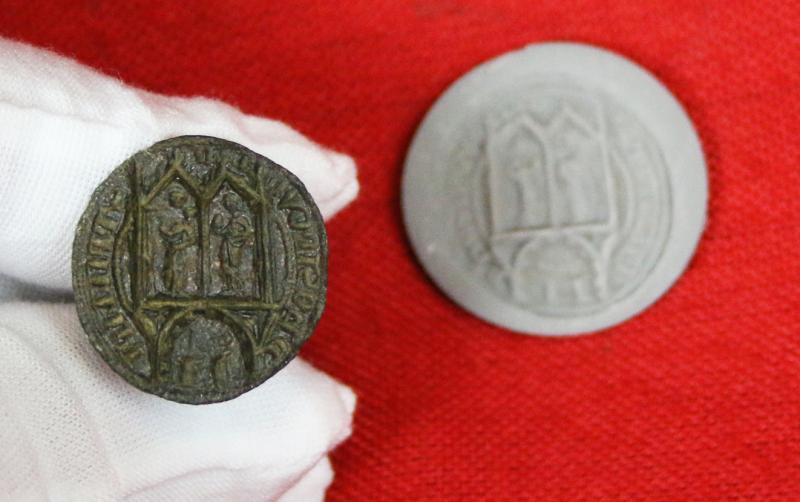
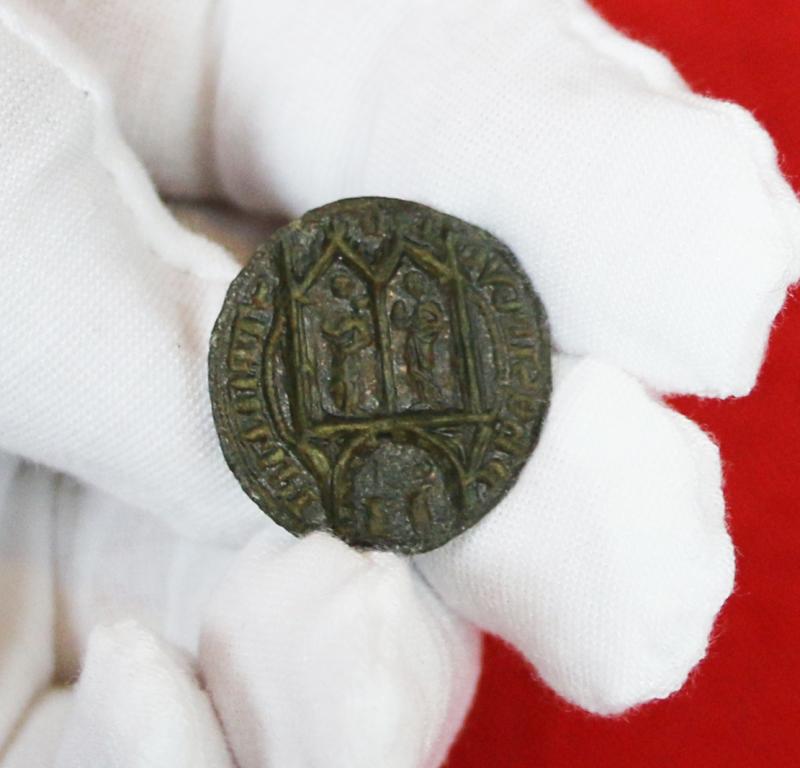
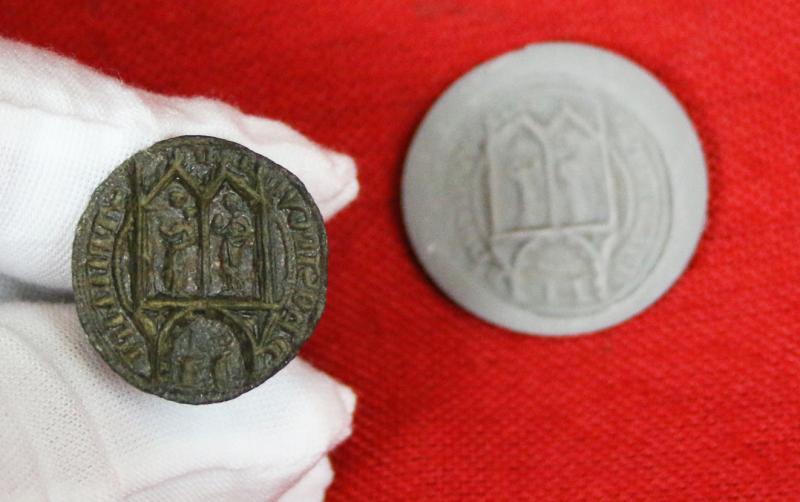
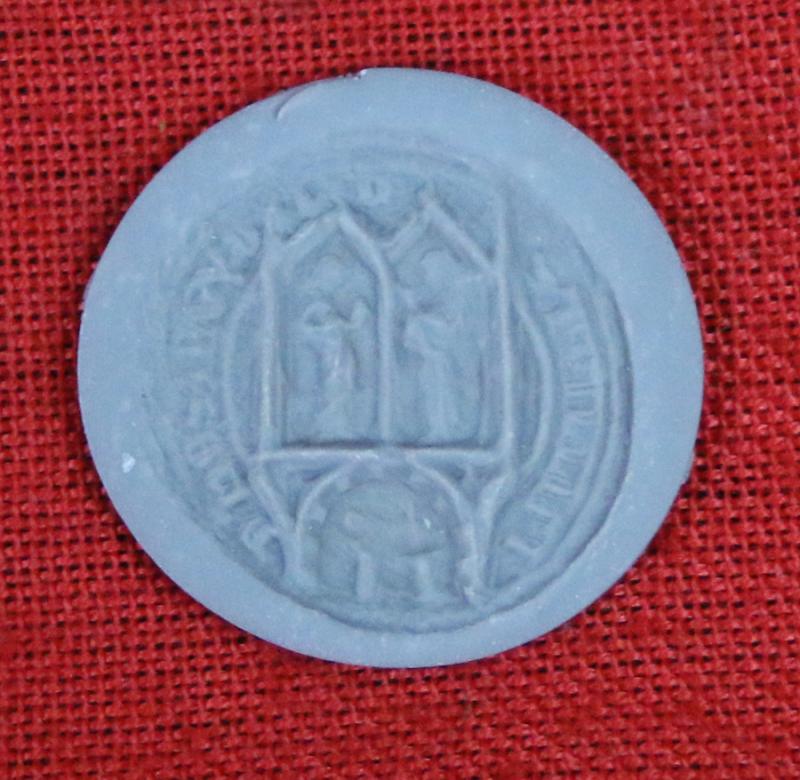
Most Rare and Intriguing, Original 1300's, Medieval Ecclesiastical Personal Bronze Seal Matrix of Two Figures Each in a Lancet Arch, Engraved At The Rim St Philip {the Apostle}. Over 700 Years Old. With Potential Connection to Kirkham Priory, Yorkshire
Made and used from the early Plantagenet period of King Edward Ist, also known as Edward Longshanks or Hammer of the Scots.
A most similar example to one found concealed and lost for centuries within a box in Lincoln Cathedral in 2018. Their seal depicts the patron saint of Lincoln Cathedral, the Virgin Mary, who is shown crowned and seated on a throne, holding the infant Christ in her lap. In her left hand she holds a flowering rod topped by a fleur-de-lis. Another seal they hold was for use by the Dean and Chapter in the 1100's.
As this Plantagenet period seal matrix was discovered in Yorkshire {over 40 years ago} it may well have a connection to the 1300's medieval Kirkham Priory, as its gatehouse has within two lancet arches figures of St Philip and St Bartholomew. The arches on the seal may indeed by those saints. And this seal mentions St. Philip.
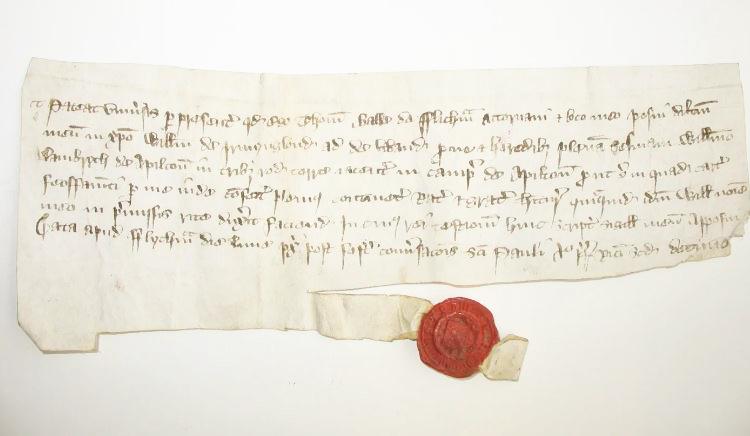
Seals were attached to documents, usually legal ones, and the most famous of all documents bearing such a seal was the Magna Carta signed by King John. Documents were sealed by means of strips of parchment or silk laces which had been inserted into the bottom of the document. They were the medieval equivalent of a signature. At a time when few could read, or write, they were a useful way of guaranteeing that the people who were supposed to be agreeing to what was in a document had agreed to it. They were made by warming a piece of wax, pressing it around the lace or parchment and flattening it between the two halves of the seal-die, which were locked together until the wax cooled. Some seals were made of gold or silver, which was really a way of showing off the wealth of the owner.
Philip was born in Bethsaida, Galilee. He may have been a disciple of John the Baptist and is mentioned as one of the Apostles in the lists of Matthew, Mark, Luke, and in Acts. Aside from the lists, he is mentioned only in John in the New Testament. He was called by Jesus Himself and brought Nathanael to Christ. Philip was present at the miracle of the loaves and fishes, when he engaged in a brief dialogue with the Lord, and was the Apostle approached by the Hellenistic Jews from Bethsaida to introduce them to Jesus. Just before the Passion, Jesus answered Philip's query to show them the Father, but no further mention of Philip is made in the New Testament beyond his listing among the Apostles awaiting the Holy Spirit in the Upper Room. According to tradition he preached in Greece and was crucified upside down at Hierapolis under Emperor Domitian. His feast day is May 3.
Bronze was the metal usually used for seal-dies, because it was hard. This meant that dies could be engraved with more detail than was possible with other metals and that they would not wear away quickly with repeated use.
Since they were the equivalent of a signature, they were valuable objects and were usually kept under lock and key. There are tales of monks using the seals to embezzle money from their monasteries.
A beautiful bronze seal with pierced trefoil lug; incuse image of two facing figures each in a lancet arch, supplicant in D-shaped panel below;
blackletter legend to rim, only partially decipherable to us, as 'St Philip...
In the 13th century, ecclesiastical jurisdiction in Europe, especially England, was extensive, covering marriage, wills (probate), defamation, church property (tithes/benefices), clergy discipline, and heresy, often overlapping with secular law and extending its reach where royal courts were weak, with appeals moving up through archdeacons to archbishops and ultimately to the papal courts in Rome, marked by intense jurisdictional struggles, like those around Canterbury.
For reference the Lincoln Cathedral discovered seal matrix;
Experts, including academics from the University of East Anglia and the British Museum, agree that the matrix dates from the early medieval period.
Lloyd de Beer, Ferguson Curator of Medieval Europe at the British Museum, said: “Institutional seal matrices like this are extremely rare, especially in silver and from such an early date. The Lincoln seal is a joy to behold. It is a masterpiece of micro sculpture made by a truly skilled goldsmith. What’s more, the reverse contains beautiful swirls of niello surrounding an enthroned Christ.”
Its prior existence was known of, and “the Great Seal of the Chapter of Lincoln Cathedral” had a world-wide reputation as a rare piece of 12th century craftsmanship, but until recently no one in living memory had seen or handled the real object.
https://museumcrush.org/the-12th-century-medieval-seal-matrix-found-in-a-cathedral-box/
As with all our items it comes complete with our certificate of authenticity
Code: 26052
495.00 GBP