

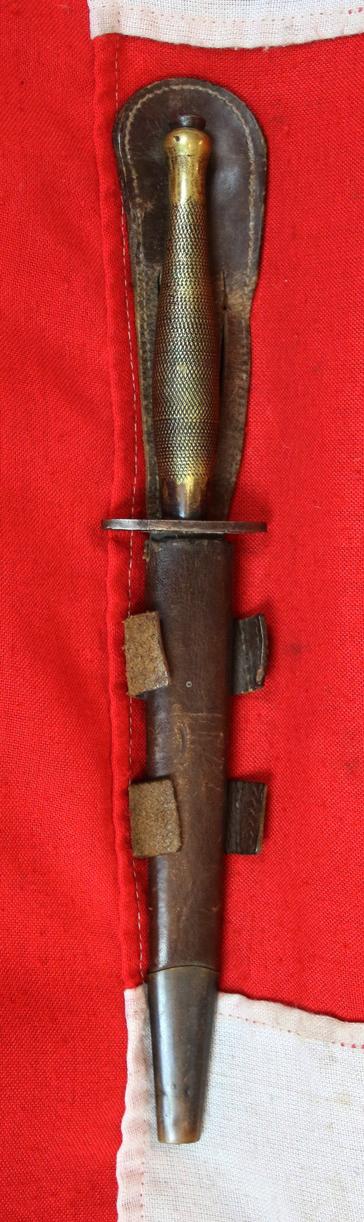
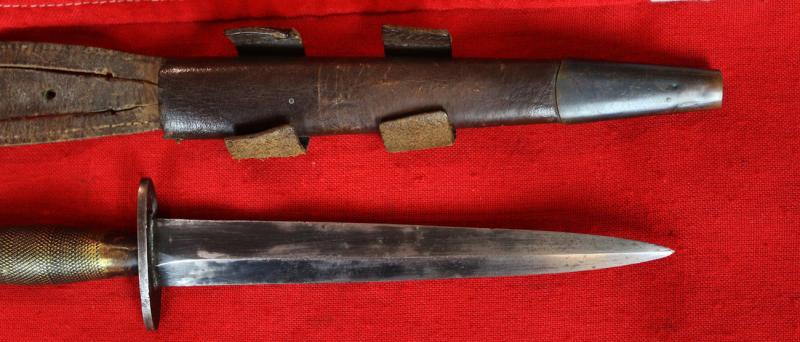
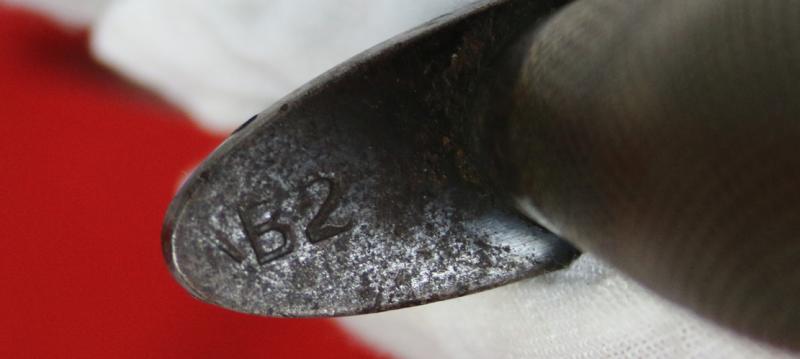
A Fabulous, WW2 Special Forces, 1942 Issue, 'B2' Broad Arrow Marked Early Second Pattern FS Commando Knife. With 'Hand Ground' Blued Finish Blade & Original Leather Scabbard In Great Service-Used Condition
An iconic WW2 British Fairbairn Sykes 2nd Pattern Fighting Knife Marked broad arrow and B2 on the crossguard, it features a tradition chequered brass grip stamped with partial broad arrow and B2 on the guard attributed to Wilkinson Swords.
The pommel nut has the classic tiny indentation The fighting knife comes complete with its original brown leather scabbard complete withits original four tabs intended to stitch to the uniform with elastic retaining strap removed. The hand ground blade has around 50%+ original blueing present, and the brass grip has a few small marks, and overall its in very good condition considering its age and use.
Prices of original and good condition WW2 FS knives, for collectors, seems to know no limit, we have seen them almost double in the past few years alone. This very good 2nd pattern, the so-called 'Officers' type. The model that was made after the 1st pattern was discontinued from the 12th August 1942 until the IInd pattern itself was discontinued in 1943.
The story about the Fairbairn Sykes Fighting knife starts in England in 1940.
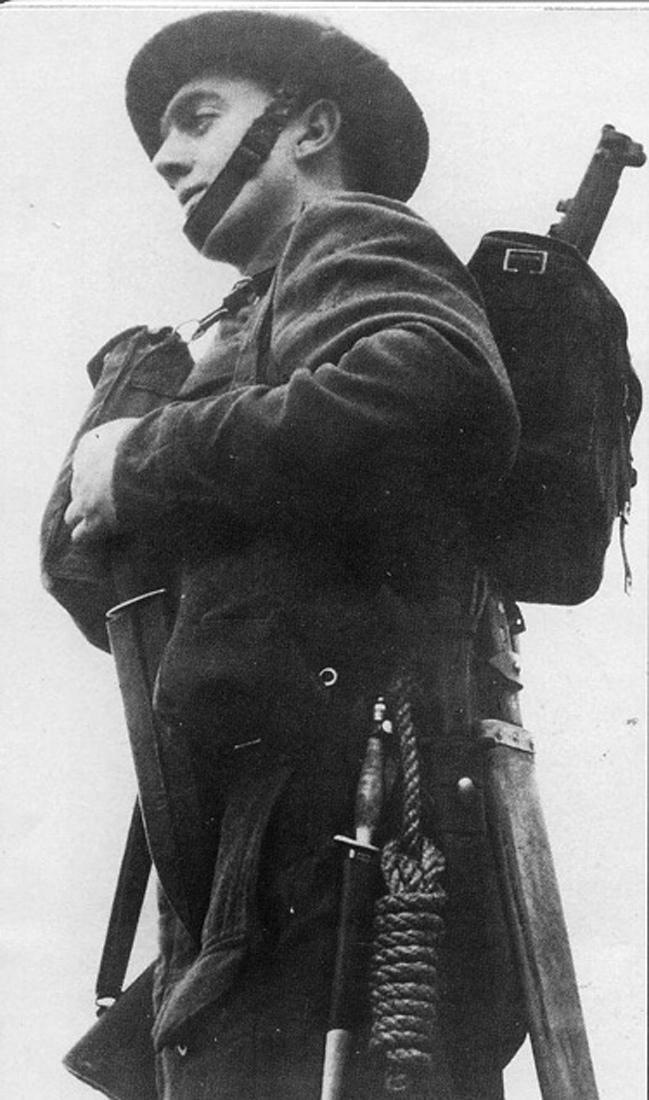
In 1940 the British formed special commandos to carry out raids. The initiative came from Winston Churchill in 1940 for a force that could carry out raids against German occupied Europe.. On the 8 June 1940, Section M09 of the War Office was brought into being. The name commando was taken from small effective mobile Boer units during the war in South Africa 1899-1902. Initially drawn from within the British Army from soldiers who volunteered for special service, the Commandos' ranks would eventually be filled by members of all branches of the United Kingdom's armed forces and a number of foreign volunteers from German-occupied countries.
Reaching a wartime strength of over 30 individual units and four assault brigades, the Commandos served in all theatres of war from the Arctic circle to Europe and from the Middle East to South-East Asia. Their operations ranged from small groups of men landing from the sea or by parachute to a brigade of assault troops spearheading the Allied invasions of Europe and Asia.
Two of the first instructors were Captain William Ewart Fairbairn (b. 28 February 1885, d. 20 June 1960) and Captain Eric Anthony Sykes (b. 5 February 1883, d. 12 May 1945). These middle aged gentlemen trained the young soldiers in a new and difficult mode of close-combat fighting at the Commando Basic Training Centre, Achnacarry, Scotland. Churchill described the commandos as 'a steel hand from the sea'
The need for a proper fighting knife, for these commandos, was apparent from the first few weeks of training specialized personnel. As Fairbairn later wrote, "...the authorities did not recognize a fighting knife as part of the equipment of the fighting services. In fact, such a thing as a fighting knife could not be purchased anywhere in Great Britain."
Until now, there had never been an official knife for the British armed services, although many types of knife had been authorised for use in the past. Bowie style knives were carried by some of the Imperial Yeomanry during the South African War of 1900-1901, and in World War I cut-down bayonets, privately purchased hunting knives, or captured German issue folding knives were extensively utilised.
In November 1940 there was a meeting between W. E. Fairbairn, E. A. Sykes and Robert Wilkinson Latham at Wilkinson Sword Company.
Fairbairn and Sykes described the type of knife they envisioned and the purpose for which it was intended. As discussion continued, preliminary sketches were drawn up and modified time and time again. As Robert Wilkinson Latham tells it: 'In order to explain exactly their point, the two men rose to their feet and one, it was Fairbairn my grandfather mentioned, grabbed the wood ruler from his desk and the two men danced around the office in mock combat'. W. E. Fairbairn author of Get Tough had also brought with him an example of a suitable fighting knife.
The system they devised utilised techniques drawn from Jiu Jitsu, Gatka, Kung Fu and 'Gutter Fighting'. It proved extremely effective. They were natural choices for the job. Both had served in the Shanghai Municipal Police Force, facing death daily in the dark, narrow streets and alleys of the city against armed thugs and organised gangs. In Shanghai they had made some fighting knives out of bayonets. The meeting resulted in the Fairbairn Sykes Fighting Knife, that was manufactured, firstly, into the 1st pattern FS Knife, it was to then evolve, briefly, into the 2nd pattern FS Knife in August 1942 and eventually into the 3rd pattern, in around October 1943. The 3rd pattern is still in use today. This is very good example of these highly sought after early 2nd types.
6 1/2 inch blade
Code: 26028