


A Most Rare, Original, Absolutely Glorious and Beautiful 2nd Dragoon Guards 1847 Heavy Cavalry Trooper's Helmet of ‘The Queen’s Bays’. A Victorian Beauty Made Before The Crimean War and Used In Combat and Full Dress In The Indian Mutiny
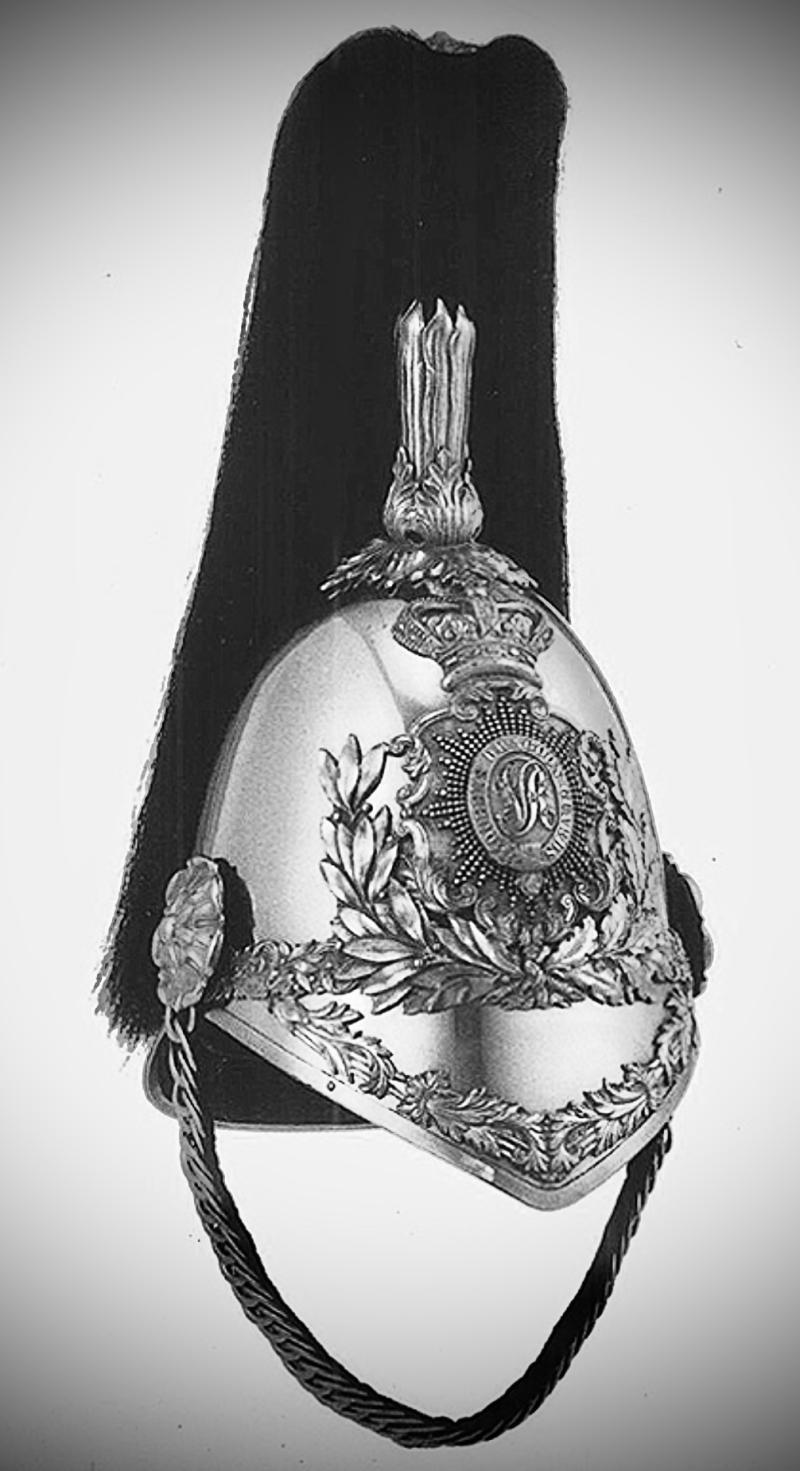
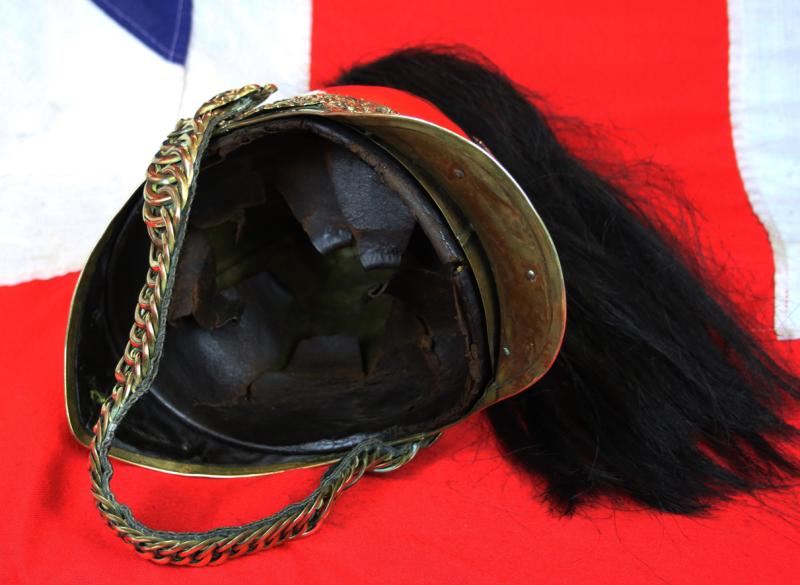
Whereas there are only a few officers helmets in existence of this vintage, other ranks' helmets are even rarer. This is a 2nd Dragoon Guards helmet with the correct black plume, and in overall good condition, the original plume has service wear.
The brass skull supports an ornate plume holder which has a brush of horsehair out of which sprouts a falling plume of the same hair. There is a rose shaped brass filial on top of the plume, similar in shape and size to the bosses that hold the chin chain. The badge on the front is similar to that on the officers' helmets except that the VR is not backed by red enamel. The star around the garter is of white metal, and placed on a Rococo shield, surrounded by a wreath of laurel and oak. The inscription on the garter is QUEENS DRAGOON GUARDS. The front and back peak are ornamented with applied acanthus leaves. Inside the helmet is a black leather sweatband.
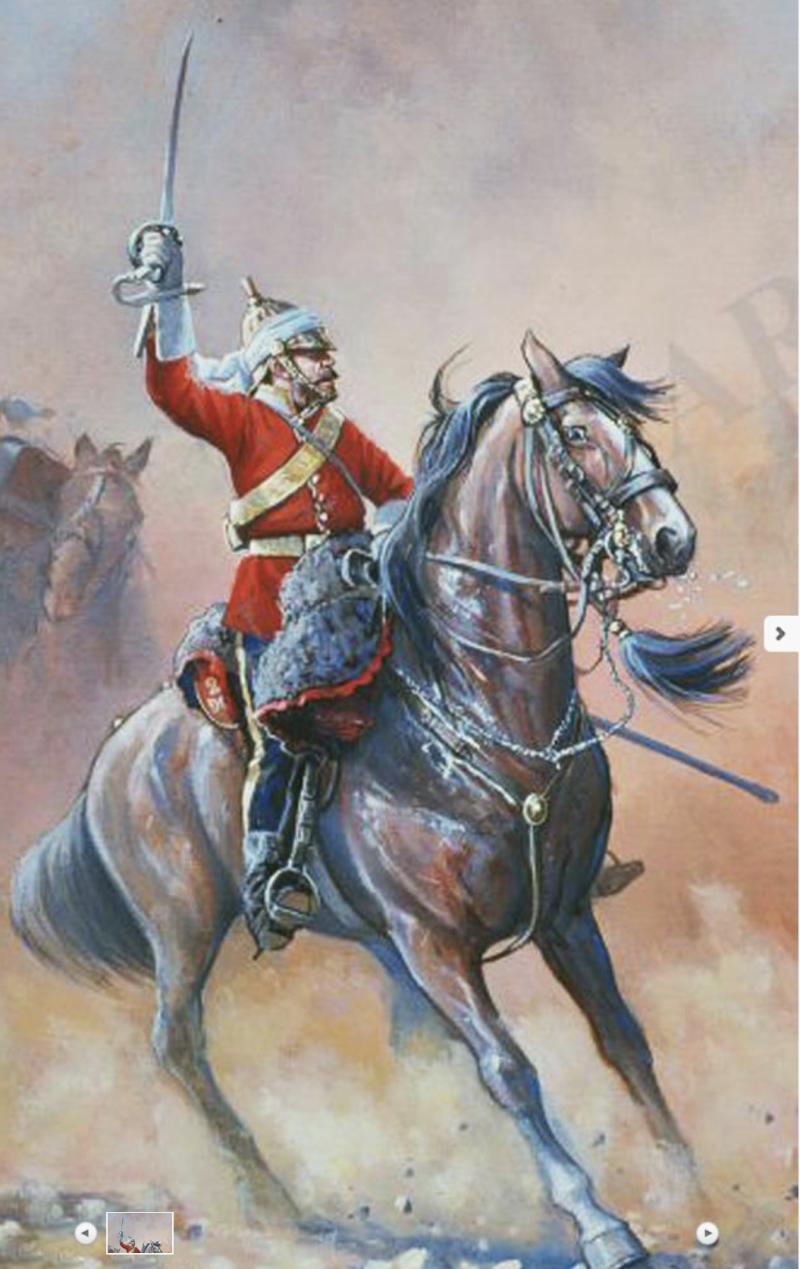
The horse hair plume was worn during regular service and full dress, in combat the black horse hair plume was removed
The regiment next saw action when a squadron under Major Piercy Smith charged the rebels at the capture of Lucknow in March 1858 during the Indian Rebellion.
The Indian Mutiny 1857-59
Passage to India 1857
The Bays were in Dublin when the Mutiny broke out in India. They were ordered to Liverpool, then on to Canterbury where one Troop was left behind. They embarked 9 Troops under the command of Lt-Col Hylton Brisco, with a strength of 28 officers 47 sergeants and 635 other ranks. They sailed on 25 July on two transports, the Blenheim and the Monarch. The voyage was a long and arduous one for the officers and men on the overcrowded transports. The only land they sighted before reaching India, was Madeira, where they lay becalmed for 28 days. This increased their journey to 141 days. During that time they were daily rationed to 1 lb of very hard biscuit, 12 oz of salt meat, a small quantity of tea and sugar, and 5 pints of water. Washing had to be done in sea water. After 3 months at sea they were told that they were only half way there and rations had to be halved. One of the Bays described the lack of appetising food: 'On Sundays, boulle soup was given for a change, but it wasn't generally approved of, as one mess found a dead mouse in theirs, and another mess found a man's finger with a rag wrapped round it.' They reached Calcutta to find that the KDG had arrived a fortnight before, having set off a month later than them. All of them suffered sickness for 4 or 5 days after disembarkation.
Nusrutpore, 23 Jan 1858
The regiment had a difficult overland journey to Allahabad with new horses that had been purchased locally. The men suffered from cholera, and the sick men had to be carried. On 23 Jan two squadrons of the Bays, and a Troop of Horse Artillery were sent out and met up with the 97th regiment and some companies of Gurkhas. They encountered a body of mutineers at Nusrutpore in jungle country. One squadron under Captain Powell made a brilliant charge, and the fighting caused the enemy to lose 1,800 men and some of their guns. Five men of the Bays were wounded, along with 7 horses killed or wounded. These casualties were light considering the heavy fire they came under from the rebels.
Relief of Lucknow
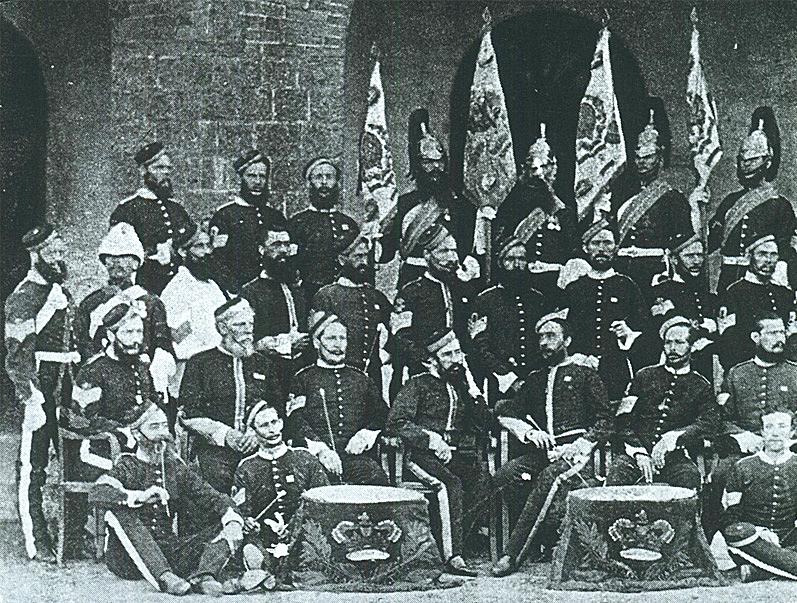
2nd Queen's Bays Dragoon Guards
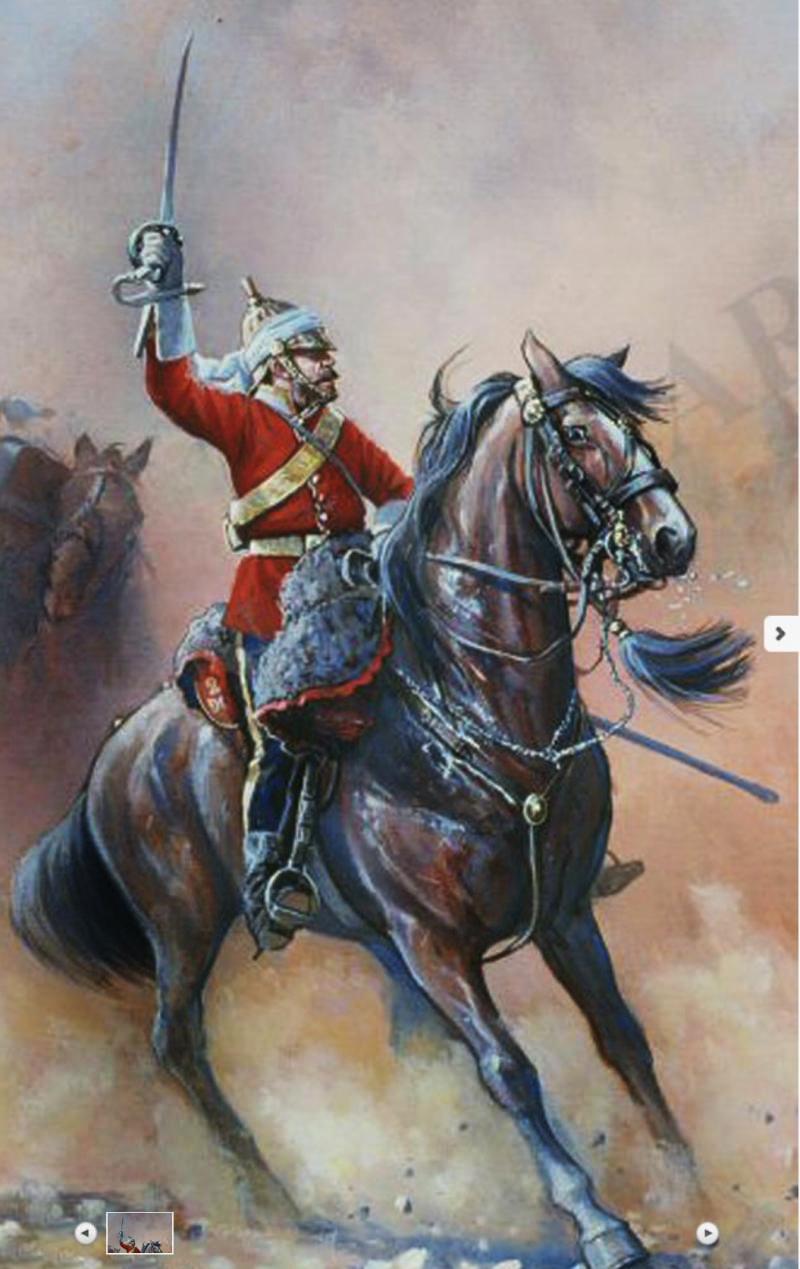
Charge at Lucknow
After the recapture of Delhi the focus of the conflict was on Lucknow, 150 miles northeast of Allahabad. Sir Colin Campbell had already rescued the beleaguered garrison there but had not prevented the rebels from capturing the city and holding it with 130,000 men. Campbell now had a force of 20,000 to march on Lucknow. The rebels made several sorties out of the town to engage with them. On 6 March two squadrons of the Bays made a charge under the command of Major Percy Smith. This got out of control over broken ground and three men were killed, including Major Smith. They were unable to retrieve his body. One corporal was unhorsed and unable to remount, so was cut to pieces. Six other men were wounded and many of the horses suffered terrible wounds from the mutineers' swords and bayonets. Lucknow was recaptured by 16 Mar 1858, but 20,000 rebels escaped. The cavalry units were already scattered around the countryside chasing small parties of rebels so were not in position to block the mass exodus on 16 Mar.
Nawabganj, 13 June 1858
In a battle at Nawabganj, east of Lucknow, 2 squadrons under Major Seymour were part of the cavalry element of Hope Grant's 3,500-strong column that attacked a force of 15,000 mutineers entrenched at a river crossing. They made a 12 mile night march to surprise the rebels. There was a three hour battle during which the British were surrounded but they turned the tables and drove the enemy off, having killed 600 and captured 9 guns. The British lost 67 killed or wounded in action, but 33 died of sunstroke and 250 ended up in hospital. All members of the regiment had suffered from fever or sunstroke, both proving fatal in many cases. The CO, William Campbell died on 6 July 1858, after being promoted to brigadier. The second lieutenant-colonel, Hylton Brisco had suffered with fever and retired in September. Because of the fatalities and sickness, officers were gaining promotion without purchase. Captain William Henry Seymour, whose letters home provide valuable information on the Bays in India, attained his majority and lieutenant-colonelcy so that within 8 months he had gone from captain to CO of the regiment.
Jamo, 8 Oct 1858
2nd Queen's Bays Dragoon Guards
Chasing Rebels
The regiment were transferred to another column led by Brigadier Sir George Barker in Oct 1858. On 8 Oct they were in action against 30 or 40 mutineers from the 42nd Bengal Native Infantry, concealed in a jungle of sugar cane at Jamo near Sundeela in Oudh. They opened fire on the Bays from a distance of a few yards. Lt-Col Seymour fought desperately with pistol and sword, but was cut down. Trumpeter Thomas Monaghan and Private Charles Anderson rushed to his rescue and fought them off so that Col Seymour was able to get up and carry on fighting. Monaghan and Anderson were awarded the VC for this action. While this was happening, boy Trumpeter John Smith engaged a sepoy in single combat and killed him.
Jowah Pass, April 1859
Colonel Seymour was in action again in the spring of 1859. There were two actions near Bungdon in Oudh, which were among the last battles fought by the Bays after their 20 consecutive months in the field. In another action mutineers had taken refuge in the mountains of Nepal and the Nepalise King asked the British to hunt them down. Two squadrons of the Bays under Major Hutchinson chased the rebels to the Jowah Pass where they charged and defeated them. They had one casualty, Cornet Torrens who was wounded. Following this they went into cantonments near Lucknow. The Queen's Bays remained in India until 1869, eleven years in all.
The regiment's most considerable 20th Century battle honours were as follows:
Early Wars: Warburg, Willems, Lucknow, South Africa 1901-02
The Great War: Mons, Le Cateau, Retreat from Mons, Marne 1914, Aisne 1914, Messines 1914, Armentières 1914, Ypres 1914 '15, Frezenberg, Bellewaarde, Somme 1916 '18, Flers-Courcelette, Arras 1917, Scarpe 1917, Cambrai 1917 '18, St. Quentin, Bapaume 1918, Rosières, Amiens, Albert 1918, Hindenburg Line, St. Quentin Canal, Beaurevoir, Pursuit to Mons, France and Flanders 1914-18
The Second World War: Somme 1940, Withdrawal to Seine, North-West Europe 1940, Msus, Gazala, Bir el Aslagh, Cauldron, Knightsbridge, Via Balbia, Mersa Matruh, El Alamein, Tebaga Gap, El Hamma, El Kourzia, Djebel Kournine, Tunis, Creteville Pass, North Africa 1941–43, Coriano, Carpineta, Lamone Crossing, Defence of Lamone Bridgehead, Rimini Line, Ceriano Ridge, Cesena, Argenta Gap, Italy 1944-45
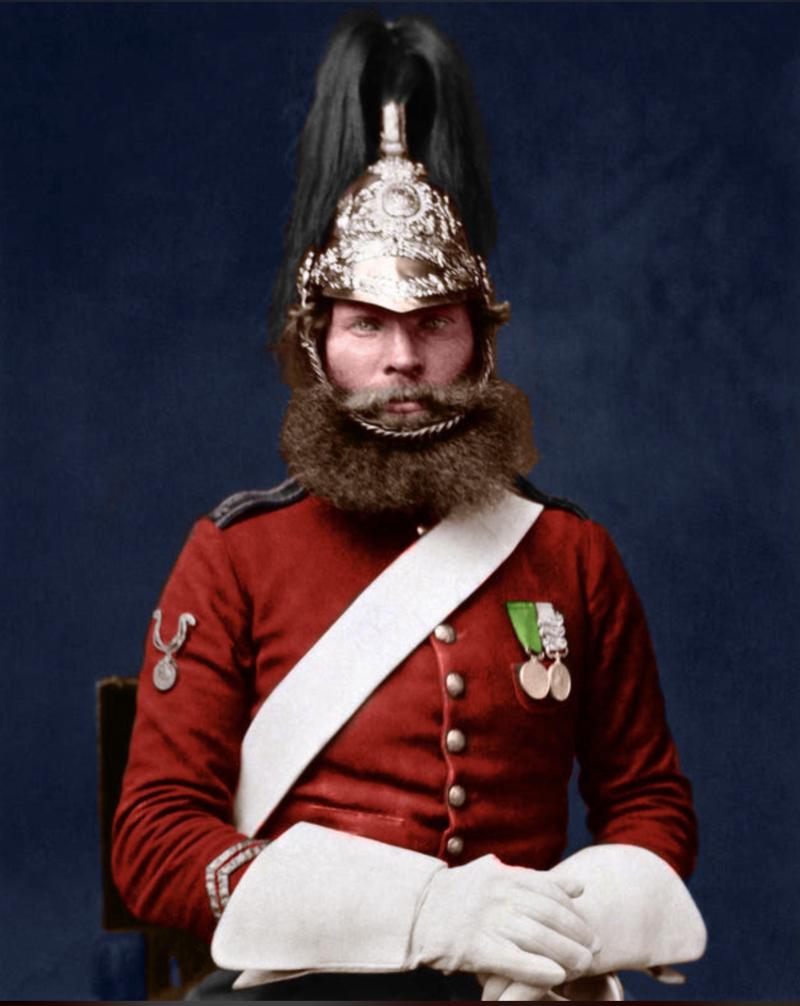
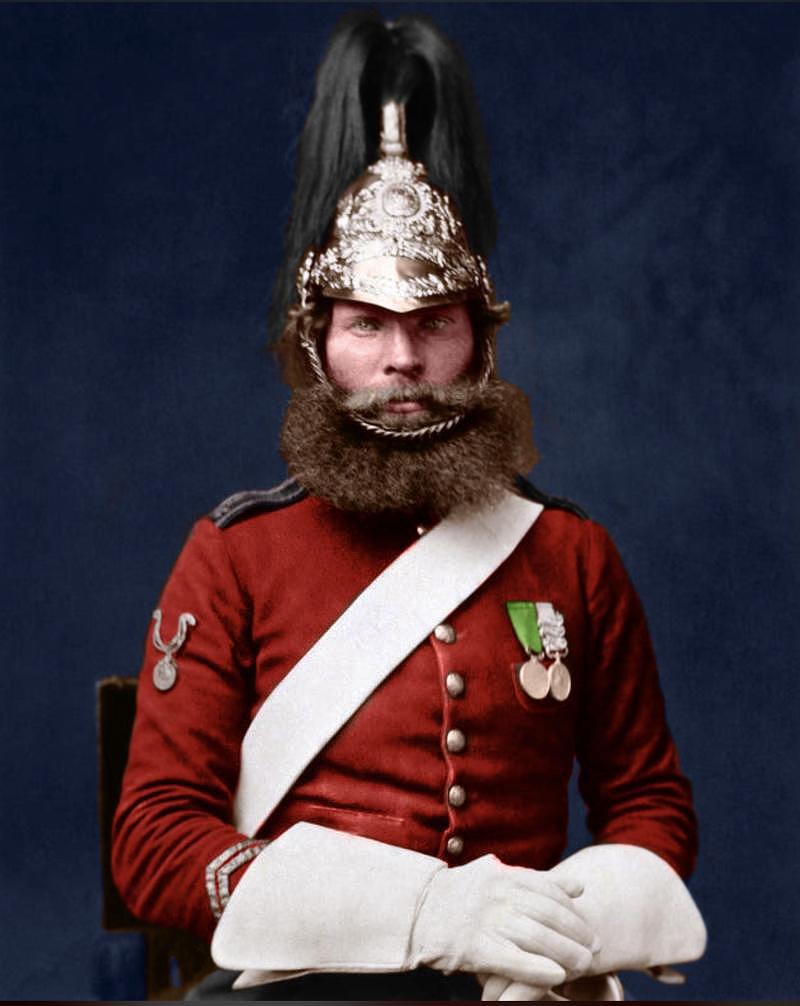
Photo in the gallery taken in the 1860’s of a Heavy Cavalry veteran wearing his very same form of helmet with its black plume {recoloured}
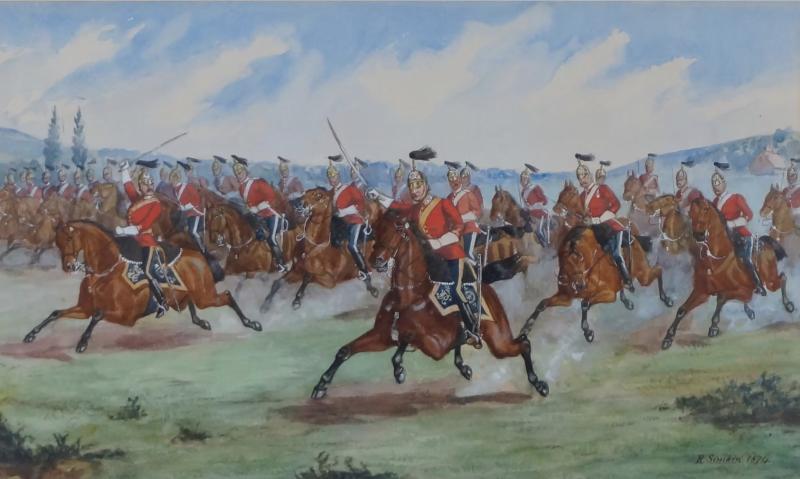
Painting in the gallery, Charge of The 2nd Dragoon Guards {The Queens Bays} by Simkin
Code: 26017
3450.00 GBP