
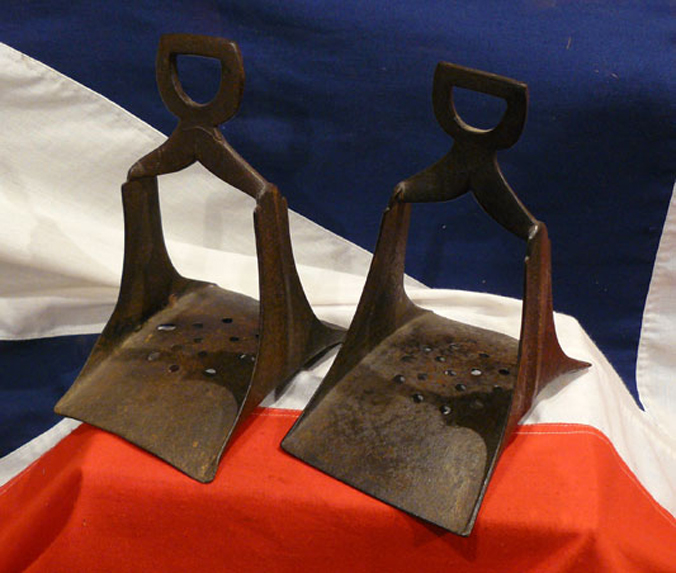
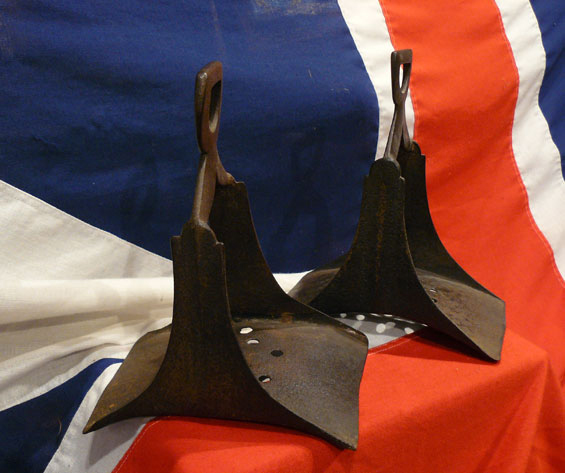
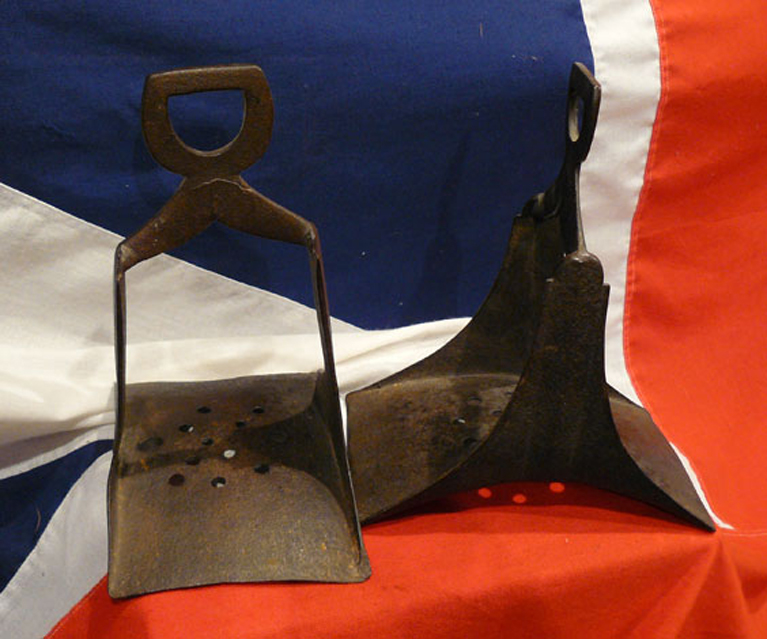
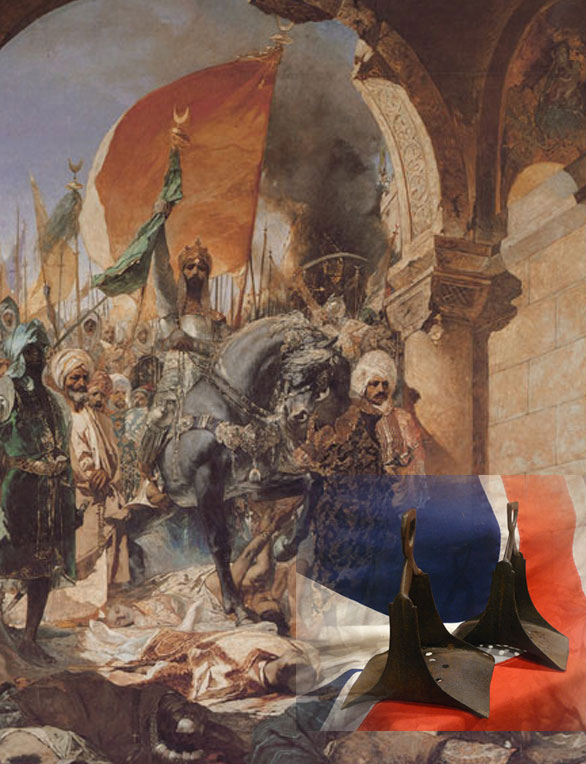
A Most Rare Pair of Early Antique Imperial Chinese Ming Dynasty Iron Stirrups 1368–1644. All The Emperors In The Ming Period Were Known As the Emperor of the Great Ming, "Son of Heaven" He was viewed As The Intermediary Between Humans and Heaven
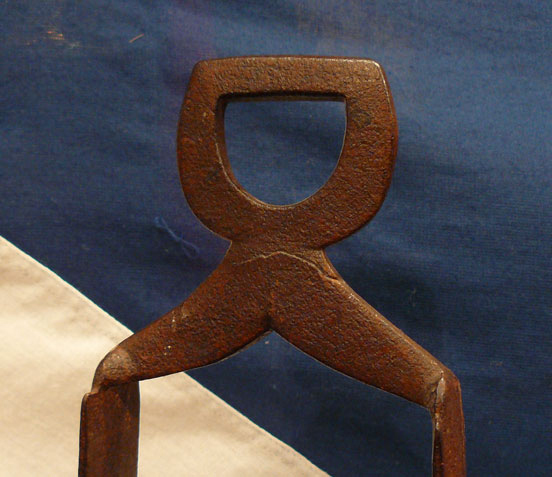
A pair of fine Ming Dynasty horse stirrups characteristic form, with broad arch treads. All steel construction in the the style that goes back to the medieval Mongol invasion period, after 1211 ad.
Could you ever imagine owning original artefacts {yet being affordable} from the era of the great Ming Dynasty. These stirrups are simply superb as collectors items, for decor display, and, also being magnificent conversation pieces. And, from one of the most famous eras of ancient China.
They {Ming antiquities} are even referred to in Sherlock Holmes by Sir Arthur Conan Doyle.
‘He opened the lid and took out a small object most carefully wrapped in some fine Eastern silk. This he unfolded, and disclosed a delicate little saucer of the most beautiful deep-blue colour.
“This is the real egg-shell pottery of the Ming dynasty. No finer piece ever passed through Christie’s. A complete set of this would be worth a king‘s ransom — in fact, it is doubtful if there is a complete set outside the imperial palace of Peking. The sight of this would drive a real connoisseur wild.” Sherlock Holmes conversing with Baron Gruner
The emperors of the Ming dynasty ruled over China proper from 1368 to 1644 during the late imperial era of China (960–1912). Members of the Ming dynasty continued to rule a series of rump states in southern China, commonly known as the Southern Ming, until 1662; the Ming dynasty succeeded the Mongol-led Yuan dynasty and preceded the Manchu-led Qing dynasty.
The Ming dynasty was founded by the peasant rebel leader Zhu Yuanzhang, known as the Hongwu Emperor. All Ming emperors were of the House of Zhu. The longest-reigning emperor of the dynasty was the Wanli Emperor (r. 1572–1620), who ruled for 48 years; the shortest was his successor, the Taichang Emperor, who ruled for only 29 days in 1620. The youngest ruler at the time of his ascension was Emperor Yingzong, who was only 9 years old, while the oldest ruler was the Hongwu Emperor, who died at the age of 71
The saddle itself was a relative latecomer in the history of riding Alexander the Great, for example, conquered his empire astride some simple pieces of cloth. Saddles with saddle trees, which made stirrups possible, are said to have first appeared in Central Asia around the time of Jesus birth. And after having initially taken the form of a buckle, notably in India, the first stirrups for both feet reinforcing the rider's balance seem to have arisen around the year 100 in the Kushan Empire (encompassing parts of Afghanistan, modern-day Pakistan and northern India) before spreading to northern China in the 3rd century and the western steppes of Iran in the 6th century.
In the Far East the Mongols were famed for their prowess as bowmen on galloping horseback simply due to their use of the stirrup that enable the rider to stand in the saddle to enable greater height and stability, this of course was adopted by the Chinese.
In the gallery we show a near identical pair of Ming dynasty stirrups {in form, though not decor} from the same period, it in the Met Collection in the US. Although their pair are decorated with inlaid gold likely for a Prince.
Overall in very good condition for age, just the usual surface russeting.
Code: 22614
1290.00 GBP