
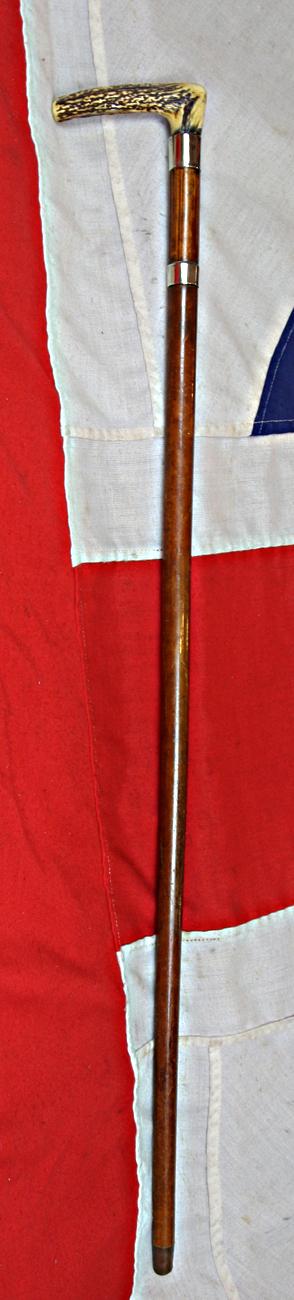
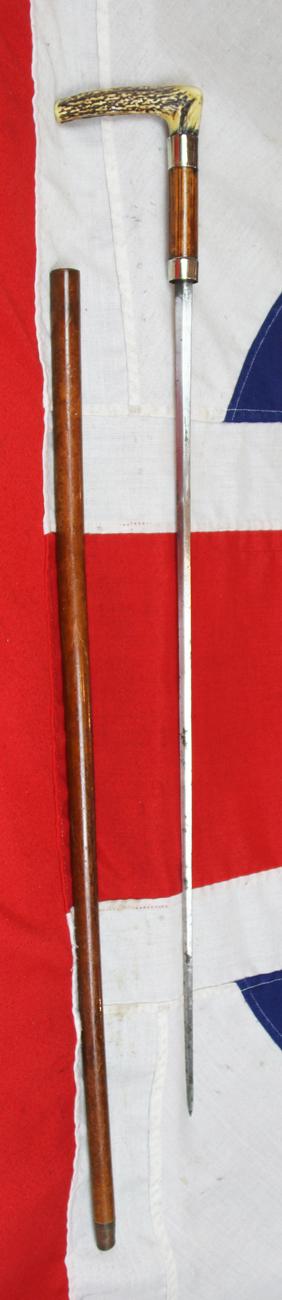
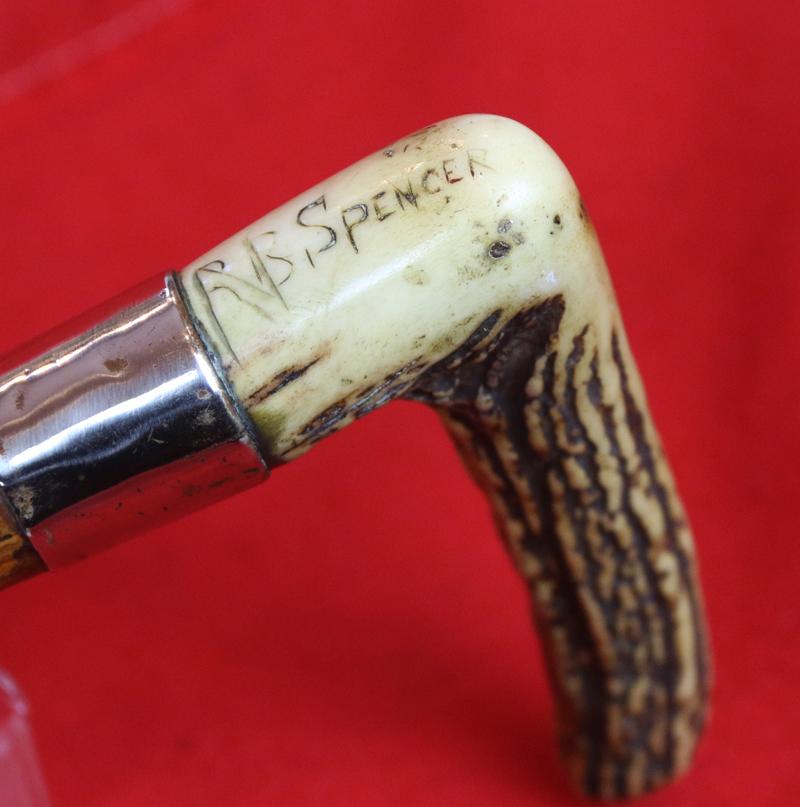
A Super Antler Hilted Sword Stick of World Renown VIctorian Maritime Artist Richard Ball Spencer
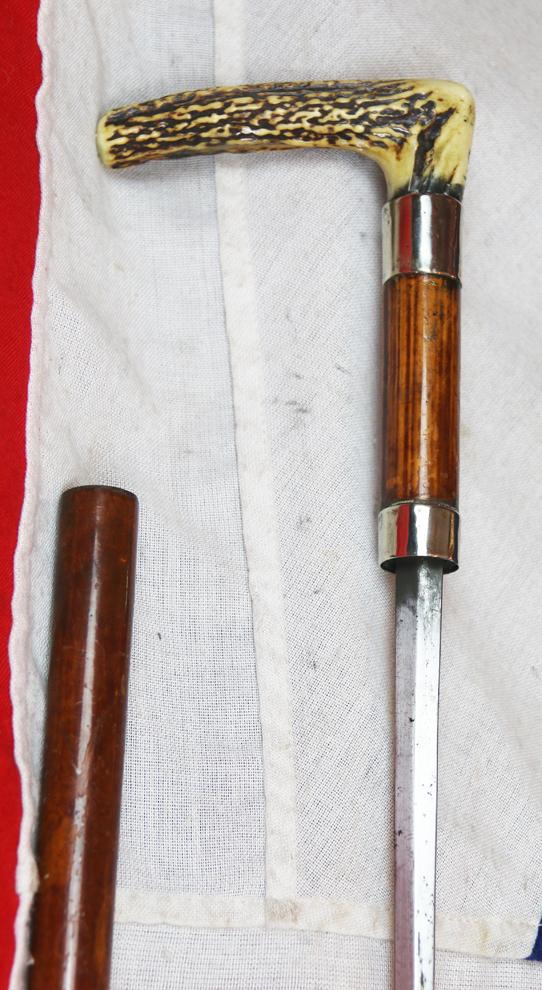
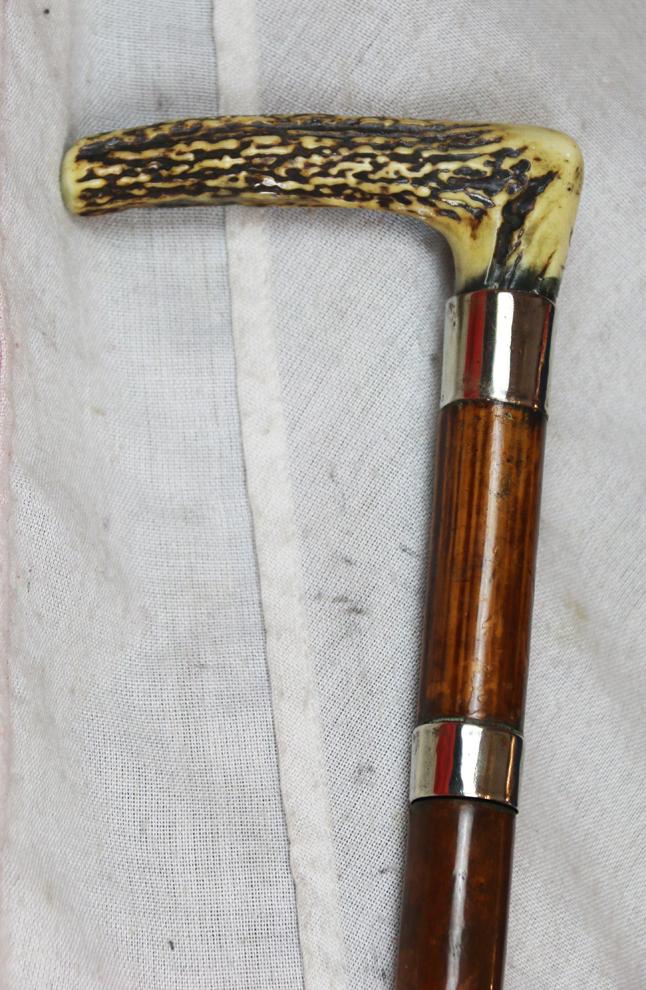
68cm tapering diamond section blade with push button catch, natural horn handle hand carved R B Spencer, [1812-1897] malacca haft, metal ferrule, 91.5cm long over all.
A great Victorian conversational and collector's piece, and one can ponder over why Mr. Richard Ball Spencer sought and required such a piece of personal defence paraphernalia. Although one likes to think that jolly old Victorian England had a London full of cheerful, chummy, cockney, chimney sweeps, regularly issuing utterances such as , “gawd bless yer gov’ner” or “ feed the birds, only tuppence a bag” it was plagued with political intrigue, nefarious characters and caddish swine prowling the endless foggy thoroughfares and dimly lit passageways of old London Town. The swordstick was a popular, and in many cases essential, fashion accessory for the wealthy during the 18th and 19th centuries. While the weapon's origins are unknown, it is apparent that the cane-sword's popularity peaked when decorative swords were steadily being replaced by canes as a result of the rising popularity of firearms, and the lessening influence of swords and other small arms.
The first sword canes were made for nobility by leading sword cutlers. Sixteenth century sword canes were often bequeathed in wills. Sword canes became more popular as the streets became less safe. Society dictated it mandatory that gentlemen of the 18th and especially 19th centuries would wear a cane when out and about, and it was common for the well-dressed gentleman to own and sport canes in a variety of styles, including a good and sound sword cane. Although Byron was proficient in the use of pistols, his lameness and his need to defend himself in some potentially dangerous situations made a swordstick doubly useful to him. He received lessons in London from the fencing master Henry Angelo and owned a number of swordsticks, some of which were supplied by his boxing instructor Gentleman John Jackson. The name NOEL BYRON on the ferrule of his one indicated that it was used after 1822, when Byron added the surname Noel after the death of his mother-in-law.
There are several references to sword sticks in the correspondence of Byron and his circle. Byron wrote to Hobhouse from Switzerland on 23 June 1816 asking him to Bring with you also for me some bottles of Calcined Magnesia a new Sword cane procured by Jackson he alone knows the sort (my last tumbled into this lake ) some of Waite's red tooth-powder & tooth-brushes a Taylor's Pawrsanias Pausanias and I forget the other things. Hobhouse responded on 9 July: Your commissions shall be punctually fulfilled whether as to muniments for the mind or body pistol brushes, cundums, potash Prafsanias Pausanias tooth powder and sword stick.
In the entry for 22 September 1816 in Byron's Alpine Journal he describes how, at the foot of the Jungfrau,
"Storm came on , thunder, lightning, hail, all in perfection and beautiful, I was on horseback the Guide wanted to carry my cane I was going to give it him when I recollected it was a Sword stick and I thought that the lightning might be attracted towards him kept it myself a good deal encumbered with it & my cloak as it was too heavy for a whip and the horse was stupid & stood still every other peal."
In a letter to Maria Gisborne of 6-10 April 1822, Mary Shelley described the "Pisan affray" of 24 March, in which Sergeant-Major Masi was pitch-forked by one of Byron's servants. She recounted how Byron rode to his own house, and got a sword stick from one of his servants.
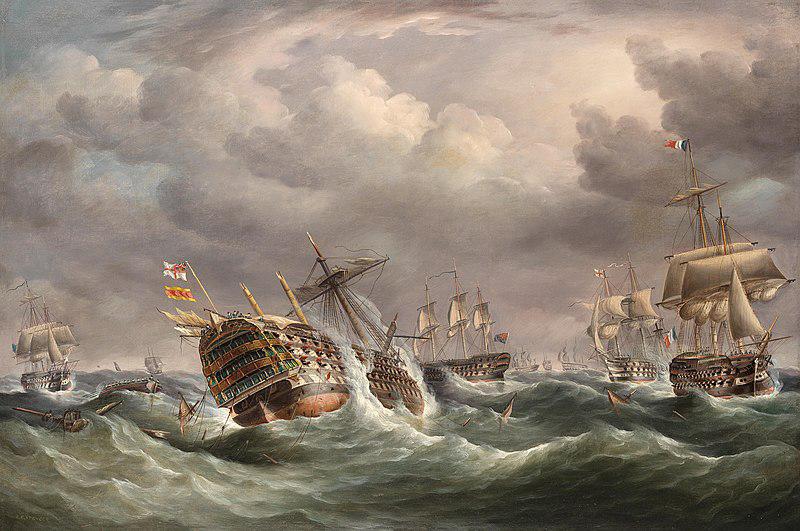
Painting in the gallery by R.B.Spencer
The Battle of Trafalgar, 21 October 1805 with 'Victory' Breaking through the Combined Fleet Astern of the 'Santisima Trinidad'
Richard Ball Spencer (1812–1897)
Thurrock Museum
Code: 24193
875.00 GBP